🤖 Dangerous Jobs Robots Could Replace: The Future of Work and Its Challenges
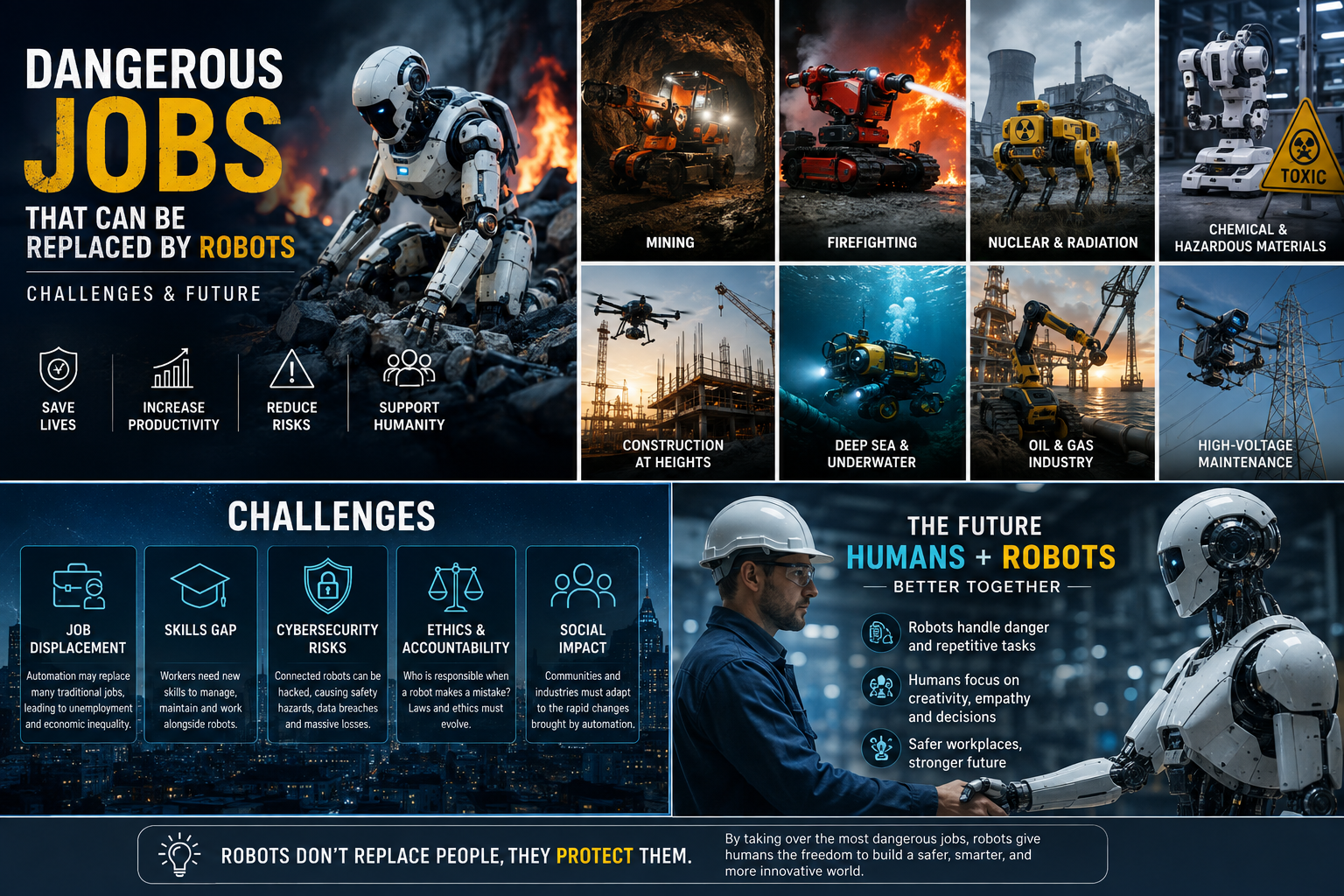
Robots are entering dangerous workplaces, but their rise brings both
life-saving opportunities and serious challenges for workers.
Robots are no longer limited to factories and science-fiction movies.
They are entering construction sites, warehouses, mines, hospitals,
farms, oil fields, disaster zones and even deep-sea environments.
One of the strongest arguments for robotics is simple:
why should humans perform extremely dangerous work when a machine
can do it instead?
🚨 Why Are Dangerous Jobs Being Automated?
Many dangerous jobs involve repetitive tasks, hazardous environments
or a high risk of injury. Robots can operate in places that are too
hot, too cold, too toxic, too radioactive or too unstable for humans.
- Extreme temperatures
- Toxic chemicals
- Radiation
- Explosions
- Heavy machinery
- Collapsing structures
- High-altitude environments
- Deep-water environments
- Underground locations
- Dangerous repetitive tasks
It should be to remove humans from unnecessary danger.
⛏️ 1. Mining Jobs
Mining is one of the most dangerous industrial environments.
Workers can face rockfalls, explosions, toxic gases, underground
fires and heavy machinery accidents.
Robots could:
- Inspect underground tunnels
- Detect dangerous gases
- Transport materials
- Perform drilling
- Monitor structural stability
- Search dangerous areas after accidents
The challenge is that mining communities can depend heavily on
employment from mines. Automation could therefore affect entire
communities, not just individual workers.
🔥 2. Firefighting
Firefighters enter environments where temperatures, smoke,
explosions and unstable buildings can become life-threatening.
Robotic systems could enter dangerous areas first, investigate
conditions and provide information to human emergency teams.
Potential applications:
- Industrial fires
- Chemical fires
- Oil and gas fires
- Explosive environments
- Collapsed buildings
- High-temperature environments
☢️ 3. Nuclear and Radiation-Related Work
Radiation is invisible and potentially extremely dangerous.
Robots can enter contaminated environments without exposing
human workers to the same level of risk.
Robots can assist with:
- Radiation monitoring
- Facility inspection
- Maintenance
- Contamination assessment
- Disaster response
- Hazardous-material handling
🧪 4. Chemical and Hazardous-Material Jobs
Factories and laboratories often deal with toxic, corrosive or
explosive substances.
Robotic systems can potentially handle certain hazardous materials
while humans operate from protected locations.
- Chemical handling
- Leak detection
- Industrial inspection
- Hazardous waste handling
- Emergency response
🏗️ 5. Construction Work at Dangerous Heights
Construction workers can face falls, heavy machinery,
unstable structures and other hazards.
Robots and drones could increasingly assist with:
- Building inspections
- Welding
- Bricklaying
- Painting
- Material transportation
- Structural scanning
- Dangerous-area surveying
🌊 6. Deep-Sea and Underwater Jobs
Deep-sea environments expose humans to extreme pressure,
limited visibility and challenging working conditions.
Underwater robots can assist with:
- Pipeline inspection
- Offshore infrastructure inspection
- Ocean research
- Underwater construction
- Ship inspection
- Search and rescue
🛢️ 7. Oil and Gas Industry
Oil refineries, drilling operations and offshore platforms
can involve fires, explosions, toxic gases and extreme conditions.
- Pipeline inspection
- Leak detection
- Tank inspection
- Offshore platform monitoring
- Equipment maintenance
- Fire and gas detection
⚡ 8. High-Voltage Electrical Maintenance
Working around high-voltage infrastructure can be extremely
dangerous. Robots and drones can help inspect power lines,
substations and electrical equipment.
- Detect damaged components
- Identify overheated equipment
- Inspect electrical infrastructure
- Monitor vegetation near power lines
- Identify structural problems
🏭 9. Factory and Industrial Jobs
Industrial automation is already transforming manufacturing.
Robotic systems can perform repetitive and physically demanding
activities.
- Welding
- Painting
- Assembly
- Packaging
- Material handling
- Quality inspection
🚚 10. Warehouse and Delivery Jobs
Warehouses are becoming increasingly automated. Autonomous
mobile robots can transport products and assist with sorting,
storage and retrieval.
This could reduce the amount of physically repetitive work while
creating greater demand for workers who can manage automated systems.
🌾 11. Dangerous Agricultural Work
Agriculture involves physically demanding work, machinery,
chemicals and exposure to extreme weather.
- Crop monitoring
- Harvesting
- Spraying
- Weed removal
- Agricultural inspection
- Autonomous transportation
🧹 12. Industrial Cleaning
Industrial cleaning can involve toxic chemicals, contaminated
areas, extreme temperatures and confined spaces.
Robots could help clean or inspect:
- Industrial tanks
- Sewage facilities
- Chemical plants
- Nuclear facilities
- Large factories
- Confined spaces
🏥 13. Healthcare and Medical Support
Robots are also entering healthcare. They can assist with
hospital logistics, disinfection, surgery, medication
transportation and rehabilitation.
Healthcare is different from many industrial environments.
Human empathy, communication, judgment and trust remain
extremely important.
🚧 14. Disaster Response
After earthquakes, explosions, industrial accidents or building
collapses, sending humans immediately into the area can be
extremely dangerous.
Robots could enter first, search for survivors, inspect structures,
detect gases and provide information to rescue teams.
🤔 Will Robots Really Replace Entire Jobs?
This is one of the most important questions surrounding automation.
A robot does not necessarily replace an entire profession. Instead,
it may replace specific tasks within a profession.
🤖 Robots
- Dangerous work
- Repetitive tasks
- Heavy physical work
- Extreme environments
- Continuous monitoring
👨💼 Humans
- Decision-making
- Creativity
- Leadership
- Communication
- Complex judgment
⚠️ The Biggest Challenge: Job Displacement
The biggest concern surrounding robotics is employment.
If a company can use robots to perform the work previously
completed by many employees, fewer workers may be required
for certain tasks.
This could particularly affect jobs involving repetitive,
predictable and physically demanding activities.
Industries that may experience significant automation include:
- Manufacturing
- Warehousing
- Transportation
- Basic inspection
- Packaging
- Material handling
- Routine physical work
💰 Who Benefits From Automation?
Robotics can increase productivity and reduce workplace accidents,
but the economic benefits may not automatically be distributed equally.
Companies may benefit from:
- Higher productivity
- Lower operational costs
- Reduced workplace injuries
- Continuous operation
- Greater production capacity
Workers may benefit if automation creates:
- Higher-skilled jobs
- Better working conditions
- New technical careers
- Higher productivity-linked wages
🧠 The Skills Challenge
The future workforce will need different skills. Workers may
increasingly need knowledge of technology and automated systems.
- Robotics
- Artificial Intelligence
- Programming
- Electronics
- Automation
- Data analysis
- Machine maintenance
- Cybersecurity
- System supervision
🔐 The Cybersecurity Problem
Robots are increasingly connected to software, networks and
sometimes the internet. This creates a new type of risk.
A compromised industrial robot, autonomous vehicle or warehouse
system could potentially cause serious operational and safety problems.
- Production shutdowns
- Equipment damage
- Safety incidents
- Data theft
- Financial losses
⚖️ What Happens When Robots Make Mistakes?
Robots are not perfect. Sensors can fail, software can contain bugs,
artificial intelligence can misunderstand situations and communication
networks can stop working.
The difficult question:
Who is responsible when an autonomous robot causes an accident?
Is it the manufacturer, programmer, company operating the robot,
or the person supervising it?
🧭 The Ethical Challenge
Not every task that can technically be automated should automatically
be automated.
- Should humans always supervise dangerous robots?
- How much autonomy should a machine have?
- Who is responsible for autonomous decisions?
- Should companies retrain displaced workers?
- How much automation is acceptable in critical industries?
🌍 The Future: Humans Working With Robots
The most realistic future may not be a world where robots
completely replace humans.
Instead, we may see a division of responsibilities.
Robots could handle:
Danger + Repetition + Heavy physical work + Extreme environments
Humans could focus on:
Creativity + Leadership + Empathy + Complex decision-making +
Strategy + Communication
🚀 Jobs of Tomorrow
As some jobs disappear or shrink, new careers will emerge around
robotics and automation.
- Robotics Engineers
- Robot Technicians
- AI Specialists
- Automation Engineers
- Robot Safety Specialists
- Cybersecurity Professionals
- Drone Operators
- Maintenance Technicians
- Data Analysts
- Human-Robot Interaction Specialists
🔥 The Real Challenge Is Not the Robot
The biggest challenge may not be the machines themselves.
The real challenge is whether humans can adapt quickly enough.
🎓 Education
Schools and universities need to teach skills that complement
automation.
🔄 Reskilling
Existing workers need opportunities to learn new skills and
move into emerging careers.
🛡️ Worker Safety
Robots should be used to remove humans from genuinely dangerous
environments whenever possible.
💼 Employment Transition
Workers affected by automation need realistic pathways toward
new employment.
⚖️ Regulation
Governments will need appropriate rules for autonomous machines,
liability, cybersecurity and workplace safety.
🌟 Final Thoughts
Robots are not simply coming to take jobs. They are also coming
to take on some of the jobs humans should never have had to
perform in dangerous conditions.
A robot entering a burning building, inspecting a radioactive
facility or exploring a collapsed structure could save human lives.
But automation becomes a serious social problem when workers
are replaced without being given opportunities to develop
new skills.
The goal should not be to build a future where
robots replace humans.
The better goal is to build a future where
robots replace unnecessary danger, repetitive work
and hazardous tasks — while humans remain at the center of
decision-making, creativity and society.
The more important question is:
“How can humans prepare for a world where robots can do more?”