15 Best NodeMCU Projects for Beginners and IoT Development
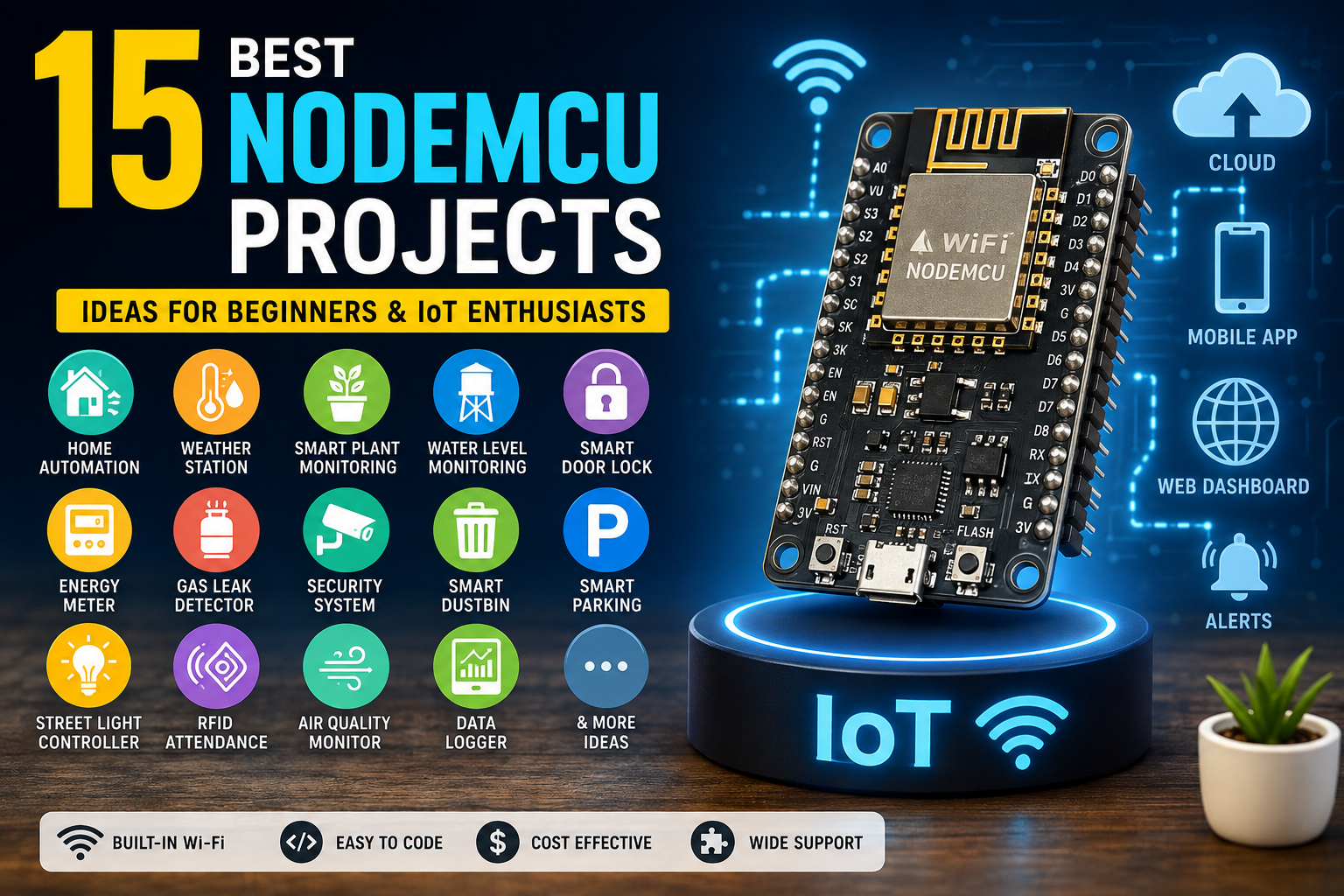
NodeMCU is one of the most popular development boards for building Wi-Fi-enabled electronics and IoT projects. Based on the ESP8266, NodeMCU combines a powerful microcontroller with built-in Wi-Fi connectivity, making it an excellent choice for students, hobbyists, makers, and IoT developers.
In this article, we explore some of the best NodeMCU project ideas that can be used for engineering projects, college mini projects, final-year projects, and practical IoT applications.
Why Choose NodeMCU for IoT Projects?
NodeMCU is popular because it is inexpensive, compact, and easy to program. Unlike traditional Arduino boards, NodeMCU includes built-in Wi-Fi, allowing your project to communicate directly with smartphones, web servers, and cloud platforms.
- Built-in Wi-Fi connectivity
- ESP8266 microcontroller
- Arduino IDE support
- Low-cost development board
- Supports many sensors and modules
- MQTT and HTTP communication
- Suitable for IoT applications
- Easy integration with web dashboards
1. Wi-Fi Home Automation System
A NodeMCU home automation system allows users to control electrical appliances through Wi-Fi.
You can use NodeMCU with relay modules to control:
- Lights
- Fans
- Water pumps
- Motors
- Other electrical appliances
A web page or mobile application can be used to send commands to the NodeMCU.
Advanced features: Add scheduling, voice control, energy monitoring, and remote access.
Components: NodeMCU, relay module, switches, Wi-Fi router, and connected loads.
2. IoT Temperature and Humidity Monitor
Connect a DHT11 or DHT22 sensor to NodeMCU and create a Wi-Fi-enabled temperature and humidity monitoring system.
The measured values can be displayed on an OLED screen or uploaded to an online dashboard.
Applications: Home monitoring, server rooms, laboratories, greenhouses, and weather monitoring.
3. Smart Plant Monitoring and Irrigation System
A NodeMCU-based smart irrigation system can automatically monitor soil moisture and control a water pump.
When the soil becomes dry, NodeMCU can activate the pump through a relay or suitable motor-control hardware.
- Soil moisture monitoring
- Automatic watering
- Temperature monitoring
- Remote monitoring
- Water pump control
This is a great project for learning about IoT and smart agriculture.
4. IoT Weather Station
Create a small weather station using NodeMCU and multiple sensors.
Depending on the sensors used, the system can monitor:
- Temperature
- Humidity
- Atmospheric pressure
- Light intensity
- Rain detection
- Air quality
The collected data can be displayed on a website or stored on a cloud platform.
5. Smart Energy Monitoring System
A NodeMCU-based energy monitoring system can collect electrical measurements and display them through an IoT dashboard.
Depending on the measurement hardware, you can monitor:
- Voltage
- Current
- Power
- Energy consumption
- Estimated electricity usage
This project demonstrates the combination of embedded electronics, sensors, Wi-Fi, and IoT data visualization.
Safety warning: Never connect mains electricity directly to NodeMCU GPIO pins. Use properly isolated and appropriately rated measurement and switching hardware.
6. IoT Gas Leakage Detection System
Build a gas monitoring and alert system using NodeMCU and an appropriate gas sensor.
When an abnormal sensor reading is detected, the system can activate a buzzer and send an alert through an internet-connected service.
Possible features:
- Gas detection
- Audible alarm
- LED warning
- Internet notification
- Online monitoring
7. Smart Door Lock Using NodeMCU
A NodeMCU smart door lock can provide electronic access control using different authentication methods.
Possible authentication options include:
- RFID cards
- Keypad password
- Mobile application
- Web-based authentication
A servo motor or suitable electronic locking mechanism can be controlled by the NodeMCU.
8. IoT Security and Motion Detection System
Combine NodeMCU with a PIR motion sensor to create a simple internet-connected security system.
When motion is detected, the system can trigger an alarm and send an alert.
- Motion detection
- Alarm activation
- Remote notification
- Security status monitoring
- Light control
For projects requiring image capture, an ESP32-CAM can be added as a separate camera platform.
9. Automatic Smart Dustbin
Build an automatic dustbin using NodeMCU, an ultrasonic sensor, and a servo motor.
The ultrasonic sensor detects when a person approaches the dustbin and NodeMCU opens the lid automatically.
An advanced version can also measure the fill level and send a notification when the dustbin needs to be emptied.
10. IoT Water Tank Level Monitoring System
Use an ultrasonic sensor to measure the water level inside a tank.
NodeMCU can calculate the approximate water level and display the information through an IoT dashboard.
- Water level monitoring
- Low-level alerts
- High-level alerts
- Automatic pump control
- Remote monitoring
This is a practical project for smart homes and water management.
11. Smart Parking System
A NodeMCU-based smart parking system can use ultrasonic sensors to determine whether parking spaces are occupied.
The information can be displayed on a web dashboard.
For example:
- Available parking spaces
- Occupied parking spaces
- Total parking capacity
- Real-time parking status
12. IoT Air Quality Monitoring System
NodeMCU can be connected to appropriate environmental sensors to create an IoT air-quality monitoring system.
The sensor readings can be transmitted through Wi-Fi and displayed on a website or cloud dashboard.
This project can be useful for demonstrating environmental monitoring and IoT data collection.
13. Smart Street Light Controller
Build an intelligent lighting controller using NodeMCU, a light sensor, and suitable switching hardware.
The system can automatically control lighting based on:
- Ambient light
- Time schedules
- Motion detection
This project can also be expanded into a smart-city lighting prototype.
14. IoT RFID Attendance System
Combine NodeMCU with an RFID reader to create a Wi-Fi-connected attendance system.
When an RFID card is scanned, the system can record:
- Student or employee ID
- Date
- Time
- Attendance status
The information can then be sent to a server or database for storage and reporting.
15. NodeMCU IoT Data Logger
A general-purpose IoT data logger is one of the most useful NodeMCU projects for learning IoT architecture.
The system can collect information from different sensors and upload it to a server.
The basic architecture is:
Sensor → NodeMCU → Wi-Fi → Internet → Server → Dashboard
This concept can be adapted for:
- Industrial monitoring
- Agriculture
- Environmental monitoring
- Energy monitoring
- Building automation
- Equipment monitoring
Popular Components for NodeMCU Projects
| Component | Application |
|---|---|
| DHT11 / DHT22 | Temperature and humidity |
| HC-SR04 | Distance measurement |
| PIR Sensor | Motion detection |
| LDR | Light detection |
| RFID RC522 | Access control and attendance |
| OLED Display | Displaying sensor information |
| Relay Module | Switching suitable electrical loads |
| Servo Motor | Locks and automation mechanisms |
| Soil Moisture Sensor | Smart irrigation |
How Does a NodeMCU IoT Project Work?
Most NodeMCU IoT projects follow a simple architecture:
Sensors → NodeMCU → Wi-Fi → Cloud/Server → Dashboard/Mobile App
The sensors collect information. NodeMCU processes the readings and connects to the internet using its built-in Wi-Fi. The data can then be sent to a web server, database, or IoT platform.
Software and IoT Platforms
NodeMCU can be programmed using the Arduino IDE. Depending on the project, developers can also use different communication protocols and IoT platforms.
- Arduino IDE
- MQTT
- HTTP APIs
- Node-RED
- ThingsBoard
- Firebase
- Blynk
- Custom PHP/MySQL dashboards
Conclusion
NodeMCU is an excellent platform for learning IoT, embedded systems, wireless communication, and automation. Beginners can start with simple projects such as temperature monitoring and smart lights, while advanced users can develop energy monitoring systems, smart agriculture solutions, industrial data loggers, and cloud-connected automation systems.
The biggest advantage of NodeMCU is its built-in Wi-Fi, which allows ordinary electronic projects to become connected IoT systems.
If you are an engineering student looking for a practical project, NodeMCU provides an affordable way to combine electronics + programming + networking + IoT into a single project.
Which NodeMCU project would you like to build? Start with a simple sensor project and gradually add Wi-Fi, a database, a web dashboard, and remote control features to turn it into a complete IoT project.