Why the UAE’s Geographical Position Makes Logistics and International Trade So Important
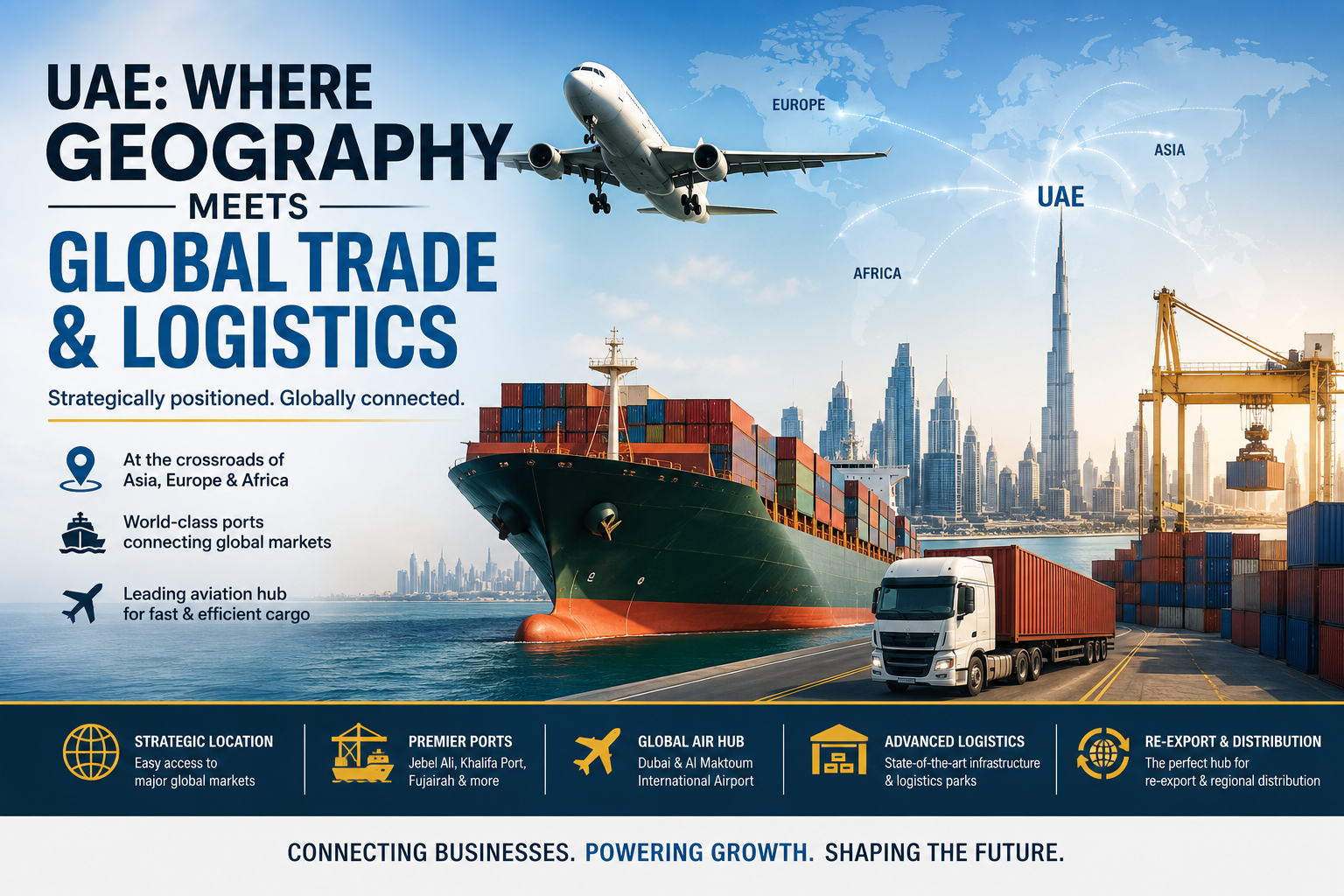
The United Arab Emirates (UAE) has transformed itself from a regional trading economy into one of the world’s most important hubs for logistics, international trade, aviation, shipping and re-export.
One of the biggest reasons behind this success is geography.
Located on the southeastern coast of the Arabian Peninsula, the UAE sits between some of the world’s most important economic regions:
Asia, Europe and Africa. It also has access to the Arabian Gulf and the Gulf of Oman, giving the country a powerful combination of maritime, aviation and land-trade connections.
But geography alone does not create a global logistics centre. The UAE has combined its location with major investments in ports, airports, highways, warehouses, free zones, customs infrastructure and digital services.
This combination has made the UAE particularly attractive for companies that want to
import products, store them, process or package them, and re-export them to other countries.
1. The UAE Sits Between Three Major Markets
The UAE’s location is one of its biggest economic advantages.
Imagine a company producing goods in Asia and wanting to sell them in Europe, Africa and the Middle East. Instead of maintaining separate distribution centres in every market, the company can use the UAE as a regional logistics and distribution base.
The country is positioned between:
- Asia
- Africa
- Europe
- Middle East
- Central Asia
- Indian subcontinent
This makes the UAE particularly attractive for companies dealing with products where delivery speed and regional accessibility matter.
2. Its Maritime Location Is Extremely Important
The UAE’s coastline gives it direct access to major maritime trade routes.
This is particularly important because shipping remains one of the most economical ways to move large quantities of goods internationally.
Major commercial ports include:
- Jebel Ali Port
- Khalifa Port
- Fujairah Port
- Zayed Port
- Mina Rashid
- Port Khalid
- Mina Saqr
Jebel Ali: More Than Just a Port
Jebel Ali is particularly important because it is connected to a much larger logistics ecosystem.
A company can bring products into the UAE by ship, move them into warehouses, manage customs procedures, distribute them across the UAE, or re-export them to another country.
This creates a complete supply-chain environment rather than simply a place where ships load and unload containers.
3. Access to the Gulf of Oman Gives the UAE Another Advantage
Another interesting geographical feature is the UAE’s eastern coastline.
Fujairah is located on the Gulf of Oman rather than directly on the Arabian Gulf. This gives Fujairah Port a strategically different position from ports located inside the Gulf.
Fujairah is an important location for liquid bulk cargo and also handles containers, general cargo, project cargo and other maritime activities.
4. The Strait of Hormuz Adds Strategic Importance
The wider geography of the region also makes the UAE significant for global energy and maritime trade.
The Strait of Hormuz is one of the world’s most important maritime chokepoints.
Its importance for global energy transportation has contributed to the development of sophisticated maritime, energy and logistics infrastructure throughout the region.
However, businesses should also understand that geopolitical developments around major shipping routes can create risks. Geography can be an advantage, but it can also expose logistics businesses to international disruptions.
5. Airports Make the UAE Important for High-Speed Logistics
The UAE’s logistics advantage is not limited to ships.
Its airports are another major part of the country’s international trade infrastructure.
Air freight is particularly useful for products where speed is more important than low shipping cost.
Examples include:
- Electronics
- Medical products
- Luxury goods
- Fashion
- Spare parts
- E-commerce shipments
- Perishable products
- High-value products
6. Dubai World Central Is Designed for Large-Scale Logistics
Another major component of the UAE’s future logistics infrastructure is
Al Maktoum International Airport, also known as Dubai World Central (DWC).
The airport is being developed as a major aviation and logistics hub, with a strong focus on cargo and multimodal transportation.
The significance is not simply the airport itself. The bigger idea is
multimodal transportation.
Another possible logistics chain is:
Integrating different transportation methods can reduce transportation time and improve supply-chain efficiency.
7. Roads Connect the Emirates and Regional Markets
Ports and airports are useful only when goods can efficiently move away from them.
The UAE has therefore invested heavily in road infrastructure connecting major commercial and industrial areas.
Goods arriving at a port can be transported to:
- Dubai
- Abu Dhabi
- Sharjah
- Ajman
- Ras Al Khaimah
- Fujairah
- Other GCC markets
This creates a relatively compact domestic logistics network.
8. Free Zones Make Re-Export Businesses Particularly Interesting
One of the most important reasons the UAE is attractive to international traders is its extensive
free-zone ecosystem.
Free zones can provide businesses with logistics facilities, warehouses, customs-related advantages and proximity to ports and airports.
This makes the free-zone model particularly interesting for companies that do not need to sell all their products inside the UAE.
Example
Imagine a company imports 10,000 electronic accessories from China.
The company could potentially:
- Receive the shipment.
- Store the products.
- Sort and package them.
- Send some products to Saudi Arabia.
- Send others to Oman.
- Export another portion to Africa.
- Sell the remaining products in the UAE, subject to applicable requirements.
The UAE therefore becomes a distribution centre rather than simply the final destination.
9. Re-Exporting Is One of the UAE’s Major Strengths
Re-exporting means importing goods into the country and subsequently exporting them to another market.
This business model fits the UAE particularly well because of its location.
→
→
→
→
→
→
10. The UAE Is Becoming More Than a Transit Point
A major change is that the UAE is no longer simply a place where goods pass through.
Businesses increasingly use the country for activities such as:
- Regional headquarters
- Warehousing
- Distribution
- Packaging
- Product assembly
- E-commerce fulfilment
- Procurement
- Wholesale
- Re-export
- Supply-chain management
This creates higher-value economic activity around the movement of goods.
11. Logistics Creates Opportunities for Small Businesses Too
The UAE’s logistics ecosystem is not only relevant to giant multinational corporations.
Smaller businesses can also build models around international trade.
Niche Importing
Import a particular category of products from Asia and distribute them to GCC retailers.
Regional Distribution
Become the distributor for a foreign brand entering the Middle East.
E-Commerce Fulfilment
Store products in the UAE and fulfil orders across GCC countries.
Spare Parts
Import automotive, industrial or machinery spare parts and distribute them regionally.
Food Trading
Import packaged foods and distribute them to restaurants, supermarkets or wholesalers,
subject to the required approvals.
B2B Wholesale
Import products in bulk and sell them to businesses across the region.
12. Geography + Infrastructure = Competitive Advantage
The UAE’s real advantage comes from combining geography with infrastructure.
This interconnected system is what makes the UAE particularly interesting for logistics businesses.
13. Why the UAE Is Attractive for GCC Distribution
The UAE is also well positioned for businesses targeting the wider
Gulf Cooperation Council (GCC) market.
Potential markets include:
- Saudi Arabia
- Oman
- Bahrain
- Qatar
- Kuwait
Saudi Arabia is particularly important because of its large population and economy.
A company operating from the UAE can therefore view the country not only as a domestic market but also as a
gateway to the wider Gulf region.
14. Logistics Is Becoming More Technology-Driven
Modern logistics is no longer simply about trucks and warehouses.
Technology is becoming increasingly important.
Future logistics businesses will increasingly use:
- Artificial intelligence
- Warehouse automation
- GPS tracking
- Internet of Things devices
- Automated inventory management
- Digital customs systems
- E-commerce platforms
- Predictive demand forecasting
- Robotics
- Data analytics
15. Opportunities Beyond Traditional Shipping
One interesting consequence of the UAE’s logistics infrastructure is the growth of supporting industries.
Warehouse Technology
Companies can provide software and automation solutions for warehouses.
Packaging
Businesses can provide customised packaging for exporters and e-commerce companies.
Cold Chain
Temperature-controlled logistics can support food, pharmaceuticals and other sensitive products.
Freight Forwarding
Businesses can coordinate international shipments between manufacturers, ports, airlines and customers.
Last-Mile Delivery
E-commerce creates demand for local delivery services.
Logistics Consulting
Companies entering the GCC may need help selecting warehouses, routes, suppliers and distribution strategies.
16. Challenges Businesses Must Not Ignore
The UAE’s location provides major advantages, but starting a logistics or trading business is not automatically profitable.
Entrepreneurs need to consider:
- Company formation costs
- Licensing requirements
- Customs rules
- Product-specific regulations
- Import restrictions
- Warehouse costs
- Shipping costs
- Insurance
- Staff costs
- VAT and corporate tax obligations where applicable
- Competition
- Currency and payment risks
- Customer acquisition
- GCC market regulations
- International shipping disruptions
17. The Biggest Opportunity May Be Regional Distribution
Perhaps the most interesting business opportunity created by the UAE’s geography is
regional distribution.
Instead of asking:
“How can I sell products in the UAE?”
An entrepreneur can ask:
“How can I use the UAE to reach the GCC, Middle East, Africa and other international markets?”
That change in thinking can produce very different business models.
For example, a company could identify a successful manufacturer in India, China, Turkey or Europe that has no strong GCC distribution network.
A UAE company could potentially become its regional distributor, subject to agreements, licensing and applicable regulations.
The business then creates value by connecting:
18. Why Location Still Matters in the Digital Age
It may seem that the internet has reduced the importance of geography.
In reality, e-commerce has made physical logistics even more important.
Customers may place an order with one click, but someone still needs to:
The faster this system works, the better the customer experience.
That is why strategically located logistics hubs remain important even in a highly digital economy.
Conclusion
The UAE’s geographical position is one of the foundations of its international trade success.
Situated between major markets in Asia, Europe and Africa, with access to important maritime routes and supported by major ports, airports, highways, free zones and logistics centres, the country has built an ecosystem designed for the movement of goods.
Its advantage is not simply that it is “in the middle.”
For entrepreneurs, this creates opportunities in importing, exporting, re-exporting, warehousing, freight forwarding, e-commerce fulfilment, distribution, packaging, cold-chain logistics and technology.
The UAE therefore offers an interesting lesson in economic development:
a strategic geographical position becomes truly valuable when a country builds the infrastructure and business environment needed to turn that location into commercial opportunity.
For anyone considering starting a trading or logistics business in the UAE, the next question should not simply be
“What can I sell in the UAE?”
but rather: