PCB Prototyping Machines in the Market: A Guide to Modern PCB Manufacturing
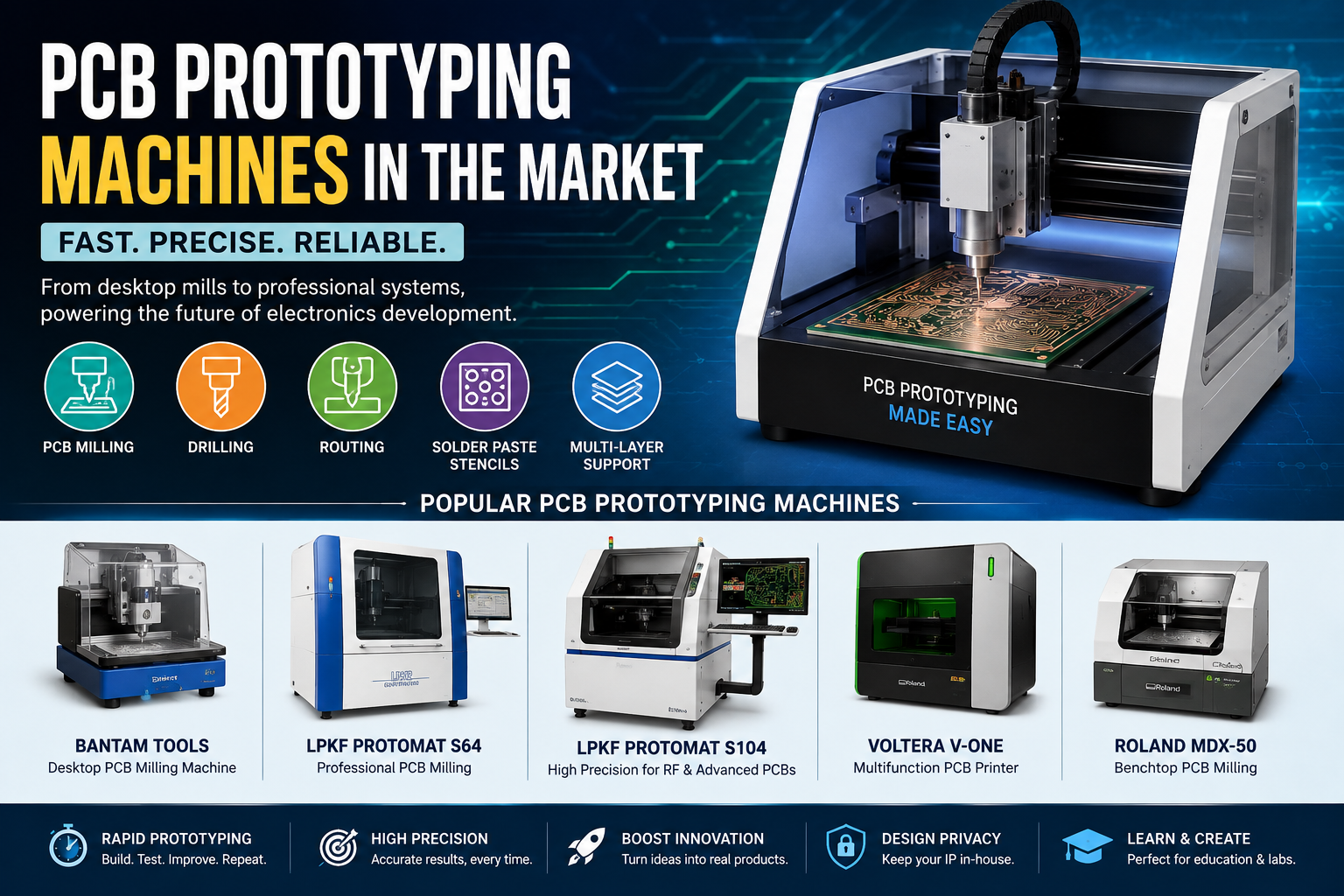
Printed Circuit Boards (PCBs) are at the heart of almost every electronic product,
from smartphones and IoT devices to automotive systems, industrial controllers and
consumer electronics. Before a PCB goes into mass production, engineers normally
create several prototypes to test the circuit, component placement and overall performance.
Traditionally, PCB prototypes were sent to external manufacturers, which could take
several days. Today, PCB prototyping machines allow electronics engineers,
universities, laboratories, startups and small manufacturers to produce prototype
circuit boards in-house, often within hours.
PCB prototyping machines are mainly used for rapid PCB development, testing and
design iterations before moving to large-scale manufacturing.
What Is a PCB Prototyping Machine?
A PCB prototyping machine is equipment used to create a working prototype of a
printed circuit board without requiring a complete industrial PCB manufacturing line.
Depending on the technology, the machine may:
- Mill unwanted copper
- Drill component holes
- Route the PCB outline
- Engrave circuit patterns
- Create solder-paste stencils
- Deposit conductive materials
- Process specialized PCB substrates
- Support rapid electronics development
Major Types of PCB Prototyping Machines
1. Desktop PCB Milling Machines
Desktop PCB milling machines are among the most accessible options for electronics
developers. They use a small CNC spindle to remove unwanted copper from copper-clad
PCB material.
These machines are particularly useful for:
- Electronics startups
- Engineering students
- Research laboratories
- Hobbyists
- IoT development
- Rapid hardware prototyping
2. Professional PCB Milling Systems
Professional PCB prototyping systems are designed for research laboratories,
universities and electronics companies that require greater precision and
repeatability.
LPKF ProtoMat is one of the well-known professional PCB
prototyping platforms. The ProtoMat range includes different systems aimed at
applications ranging from general PCB prototyping to RF and microwave development.
3. Laser PCB Prototyping Systems
Laser-based PCB prototyping is another technology used in advanced electronics
development. Instead of mechanically cutting the copper with a milling tool,
laser systems use controlled laser energy to process PCB materials.
Laser technology can be useful for applications where high precision and
specialized PCB structures are required.
4. Multifunction PCB Prototyping Machines
A growing category of equipment combines several PCB development processes into
one platform.
- PCB milling
- Conductive material dispensing
- Solder-paste dispensing
- Reflow
- PCB assembly support
These systems can be particularly useful for hardware startups and R&D teams
that want to reduce the amount of equipment required in their laboratory.
Popular PCB Prototyping Machine Brands
| Brand | Market Position | Suitable For |
|---|---|---|
| LPKF | Professional | R&D labs, universities and advanced electronics |
| Bantam Tools | Desktop | Startups, education and electronics developers |
| Voltera | Multifunction | Hardware R&D and rapid prototyping |
| Roland DG | Benchtop CNC | Education and laboratories |
| T-Tech | Professional | Electronics development and laboratories |
Why Companies Are Buying PCB Prototyping Machines
Faster Design Iteration
Engineers can create a PCB prototype, test it, identify problems and produce
another version without waiting for every revision to be manufactured externally.
Reduced Dependence on External Fabrication
Companies can produce early prototypes internally before sending a finalized
design for professional PCB manufacturing.
Useful for Research and Development
Research laboratories often need experimental boards that may never become
commercial products. In-house prototyping can make these experiments faster.
Educational Applications
Universities and engineering colleges can use PCB prototyping equipment to teach
students PCB design, electronics manufacturing and rapid hardware development.
Design Privacy
Sensitive prototype designs can remain inside the company’s laboratory instead
of being sent to an external PCB manufacturer during the early development stage.
Limitations of PCB Prototyping Machines
PCB prototyping machines do not completely replace professional PCB manufacturers.
Prototype milling generally cannot provide all the features available from a
conventional PCB fabrication facility.
- Limited multilayer PCB capability on many systems
- Limited or no conventional solder-mask processing
- Mechanical milling can create dust and noise
- Fine-pitch designs may require advanced equipment
- Large-volume production is normally better handled by PCB manufacturers
What Should You Check Before Buying?
1. Trace Width
Check the minimum trace and spacing capability of the machine.
2. Spindle Speed
Spindle speed is important for accurate PCB milling.
3. Accuracy
Look at positioning accuracy and repeatability.
4. Materials
Check compatibility with the PCB materials you intend to use.
5. Double-Sided PCB
Check whether the machine supports accurate double-sided alignment.
6. Software
Make sure the machine works with your PCB design workflow.
PCB Prototyping Machines in India
India has a growing electronics manufacturing and hardware startup ecosystem,
creating opportunities for PCB prototyping equipment in engineering colleges,
electronics laboratories, startups, product-development companies and research
institutions.
For Indian buyers, the final cost should include not only the machine price but
also shipping, taxes, tooling, replacement cutters, maintenance, software and
installation where applicable.
Future of PCB Prototyping
The future of PCB prototyping is moving toward automation, higher
precision, faster fabrication and multifunction machines.
As IoT, robotics, drones, electric vehicles, industrial automation and other
electronics applications continue to grow, rapid hardware development will become
increasingly important.
Desktop manufacturing equipment could therefore become an increasingly useful
part of electronics laboratories and hardware startups.
Conclusion
PCB prototyping machines provide engineers with a faster way to move from a
circuit design to a physical prototype. The market ranges from compact desktop
PCB milling machines to professional systems designed for advanced research.
For students and hobbyists, desktop machines can provide an excellent introduction
to PCB fabrication. For startups, they can shorten the design-test-redesign cycle.
For professional laboratories, advanced systems can provide precision and
specialized capabilities.
However, these machines should primarily be considered rapid prototyping
tools rather than direct replacements for high-volume PCB manufacturing.
Machine specifications, prices and availability can change. Always check the
manufacturer’s current specifications and obtain a quotation before purchasing
PCB prototyping equipment.
Frequently Asked Questions
Can a PCB prototyping machine make a complete PCB?
It can produce functional prototype boards, depending on the machine and process.
However, many systems do not provide every feature of professionally manufactured
PCBs.
Is a PCB milling machine suitable for beginners?
Desktop systems can be suitable for beginners, especially for learning PCB design
and rapid prototyping. Users should follow the manufacturer’s safety and tooling
instructions.
Are PCB prototyping machines suitable for mass production?
Generally, no. They are primarily intended for prototypes, experimentation,
research and small-scale development.
Which is better: PCB milling or laser prototyping?
It depends on the application. Milling is widely used for desktop and professional
prototyping, while laser systems can provide advantages for certain advanced
materials and precision applications.
Interested in Electronics & Technology?
Follow our technology articles for more information about PCB manufacturing,
electronics, hardware development, CNC machines and emerging technologies.