PVC Chip Cards: What Are They, How Do They Work and Where Are They Used?
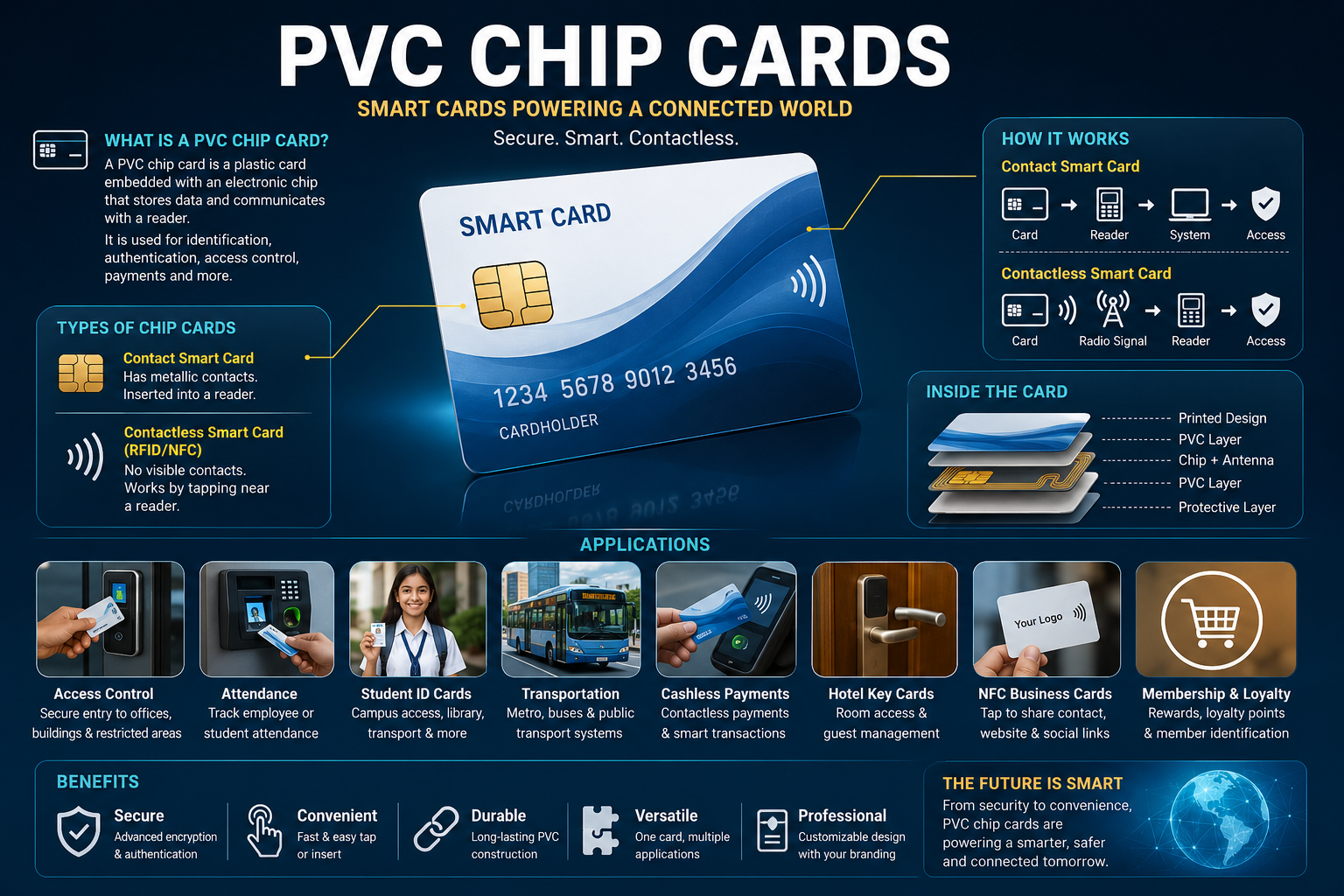
Recently, you may have noticed a PVC card that looks similar to a normal ID card, bank card, or driving licence, but with a small electronic chip embedded in it. The chip may even look similar to the metallic portion of a mobile SIM card.
These cards are generally known as smart cards, chip cards, RFID cards, or NFC cards, depending on the technology used.
Today, these cards are used in many areas including access control, employee identification, attendance, transportation, banking, government services, hotel room access, membership systems, and digital business cards.
What Is a PVC Chip Card?
A PVC chip card is a plastic card containing an electronic chip. The chip can store information, identify the card, communicate with a reader, and in more advanced systems perform authentication and cryptographic operations.
The card can look almost identical to an ordinary PVC ID card, but its embedded electronics give it additional functionality.
A smart card may contain information such as:
- Unique identification number
- Authentication information
- Application data
- Digital credentials
- Security information
- Membership information
However, the complete personal information does not always have to be stored inside the card. In many systems, the chip simply identifies the card and the actual information is stored on a central computer or server.
What Does the Chip Look Like?
There are two common types of smart-card technology that you may notice in PVC cards.
1. Contact Smart Card
A contact smart card has visible metallic contact pads on the surface of the card. The card must be inserted into a compatible reader so that the reader can physically contact these pads.
It can look quite similar to the chip found on a SIM card or some bank cards.
2. Contactless Smart Card
A contactless card does not normally have visible metal contacts. Instead, the card contains a small chip connected to an antenna inside the plastic.
When the card is placed close to a compatible reader, the reader communicates with the chip using radio-frequency technology.
If you see visible metallic contact points, it is likely a contact smart card. If the card works simply by tapping it near a reader, it is likely a contactless RFID/NFC card.
How Does a Contact Smart Card Work?
A contact smart card contains an electronic chip connected to the metallic contact points.
When the card is inserted into a reader, the reader supplies power and communicates with the chip.
The basic process is:
Smart Card → Card Reader → Computer/System → Authentication
Depending on the chip and application, the card can perform tasks such as:
- Reading information
- Writing information
- Authentication
- Secure identification
- Encryption
- Digital signatures
How Does a Contactless Card Work?
Contactless cards work without physically connecting the card to the reader.
Inside the card is a small electronic chip connected to an antenna. When the card is placed close to a compatible reader, the reader generates a radio-frequency field.
The card’s antenna interacts with the field and allows the chip and reader to communicate.
The simplified process is:
Reader → Radio Signal → Card Antenna → Chip → Data Exchange
Many NFC cards operate at 13.56 MHz, although the exact technology depends on the card and application.
RFID vs NFC vs Smart Card
These terms are often used interchangeably, but they are not exactly the same.
| Technology | Main Use | Typical Example |
|---|---|---|
| RFID | Identification and tracking | Access cards, attendance |
| NFC | Short-range communication | Tap-to-share cards, NFC applications |
| Smart Card | Secure identification and authentication | Government and payment cards |
Applications of PVC Chip Cards
1. Employee Access Cards
Companies can issue employees smart cards or RFID cards for accessing offices and restricted areas.
A typical system works like this:
Employee Card → Reader → Authentication → Door Opens
These systems can be used for:
- Office entrances
- Server rooms
- Laboratories
- Parking areas
- Restricted departments
2. Employee Attendance
RFID or smart cards can also be used for attendance management.
An employee can tap their card on an attendance machine and the system records the employee ID and time.
This reduces manual attendance entry and makes it easier to maintain attendance records.
3. School and College ID Cards
Educational institutions can use smart cards as multifunctional student ID cards.
A single card can potentially be associated with:
- Student identification
- Library access
- Hostel access
- Attendance
- Campus entry
- Canteen services
- Transportation
4. Government Smart Cards
Smart-card technology has been used for various government applications, including identity and document-related systems.
In India, smart-card technologies have been used in areas such as driving licences and vehicle registration-related applications.
5. Driving Licence and Vehicle Documents
Smart-card technology can provide machine-readable information and electronic authentication capabilities for documents such as driving licences and vehicle-related cards.
This is more advanced than simply printing a person’s information on the card.
6. Metro and Transportation Cards
Contactless smart cards are widely suited to public transportation.
A passenger can tap the card at a compatible reader. The system can identify the card and process the journey or fare according to the system’s rules.
7. Contactless Payment Cards
You may already be using a smart card without realizing it.
Many modern payment cards contain a chip and antenna that allow contactless communication with compatible payment terminals.
However, a normal NFC or RFID card should not be confused with a secure bank payment card. Payment cards use specialized security systems and payment infrastructure.
8. Hotel Key Cards
Hotels and resorts can use contactless cards as room keys.
The card can be configured to allow access to a particular room for a particular period.
9. Apartment and Building Access
Residential buildings can use RFID cards for:
- Main gate access
- Building entrance
- Parking
- Gym access
- Clubhouse access
- Swimming pool access
10. NFC Digital Business Cards
One interesting modern application is the NFC business card.
Instead of giving someone a traditional paper visiting card, a business owner can provide a PVC card containing an NFC chip.
When the customer taps the card with a compatible smartphone, it can open a digital profile.
For example:
- Website
- Portfolio
- Google Maps
- Digital contact card
- Business information
NFC PVC business cards can be useful for photographers, designers, freelancers, real-estate agents, restaurants, shops and small businesses that want a reusable digital visiting card.
11. Membership and Loyalty Cards
Businesses can use smart cards for membership and loyalty programs.
For example, a gym could provide each member with an RFID card linked to their membership account.
The system can record:
- Membership status
- Entry records
- Reward points
- Customer ID
- Discount eligibility
12. Library Cards
Libraries can use RFID and smart cards to identify members and automate book issuing and other services.
What Is Inside a PVC Smart Card?
A simplified contactless card can contain multiple layers.
↓
Printed Design
↓
Chip + Antenna
↓
PVC Layer
↓
Protective Surface
The antenna can be extremely thin and is normally hidden inside the card.
Is the Chip Similar to a Mobile SIM Card?
It can look similar, especially when the card contains visible metal contact pads.
However, the purpose can be completely different.
A SIM card is designed for mobile-network subscriber authentication and related functions.
A smart PVC card can instead be designed for:
- Access control
- Identification
- Authentication
- Transportation
- Payments
- NFC applications
So, a chip that looks like a SIM chip does not mean that the card is a mobile SIM.
Can a Normal PVC Printer Print These Cards?
This is an important question for people involved in PVC ID-card printing.
A compatible card printer can print the visual design on a smart-card-compatible PVC card, but printing and chip programming are two different processes.
For example:
Printing: Name + Photo + Logo + ID Number
Encoding: Card ID + Application Data + Security Credentials
A card printer may print the card while a compatible encoder or reader is used to communicate with the chip.
Therefore, simply printing an image on a PVC card does not automatically turn it into a functioning smart card.
Can an NFC Chip Be Added to a PVC Card?
NFC inlays and NFC-enabled PVC cards are commercially available.
The chip and antenna are normally embedded between layers of plastic during card manufacturing.
This allows the finished card to maintain the appearance of a normal PVC card while providing contactless functionality.
How Much Data Can a Smart Card Store?
There is no single answer because different chips have different memory capacities and capabilities.
A simple NFC tag may be suitable for storing a website URL or small amount of information.
A more advanced smart card can contain secure memory and a microprocessor capable of performing cryptographic operations.
Therefore, the term “smart card” does not refer to one specific chip or memory capacity.
Are PVC Smart Cards Secure?
Security depends on the type of chip and how the complete system is designed.
Advanced smart-card systems can support:
- Authentication
- Encryption
- Secure keys
- Cryptographic operations
- Access restrictions
- Secure communication
However, inexpensive RFID or NFC tags may provide much simpler functionality.
Ordinary PVC Card vs NFC Card vs Smart Card
| Card Type | Electronic Component | Typical Applications |
|---|---|---|
| Normal PVC ID Card | None | Identification |
| RFID Card | RFID chip + antenna | Access, attendance |
| NFC Card | NFC chip + antenna | Tap-to-share, NFC applications |
| Secure Smart Card | Microprocessor/security chip | Government, banking, authentication |
Why Are Smart PVC Cards Becoming Popular?
Smart cards provide several advantages compared with ordinary printed cards.
- Fast identification: Cards can be read electronically.
- Automation: Card readers can communicate with software systems.
- Convenience: Contactless cards can simply be tapped.
- Security: Advanced chips can support authentication and encryption.
- Multiple applications: One card can potentially be connected to several services.
- Professional appearance: The card can still include photographs, logos and other printed information.
The Future of PVC Smart Cards
Smart cards are not necessarily being replaced by smartphones. Instead, physical cards and smartphones are increasingly working together.
For example, an NFC card can open a digital profile on a smartphone, while a secure access card can work alongside mobile credentials.
This makes the smart card an interesting bridge between the physical and digital worlds.
Frequently Asked Questions
What is the chip in a PVC card?
It may be an RFID, NFC or smart-card chip depending on the application. The exact technology cannot always be identified simply by looking at the card.
Is an NFC card the same as an RFID card?
Not exactly. NFC is a specific short-range communication technology, while RFID is a broader family of radio-frequency identification technologies.
Can I read an NFC PVC card with my phone?
If the card uses a compatible NFC technology and your phone has NFC hardware, the phone may be able to read it. The exact information available depends on the chip and how it has been programmed.
Can I print a smart card using a PVC card printer?
Compatible PVC smart cards can generally be printed with suitable card printers, but printing does not program the electronic chip. Chip encoding normally requires compatible hardware and software.
Can I use an NFC PVC card as a bank card?
No. A generic NFC card cannot simply be programmed to become a bank payment card. Payment cards use specialized chips, security credentials and payment networks.
Can a smart card store personal information?
Some cards can store information, but many systems store only an identifier on the card and keep the detailed information in a secure database.
Conclusion
The PVC card with a chip that you recently noticed is most likely part of the growing world of smart-card technology.
Depending on the design, it could be a contact smart card, RFID card, NFC card or another type of electronic credential.
These technologies are already being used in offices, schools, colleges, hotels, transportation systems, government services, banks, residential buildings, gyms, libraries and businesses.
The biggest difference between an ordinary PVC card and a smart PVC card is that the smart card can interact electronically with a reader or smartphone.
As businesses increasingly connect physical identification with digital services, smart PVC cards are likely to remain an important part of access control, identification and contactless technology.
⚠️ Important Disclaimer
The information in this article is provided for general educational purposes only. Different RFID, NFC and smart-card technologies have different security features, communication protocols and applications. Do not use a generic card or modify a card for banking, government identification, access-control or other regulated applications without proper authorization and technical knowledge.
For security-sensitive applications, always use certified hardware, approved cards and properly configured systems from the relevant service provider.