🌾 Harvest Festivals of India: A Month-by-Month Celebration
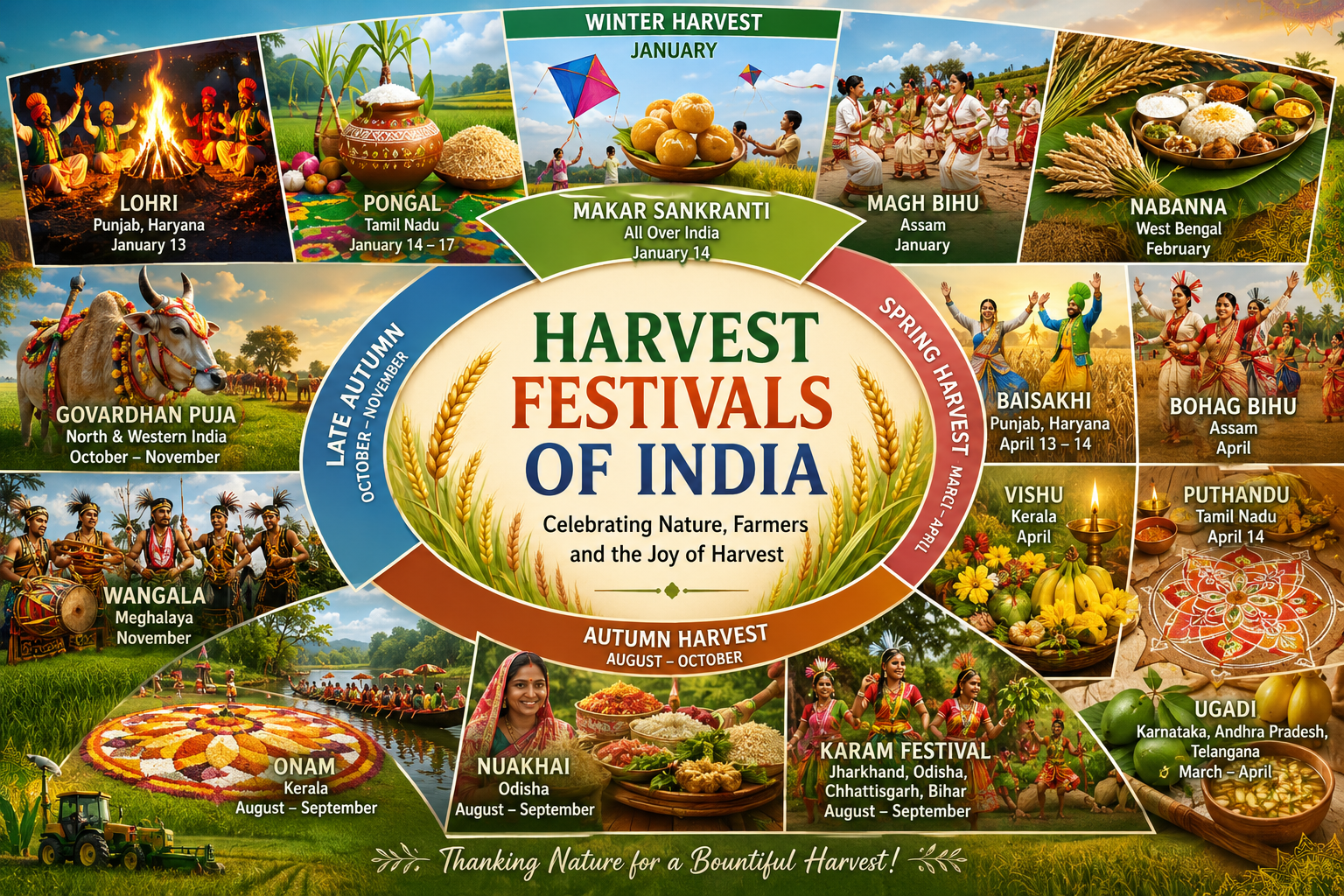
Across the country, farmers and communities celebrate the arrival of a new harvest
with colourful festivals, traditional food, music, dance, prayers and family gatherings.
From Pongal in Tamil Nadu to Onam in Kerala and Bihu in Assam, harvest celebrations
take place at different times depending on the regional agricultural calendar.
🌱 Why Are Harvest Festivals Celebrated?
Harvest festivals are traditionally occasions to express gratitude for a successful
agricultural season. They also celebrate the hard work of farmers and the importance
of nature, sunlight, rain, cattle and fertile soil.
Gratitude for nature + respect for farmers + celebration of food + community happiness.
📅 January – Major Harvest Celebrations
🌾 Pongal – Tamil Nadu
Pongal is one of Tamil Nadu’s most important agricultural festivals.
It is traditionally associated with the rice harvest and thanksgiving to
the Sun, nature, cattle and farmers.
Four important days:
- Bhogi
- Thai Pongal
- Mattu Pongal
- Kaanum Pongal
A special Pongal dish is traditionally prepared using newly harvested rice,
milk and jaggery.
🔥 Lohri – Punjab and Haryana
Lohri is traditionally associated with the end of winter and the agricultural
cycle. Bonfires, folk songs, Bhangra and Giddha are important parts of the celebration.
Traditional foods include peanuts, sesame-based sweets, popcorn and rewri.
☀️ Makar Sankranti – Across India
Makar Sankranti is celebrated in many parts of India. It marks the Sun’s
transition into Makara (Capricorn) and coincides with an important period
in the agricultural calendar.
🥁 Magh Bihu – Assam
Also known as Bhogali Bihu, Magh Bihu celebrates the completion of the
harvesting season in Assam. Community feasts, traditional food and bonfires
are important features.
🌸 March–April – Spring and Agricultural New Year
🌾 Baisakhi – Punjab and Haryana
Baisakhi is strongly connected with the wheat harvest in Punjab and Haryana.
Farmers celebrate the completion of the harvest season with fairs, music,
Bhangra and traditional food.
🌿 Bohag Bihu – Assam
Bohag Bihu, also called Rongali Bihu, marks the Assamese New Year and the
beginning of a new agricultural cycle.
Traditional dance, music, new clothes and community celebrations make
Bohag Bihu one of Assam’s most colourful festivals.
🌼 Vishu – Kerala
Vishu marks an important seasonal and cultural transition in Kerala.
Traditional customs include Vishukkani, Vishukkaineettam, special meals
and fireworks.
The festival also has a strong connection with Kerala’s traditional
agricultural heritage.
🌺 Puthandu – Tamil Nadu
Puthandu is the Tamil New Year. Families decorate their homes with colourful
kolams, prepare traditional food and visit temples and relatives.
🌱 Ugadi – Karnataka, Andhra Pradesh and Telangana
Ugadi marks the beginning of the traditional New Year in Karnataka,
Andhra Pradesh and Telangana. House cleaning, decorations, traditional
food and religious ceremonies are important parts of the celebration.
🌾 August–September – Autumn Harvest Celebrations
🌸 Onam – Kerala
Onam is Kerala’s most famous festival and has deep connections with the
state’s agricultural traditions and harvest season.
Popular Onam traditions include:
- 🌸 Pookkalam
- 🍛 Onam Sadya
- 🚣 Vallam Kali
- 🐯 Pulikali
- 💃 Traditional dances
- 🎯 Traditional games
The famous Onam Sadya is a large vegetarian feast traditionally served
on a banana leaf.
🌾 Nuakhai – Odisha
Nuakhai is an important agricultural festival, particularly in western Odisha.
The festival is associated with the consumption of newly harvested rice
after it is traditionally offered to the deities.
🌿 Karam Festival – Eastern and Central India
Karam is celebrated in parts of Jharkhand, Odisha, Chhattisgarh, Bihar
and neighbouring regions. The festival is associated with agriculture,
fertility, nature and community life.
🍂 October–November – Agricultural Traditions
🐄 Govardhan Puja – North and Western India
Govardhan Puja is primarily a religious festival, but it also has
agricultural and cattle-related traditions in many rural communities.
Cattle may be decorated and honoured as an important part of farming life.
🥁 November – Harvest Festival of Northeast India
🥁 Wangala – Meghalaya
Wangala is an important harvest festival of the Garo community in Meghalaya.
It celebrates the completion of agricultural work and is famous for
traditional drums, dancing, colourful clothing and community gatherings.
📊 India Harvest Festival Calendar
| Month | Festival | Region | Agricultural Connection |
|---|---|---|---|
| January | Pongal | Tamil Nadu | Rice harvest |
| January | Lohri | Punjab & Haryana | Winter harvest |
| January | Makar Sankranti | Many Indian states | Seasonal / harvest period |
| January | Magh Bihu | Assam | Rice harvest |
| February | Nabanna | West Bengal | New rice |
| April | Baisakhi | Punjab & Haryana | Wheat harvest |
| April | Bohag Bihu | Assam | Agricultural new year |
| April | Vishu | Kerala | Agricultural traditions |
| April | Puthandu | Tamil Nadu | Seasonal transition |
| March–April | Ugadi | Karnataka, AP & Telangana | Agricultural new year |
| August–September | Onam | Kerala | Harvest traditions |
| August–September | Nuakhai | Odisha | New rice harvest |
| August–September | Karam | Eastern & Central India | Agriculture & fertility |
| October–November | Govardhan Puja | North & Western India | Cattle & farming traditions |
| November | Wangala | Meghalaya | End of agricultural season |
🌦️ Why Do Harvest Festivals Occur at Different Times?
1. Climate
India’s different climatic zones influence when crops can be planted and harvested.
2. Crop Type
Rice, wheat, sugarcane, pulses and other crops have different growing periods.
3. Monsoon
The Indian monsoon plays an important role in determining sowing and harvesting
periods, especially for rain-fed agriculture.
4. Regional Farming Practices
Farming calendars differ from one region to another, resulting in different
harvest periods and festivals.
5. Local Culture
Over generations, agricultural activities became connected with traditional
food, music, dance, religion and community celebrations.
🌏 More Than Just Harvest Festivals
Indian harvest festivals are more than celebrations of crops. They are also
celebrations of farmers, nature, food, animals, family and community.
🌾 Farmers → 🌱 Nature → ☀️ Sun → 🐄 Animals → 🍚 Food → 👨👩👧👦 Community → 🎉 Culture
From the colourful Pongal celebrations of Tamil Nadu to the Bihu dances of Assam,
the Onam celebrations of Kerala and the Lohri bonfires of Punjab, India’s
harvest traditions showcase the country’s extraordinary cultural diversity.
🌾 Conclusion
India’s harvest festivals are a beautiful reflection of the country’s
agricultural heritage. Although they take place at different times and
follow different traditions, many share a common message of gratitude
towards nature, respect for farmers and celebration of food and community.
These festivals also help preserve traditional food, music, dance, clothing
and customs that have been passed from one generation to another.