Modern Musical Instruments Around the World: A Journey Through Innovation and Creativity
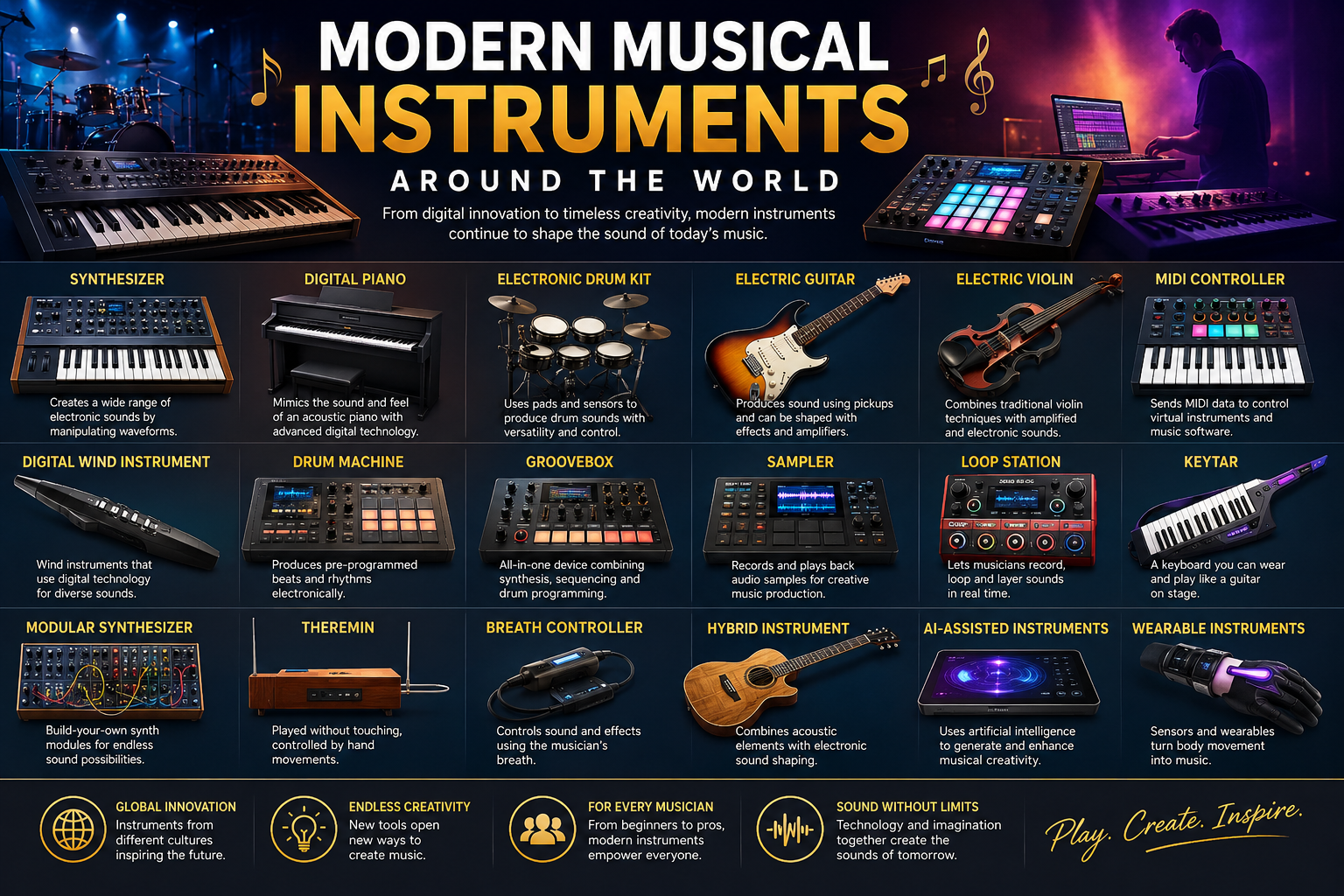
Musical instruments are no longer limited to traditional acoustic designs. Modern technology has introduced an enormous range of electronic, digital and hybrid instruments that allow musicians to experiment with sound in completely new ways.
Today, a musician can play a traditional violin through electronic effects, control a synthesizer using hand movements, create an entire song with a groovebox, or perform live using nothing more than a computer and a MIDI controller.
1. Electronic Synthesizers
The synthesizer is one of the most influential modern musical instruments. Instead of relying entirely on physical strings or air columns, synthesizers generate and manipulate electronic signals to create sound.
Musicians can create basses, leads, pads, atmospheric textures, percussion, sound effects and completely experimental sounds.
Types of Synthesizers
- Analog synthesizers
- Digital synthesizers
- Software synthesizers
- Modular synthesizers
- Hybrid synthesizers
2. Digital Pianos and Stage Keyboards
Digital pianos use electronic sound generation to reproduce the experience of an acoustic piano. Many modern models attempt to reproduce the sound, dynamics and feel of traditional instruments.
Professional stage keyboards can contain hundreds or even thousands of sounds, allowing musicians to switch between piano, organ, strings, brass and synthesizers during a performance.
3. MIDI Controllers
MIDI controllers have become essential tools for modern musicians and producers. MIDI stands for Musical Instrument Digital Interface.
A MIDI controller can send musical information to computers, synthesizers, virtual instruments and other electronic equipment.
- MIDI keyboards
- Drum pads
- Control surfaces
- Knob and slider controllers
- Touch controllers
4. Electronic Drum Kits
Electronic drum kits use sensors and electronic triggers instead of relying completely on traditional acoustic drumheads.
They are popular for home practice, studio recording and live performance because musicians can change sounds, control volume and practice using headphones.
5. Electric Guitar
The electric guitar is one of the world’s most successful combinations of traditional musicianship and electronic technology.
Modern guitarists can use distortion, delay, reverb, chorus, looping, pitch shifting and digital amp modelling to transform the basic guitar sound.
6. Electric Violin
Electric violins use pickups to convert string vibrations into electrical signals. These signals can then be amplified and processed.
This allows violinists to combine traditional bowing techniques with modern effects and electronic sounds.
7. Digital Wind Instruments
Digital wind instruments provide wind players with an electronic alternative to traditional instruments. Musicians can use familiar finger movements while controlling synthesizers and digital sounds.
8. Drum Machines
Drum machines allow musicians to create rhythmic patterns without using an acoustic drum kit. They have played an important role in electronic music, hip-hop, pop and many other genres.
- Kick drums
- Snares
- Hi-hats
- Claps
- Electronic percussion
- Sound effects
9. Grooveboxes
A groovebox combines multiple musical functions into one device. Depending on the model, it may contain synthesizers, drum machines, samplers, sequencers and effects.
This allows musicians to create complete musical arrangements using a relatively compact setup.
10. Samplers
A sampler allows musicians to record or load pieces of sound and use them as musical material.
A musician might sample a drum hit, voice, guitar note, environmental sound or traditional instrument and transform it into something completely new.
11. Computer-Based Musical Instruments

Modern computers have effectively become musical instruments themselves. Digital Audio Workstations allow musicians to record, edit, sequence and manipulate sound.
- Virtual instruments
- Digital synthesizers
- Software drum machines
- Audio effects
- Looping
- Digital recording
12. Touch-Based Musical Controllers
Touchscreens and specialized touch controllers allow musicians to manipulate sound using virtual keys, pads, sliders and controls.
This creates a more visual and interactive approach to music performance.
13. Keytar
A keytar combines the layout of a keyboard with the physical form of a guitar. It can be worn around the musician’s body, allowing keyboard players to move around the stage.
14. Loop Stations
Loop stations have transformed solo performance. A musician can record a musical phrase and immediately repeat it while adding new layers.
A single performer can build drums, bass, guitar, vocals and melodies in real time.
15. Electronic Accordion
Electronic accordions combine traditional accordion playing techniques with digital sound technology.
Players can access accordion, organ, strings, brass, bass and synthesizer sounds from a single instrument.
16. MIDI Guitars
MIDI guitar systems allow guitarists to control synthesizers and virtual instruments using their normal guitar playing techniques.
This gives guitarists access to sounds and musical possibilities traditionally associated with keyboard players.
17. Modular Synthesizers
Modular synthesizers are among the most experimental modern instruments. Instead of using one fixed system, musicians connect individual modules together.
- Oscillators
- Filters
- Envelopes
- Sequencers
- Effects
- Mixers
- Controllers
Because musicians can build different configurations, modular synthesis encourages experimentation and instrument design.
18. Motion-Controlled Instruments
Some experimental instruments allow musicians to control sound using hand and body movements.
Sensors can detect position, movement and gestures and translate them into musical information.
19. The Theremin
The theremin is one of the world’s most unusual electronic instruments. The performer controls the instrument without directly touching the main playing surface.
Hand movement around its antennas controls pitch and volume, creating a distinctive electronic sound.
20. Breath Controllers

Breath controllers allow musicians to control electronic sounds using their breathing. They can be particularly useful for wind musicians who want expressive control over synthesizers.
21. Hybrid Acoustic-Electronic Instruments
Hybrid instruments combine traditional acoustic sound production with modern electronic technology.
- Acoustic-electric guitars
- Electric violins
- Amplified cellos
- Hybrid drums
- Electronic wind instruments
These instruments demonstrate that technology does not necessarily have to replace traditional instruments. It can expand their possibilities.
22. 3D-Printed Musical Instruments
3D printing has opened new possibilities for instrument designers. Unusual shapes and experimental designs can be produced more easily than with some traditional manufacturing techniques.
Musicians can experiment with instrument bodies, controllers and other components and create prototypes of their own designs.
23. AI-Assisted Musical Instruments
Artificial intelligence is beginning to influence music technology. AI systems can analyze musical patterns, generate musical material and respond to performers.
In the future, instruments may become increasingly interactive and capable of responding to a musician’s playing in real time.
24. Wearable Musical Instruments
Wearable musical technology uses sensors placed on the body or clothing to transform movement into musical information.
A musician could potentially control pitch, volume or effects simply by moving their hands or body.
25. Why Musicians Experiment With New Instruments
Musicians experiment with modern instruments because they want to discover new forms of expression.
- Create unique sounds
- Develop new performance techniques
- Combine different musical traditions
- Make live performances more interactive
- Control electronic music physically
- Create personalized instruments
- Explore new genres
26. Traditional Instruments Meet Modern Technology
The future of music does not necessarily mean replacing traditional instruments.
Some of the most interesting musical experiments happen when traditional instruments are combined with modern technology.
Examples
- Sitar + Synthesizer
- Tabla + Electronic Percussion
- Violin + Digital Effects
- Flute + Electronic Processing
- Guitar + Computer Synthesizer
- Traditional Drums + Sampling
27. The Musician as an Instrument Designer
Modern technology has changed the role of the musician.
Today’s musician can simultaneously become a performer, composer, producer, programmer, engineer and instrument designer.
A musician can create a custom controller, connect it to software, design sounds and then perform the result live.
28. What Could Musical Instruments Look Like in the Future?
The next generation of musical instruments may use technologies such as artificial intelligence, sensors, gesture recognition, augmented reality, virtual reality and other forms of interactive technology.
Future instruments could respond to body movement, voice, gestures and other forms of human interaction.
Conclusion
The story of musical instruments is ultimately a story of human creativity.
From ancient drums and flutes to electric guitars, synthesizers, samplers, digital controllers, AI-assisted systems and experimental instruments, musicians have continuously searched for new ways to express themselves.
Modern technology gives today’s musicians an enormous creative playground. A musician can combine traditional instruments with electronic effects, create loops in real time, control synthesizers through movement and even design a completely personalized instrument.
The evolution of musical instruments is far from finished.