Scope of High-Quality Plastic Moulders: From Basic to Advanced
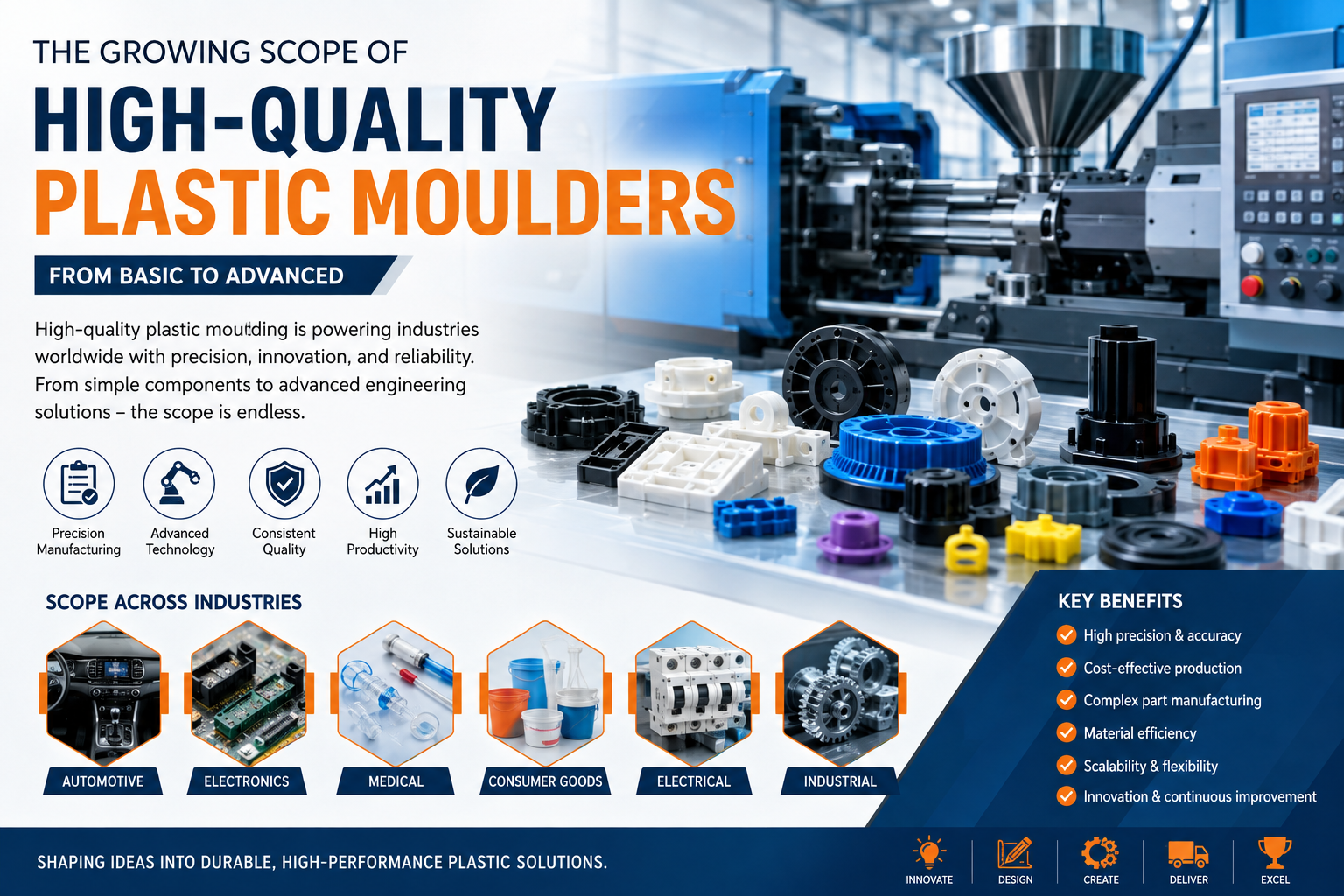
A modern plastic moulder is no longer limited to simply producing plastic parts. High-quality moulders provide complete solutions that may include product development, mould design, material selection, injection moulding, quality inspection, automation, assembly, and advanced manufacturing technologies.
1. Basic Scope of Plastic Moulding
At the basic level, plastic moulding involves converting plastic raw materials into finished components using moulds and moulding machines.
Common plastic moulding processes include:
- Injection moulding
- Blow moulding
- Compression moulding
- Rotational moulding
- Extrusion moulding
- Thermoforming
Among these, injection moulding is widely used for manufacturing precision plastic components in large quantities.
Basic products manufactured through plastic moulding include:
- Plastic containers
- Caps and closures
- Electrical components
- Household products
- Automotive clips and covers
- Consumer product housings
- Industrial components
2. Intermediate Scope: Precision and Quality
As customer requirements increase, moulders need to move beyond basic production and focus on precision manufacturing.
A high-quality plastic moulder should be capable of controlling:
- Dimensional accuracy
- Product weight
- Surface finish
- Colour consistency
- Shrinkage
- Warpage
- Flash
- Short moulding
- Weld lines
- Material degradation
Modern quality systems such as ISO 9001, statistical process control (SPC), first-piece inspection, process documentation, and traceability can help manufacturers maintain consistent quality.
3. Advanced Plastic Moulding
Advanced moulding focuses on producing complex components with high precision and repeatability.
Multi-Cavity Moulding
Multi-cavity moulds allow manufacturers to produce several components in a single machine cycle. This improves productivity and can reduce the cost per component.
Hot Runner Technology
Hot runner systems can improve material efficiency and cycle times while reducing runner waste. They are particularly useful for high-volume production.
Insert Moulding
Insert moulding combines plastic with another material, such as metal inserts, to create integrated components.
Overmoulding
Overmoulding allows two or more materials to be combined in one component. It is commonly used for handles, seals, grips, connectors, and consumer products.
Two-Component Moulding
2K or two-shot moulding can produce components using two different materials or colours within a controlled manufacturing process.
4. Automation and Industry 4.0
The future of high-quality plastic moulding is strongly connected with automation and digital manufacturing.
Modern moulding facilities can use:
- Robotic part removal
- Automatic material feeding
- Vision inspection systems
- Automated packing
- Real-time machine monitoring
- Production dashboards
- Digital quality records
- Predictive maintenance
- Automatic process adjustment
Industry 4.0 technologies allow manufacturers to collect production data and identify problems before they result in large quantities of rejected parts. This improves productivity, consistency, traceability, and overall equipment effectiveness (OEE).
5. Scope in Automotive Manufacturing
The automotive sector is one of the biggest opportunities for advanced plastic moulders.
Plastic components are increasingly used to reduce vehicle weight, improve design flexibility, and integrate multiple functions into single components.
Potential products include:
- Interior components
- Dashboard parts
- Door components
- Bumpers and trims
- Connectors
- Clips and brackets
- Under-the-hood components
- Lighting components
- EV battery-related components
Electric vehicles are creating additional opportunities for precision plastic components used in charging systems, battery systems, electrical connections, thermal-management systems, and vehicle interiors.
6. Scope in Electronics and Electrical Industries
Electronics manufacturers require highly accurate plastic components with excellent surface quality and dimensional stability.
Opportunities include:
- Switches
- Connectors
- Sensor housings
- Electrical enclosures
- Consumer electronics housings
- Cable-management components
- Insulating components
As electronic products become smaller and more sophisticated, the demand for precision moulding and micro-components is also increasing.
7. Medical and Healthcare Applications
Medical moulding is one of the most demanding areas of plastic manufacturing.
Products can include:
- Medical device components
- Laboratory products
- Diagnostic components
- Syringe components
- Surgical-device components
- Disposable healthcare products
This sector requires strict control over materials, cleanliness, dimensional accuracy, validation, traceability, and manufacturing processes.
Therefore, moulders that develop specialized capabilities and appropriate quality systems can enter a high-value market.
8. Sustainable Plastic Moulding
Sustainability is becoming an important part of the future of plastic manufacturing.
High-quality moulders can improve sustainability by focusing on:
- Material optimization
- Lightweight component design
- Reduced production waste
- Recycling of suitable production scrap
- Energy-efficient machines
- Efficient mould designs
- Recyclable materials
- Bio-based and recycled polymers where technically appropriate
Customers increasingly expect suppliers to demonstrate both quality and environmental responsibility.
9. Product Development and Design Support
The most advanced plastic moulders can become development partners rather than simply manufacturing suppliers.
They can support customers from the early design stage through:
Product Concept → DFM Analysis → Moldflow Analysis → Mould Design → Tool Manufacturing → Sampling → Validation → Mass Production
Design for Manufacturing (DFM) helps identify potential manufacturing problems before the mould is built.
This reduces development time, tooling changes, production problems, and overall project costs.
10. Future Scope of Plastic Moulding
The future of high-quality plastic moulding is moving toward precision, automation, sustainability, digitalization, and value-added manufacturing.
Companies that invest in modern injection moulding machines, advanced mould technology, automation, skilled engineers, quality systems, and digital production monitoring can move into higher-value markets.
The biggest opportunity is to transform from a traditional “plastic part supplier” into a complete engineering and manufacturing partner.
Conclusion
The scope of high-quality plastic moulders is much broader than conventional plastic part production. Starting from basic moulding, manufacturers can gradually develop capabilities in precision moulding, multi-cavity tooling, insert moulding, overmoulding, automation, robotics, Industry 4.0, medical components, automotive applications, electronics, and sustainable manufacturing.
A successful plastic moulder of the future will combine advanced technology, skilled people, strong quality systems, efficient production, and engineering expertise.
With continuous investment and innovation, high-quality plastic moulders can serve both domestic and international markets and become strategic partners for major manufacturers across multiple industries.