Can You Use UAE Buildings, Skyline and the UAE Flag in Promotional Videos?
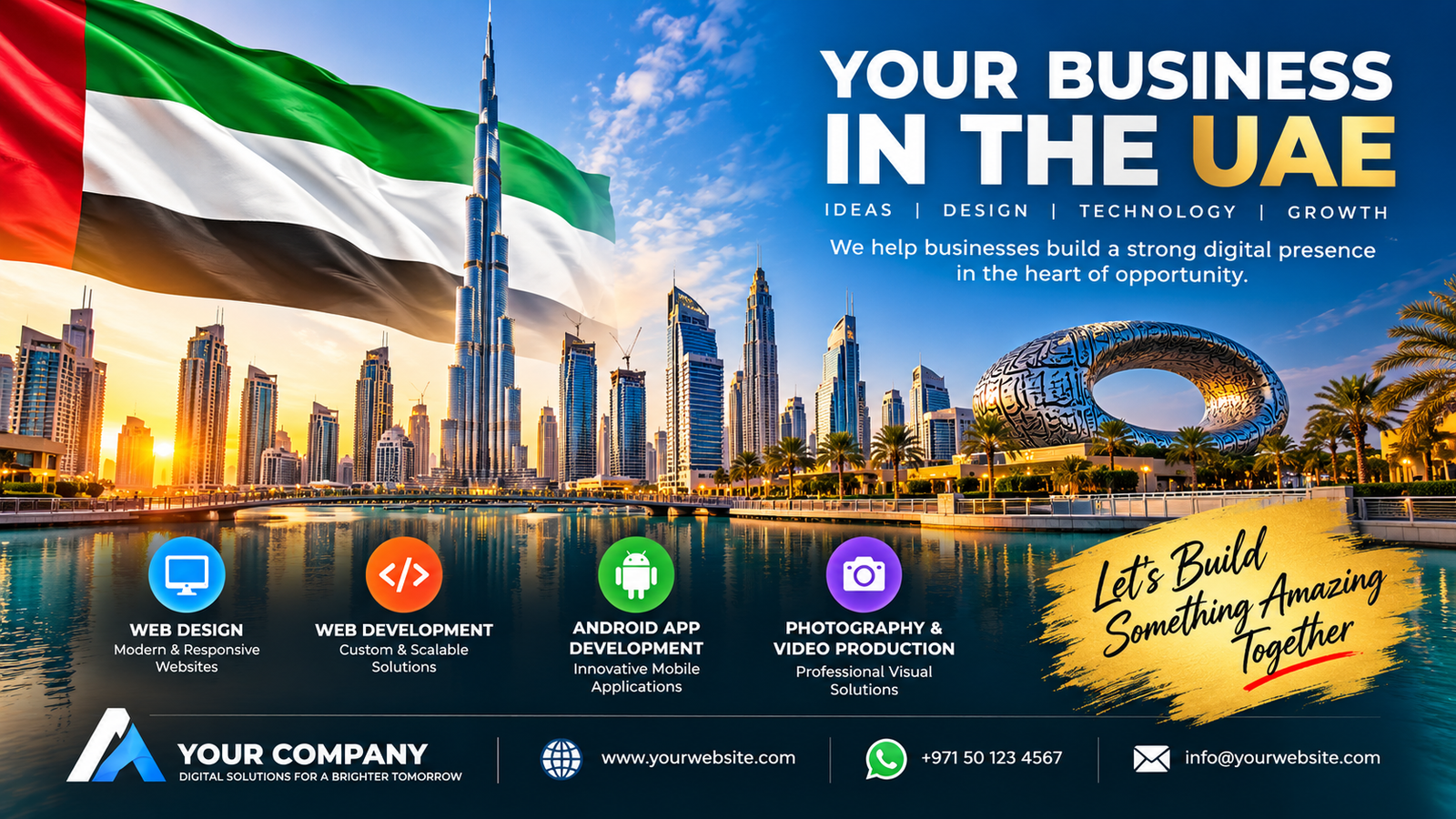
The United Arab Emirates is one of the most visually recognizable destinations in the world. Dubai’s skyline, Abu Dhabi’s landmarks, modern architecture, roads, hotels and the UAE flag are frequently seen in travel videos, social-media content and promotional videos.
But what happens when you want to use UAE footage and then promote your own company, website, services or brand at the end of the video?
For example, you may create a video showing:
- The Dubai skyline
- UAE buildings and streets
- Modern architecture
- The UAE flag
- Tourist attractions
- A short cinematic sequence
- Your company logo
- Your website and contact information
In general, the use of UAE-related visuals is not automatically prohibited. However, once content becomes advertising or promotional content, additional rules and responsibilities can apply.
1. Can You Show the UAE Flag in a Video?
The UAE Constitution recognizes the national flag as an official symbol of the United Arab Emirates. UAE media standards require media content to respect the country’s symbols, institutions, national identity and values.
Therefore, simply showing the UAE flag respectfully in a normal video is very different from using the flag in a disrespectful, misleading or inappropriate manner.
For example, a travel video showing the UAE flag on a government building, street, hotel or public celebration is fundamentally different from manipulating the flag to make it appear damaged, insulting or offensive.
Examples of normal use
- Showing the UAE flag while introducing Dubai or Abu Dhabi
- Showing a UAE flag in the background of a travel video
- Showing a flag during a national celebration
- Including a short UAE flag shot in a cinematic city video
- Showing flags outside buildings or public locations
The important principle is to use the national symbol respectfully and avoid creating a misleading impression that your company is officially connected with the UAE government.
2. Can You Show UAE Buildings?
Showing buildings, roads, skylines and architecture in a video is not automatically prohibited simply because the video later contains a commercial message.
For example, a promotional video could begin with cinematic footage of a UAE skyline and then transition into your company’s services.
A possible structure could be:
UAE skyline → Dubai/Abu Dhabi city footage → modern buildings → your message → your company logo → website/contact details
However, there is an important distinction between using footage and having permission to film or commercially use that footage.
If you record the footage yourself, you should consider whether filming at the particular location requires permission. If you use footage created by someone else, you should make sure that you have the appropriate rights or a commercial licence.
3. What About Famous UAE Landmarks?
Famous landmarks can make a promotional video look much more attractive. Examples include:
- Burj Khalifa
- Dubai Frame
- Museum of the Future
- Burj Al Arab
- Abu Dhabi skyline
- Sheikh Zayed Grand Mosque
- Dubai Marina
- Palm Jumeirah
- Other recognizable UAE architecture
However, the fact that a building is visible in public does not necessarily mean that every possible commercial filming use is automatically permitted.
Location-specific filming rules, property rules, photography restrictions and intellectual-property considerations can apply depending on the location and the way the footage is produced.
4. What If You Add Your Own Company Logo?
Adding your own company logo at the end of the video is a normal form of branding.
For example:
“Web Design & Development”
“Android App Development”
“Photography & Video Production”
“Contact Us”
followed by your company logo and website.
There is an important difference between:
- Your own company logo
- The official UAE national emblem
The UAE has specific legal protection for its national emblem. Federal legislation states that the national emblem cannot be used for commercial or industrial purposes, including advertisements, without the required permission.
Therefore, you should not design your company advertisement so that it appears to use or incorporate the official UAE national emblem as your company’s branding.
5. UAE Flag vs. UAE National Emblem
This distinction is particularly important for businesses.
| Item | Consideration |
|---|---|
| UAE flag | Use respectfully and follow applicable advertising/media requirements. |
| Your company logo | Can be used as your own branding, subject to normal legal requirements. |
| UAE national emblem | Commercial use is specifically restricted and may require permission. |
| UAE government logo | Do not use it in a way that suggests official authorization or endorsement. |
| Government building footage | Consider filming/location permissions and the context of use. |
6. What If the Video Is Actually an Advertisement?
This is where the situation becomes more important.
The UAE Media Council’s media content standards state that advertising content must respect the culture, identity and values of the UAE. Advertisements also have specific requirements concerning the use of the UAE flag, symbols, emblem and national anthem.
Therefore, if your video ends with a promotion for your business, you should treat the complete video as promotional content rather than assuming that the first part is simply a travel video.
For example:
Dubai skyline → UAE flag → beautiful city footage → “Build Your Business Online” → company logo → website
This is clearly promotional content because the final portion is advertising a service.
7. What About Promoting Your Own Business?
The UAE Media Council’s current FAQ contains an important distinction: an individual promoting a product or service belonging to their own company or project through their personal social-media account does not require the individual advertiser permit solely for that own-company promotion.
However, different rules can apply when an individual is advertising another company’s products or services.
It is therefore important to distinguish between:
- Promoting your own company
- Promoting another company’s product
- Being paid by another business to create an advertisement
- Using an influencer or another advertiser
If you are creating your own company’s promotional video, check the current UAE Media Council requirements applicable to your specific situation before publishing it.
8. Can You Make a Video Like This?
Yes, a concept such as the following can be structured as a promotional video:
Scene 1: UAE skyline
Scene 2: Beautiful UAE building
Scene 3: UAE flag
Scene 4: Modern city/road footage
Scene 5: “Your Digital Presence Starts Here”
Scene 6: Your company logo
Scene 7: “Web Design • Android Apps • Digital Solutions”
Scene 8: Website/contact information
The key is to ensure that the footage is legitimately available for your intended commercial use, that the content respects UAE media standards, and that your branding does not falsely suggest government affiliation.
9. Things You Should Avoid
When making a UAE-themed commercial video, avoid the following:
- Using the UAE national emblem as your company logo
- Making your company appear to be an official UAE government organization
- Using government logos without authorization
- Manipulating the UAE flag in a disrespectful manner
- Using the UAE flag in an offensive or insulting context
- Using footage that you do not have commercial rights to use
- Ignoring location-specific filming restrictions
- Creating misleading claims about government approval or endorsement
- Using inappropriate material together with UAE national symbols
10. Be Careful With Stock Footage
One of the easiest mistakes is downloading a beautiful Dubai video from the internet and assuming that it can automatically be used in an advertisement.
That is not necessarily true.
A video may be available to watch online but still be protected by copyright. Before using stock footage commercially, check its licence.
Look specifically for permissions covering:
- Commercial use
- Advertising
- Social media
- Modification/editing
- Client or business promotion
- Monetized content
If the licence does not allow commercial use, choose footage with an appropriate commercial licence or create your own footage where permitted.
11. What About Drone Footage?
Drone filming is a separate issue and should not be treated in the same way as ordinary handheld photography or video recording.
Drone operations in the UAE can be subject to aviation and local regulatory requirements. If your promotional video uses aerial footage, make sure the drone operation and filming are legally authorized for the location and purpose.
12. A Safe Approach for Small Businesses
If you are a small business creating promotional videos, a simple approach is to keep the national imagery as part of the location/cultural context rather than making it appear to be part of your company’s official identity.
For example:
Good concept:
“Dubai is a city of innovation and opportunity.”
Show UAE city footage and then transition to:
“We help businesses build their digital presence.”
Then show your own logo and services.
This makes it clear that the UAE footage establishes the setting while your company is separately identified as the service provider.
13. Don’t Make It Look Like Government Endorsement
This is one of the most important practical points.
Your video should not create the impression that:
- The UAE government recommends your company
- A UAE ministry approved your service
- Your company is a government contractor when it is not
- Your company is officially affiliated with a government organization
- Your company has received an official endorsement that it has not actually received
Keep your company branding visually separate from official government branding.
14. A Good Promotional Video Structure
For a modern business advertisement, you could use this structure:
- Opening: UAE skyline or city shot
- Location: Attractive building or street footage
- Emotion: Modern UAE lifestyle/business visuals
- Message: “Your Business Deserves a Strong Digital Presence”
- Services: Web Design, Web Development, Android App Development
- Branding: Your company logo
- Call to Action: “Let’s Build Something Together”
- Contact: Website, WhatsApp, email or social media
15. Final Checklist Before Publishing
Before uploading your promotional video, ask yourself:
- Do I have the right to use all the video footage?
- Is the footage licensed for commercial use?
- Am I using the UAE flag respectfully?
- Have I avoided unauthorized use of the UAE national emblem?
- Have I avoided government logos?
- Does the video falsely suggest government endorsement?
- Does the advertisement respect UAE culture, identity and values?
- Do I need filming/location permission for where I recorded the footage?
- If I am advertising on social media, do the current UAE Media Council rules apply to my situation?
Conclusion
Using UAE buildings, skyline footage and the UAE flag in a promotional video is not automatically prohibited. The important issue is how the material is used, where the footage came from, whether it is being used commercially, and whether the video complies with UAE media and advertising requirements.
For a small business creating a video such as UAE scenery → your message → your own company logo → your services, the concept can be reasonable when handled properly.
The biggest things to remember are: respect UAE national symbols, don’t use the official national emblem as commercial branding without authorization, don’t imply government endorsement, and make sure you have the necessary rights or permissions for your footage.
Important: UAE media, advertising, filming and intellectual-property rules can depend on the specific circumstances, location, platform and type of content. This article is for general informational purposes and is not legal advice. For a commercial production with significant business use, verify the current requirements with the relevant UAE authority or a qualified UAE legal professional before publishing.