Critically Endangered Animals in India: Species on the Brink of Extinction
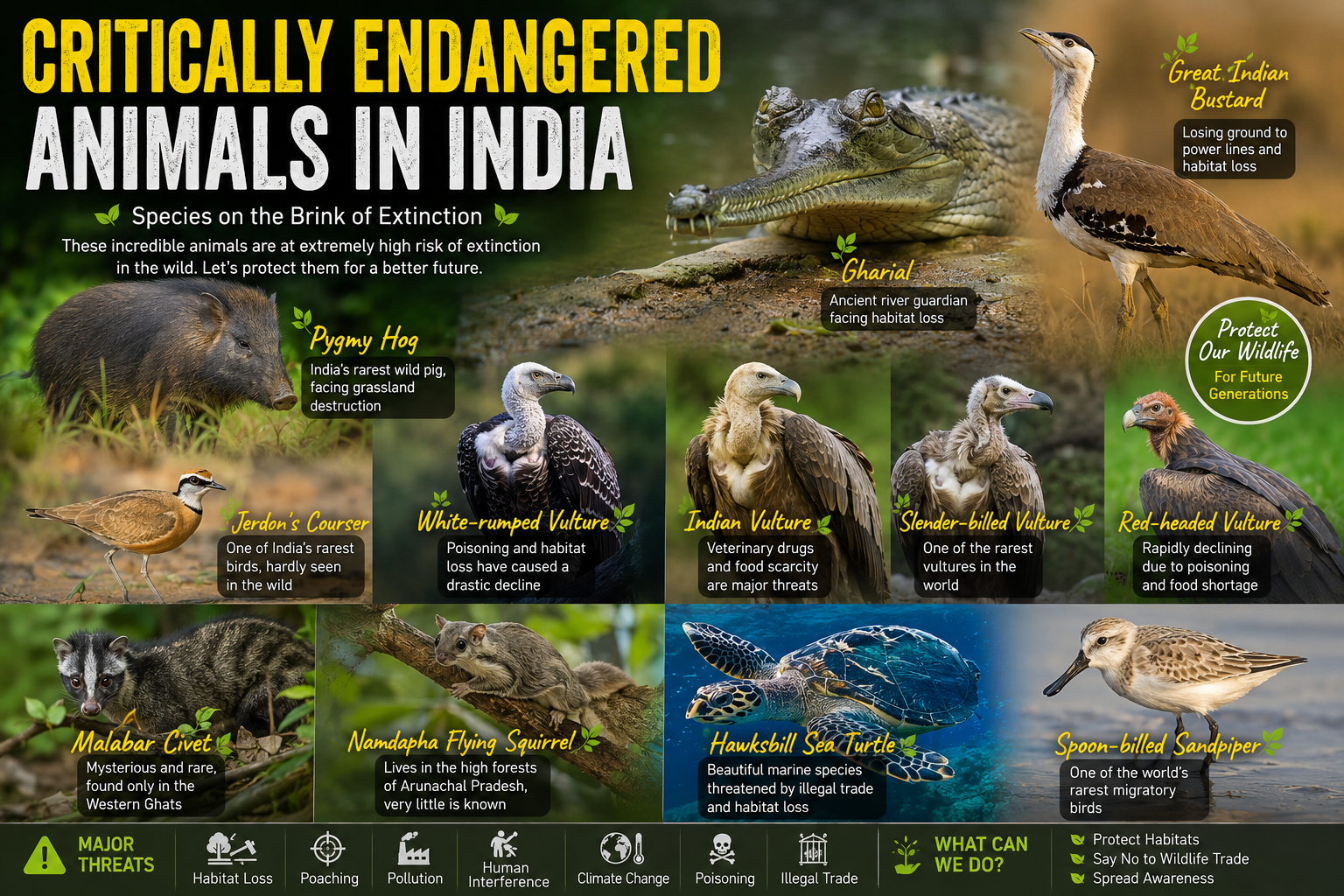
India is one of the world’s most biodiverse countries, home to thousands of unique species found nowhere else on Earth. However, habitat destruction, climate change, pollution, illegal hunting, and human encroachment have pushed several animals to the edge of extinction. According to the International Union for Conservation of Nature (IUCN), Critically Endangered species face an extremely high risk of becoming extinct in the wild.
In this article, we’ll explore India’s most critically endangered animals, where they are found, why they are disappearing, and the conservation efforts helping to save them.

What Does “Critically Endangered” Mean?
A species classified as Critically Endangered (CR) by the IUCN is considered to be facing an extremely high risk of extinction in the near future. These species often have very small populations, limited habitats, or face severe threats from human activities.
Top Critically Endangered Animals in India
| Animal | Scientific Name | Main States / Regions | Estimated Population | Main Threats |
|---|---|---|---|---|
| Great Indian Bustard | Ardeotis nigriceps | Rajasthan, Gujarat, Maharashtra | Less than 150 | Power lines, habitat loss |
| Gharial | Gavialis gangeticus | Madhya Pradesh, Uttar Pradesh, Rajasthan | Around 1,000 adults worldwide | River pollution, sand mining, fishing nets |
| Pygmy Hog | Porcula salvania | Assam | Few hundred | Grassland destruction, fires |
| Jerdon’s Courser | Rhinoptilus bitorquatus | Andhra Pradesh | Possibly fewer than 50 | Habitat destruction |
| White-rumped Vulture | Gyps bengalensis | Across Northern & Central India | Declined by over 99% | Diclofenac poisoning |
| Indian Vulture | Gyps indicus | Central & Southern India | Very small population | Veterinary drugs |
| Slender-billed Vulture | Gyps tenuirostris | Northeast India | Critically low | Poisoning, habitat loss |
| Red-headed Vulture | Sarcogyps calvus | Scattered across India | Rapid decline | Food shortage, poisoning |
| Malabar Civet | Viverra civettina | Kerala | Possibly fewer than 250 | Deforestation |
| Namdapha Flying Squirrel | Biswamoyopterus biswasi | Arunachal Pradesh | Extremely rare | Habitat loss |
| Hawksbill Sea Turtle | Eretmochelys imbricata | Andaman & Nicobar Islands | Declining | Illegal shell trade |
| Spoon-billed Sandpiper | Calidris pygmaea | Eastern Coast (Migratory) | Very few | Wetland destruction |
Why Are These Animals Becoming Extinct?
- Rapid deforestation and habitat destruction
- Urban expansion and infrastructure development
- Illegal hunting and wildlife trafficking
- Pollution of rivers and forests
- Climate change and changing weather patterns
- Poisoning from veterinary medicines
- Electrocution from overhead power lines
- Overfishing and accidental trapping in fishing nets
States with the Highest Number of Critically Endangered Species
| State | Notable Critically Endangered Species |
|---|---|
| Rajasthan | Great Indian Bustard, Gharial |
| Assam | Pygmy Hog, White-rumped Vulture |
| Kerala | Malabar Civet |
| Arunachal Pradesh | Namdapha Flying Squirrel |
| Andhra Pradesh | Jerdon’s Courser |
| Andaman & Nicobar Islands | Hawksbill Sea Turtle |
Conservation Efforts in India
India has launched several conservation programs to protect endangered wildlife.
- Project Great Indian Bustard
- Project Gharial
- Pygmy Hog Conservation Programme
- Vulture Breeding Centres
- Protected National Parks and Wildlife Sanctuaries
- Ban on veterinary Diclofenac
- Habitat restoration projects
- Anti-poaching patrols and stricter wildlife laws
How Can You Help?
- Support wildlife conservation organizations.
- Avoid purchasing products made from wildlife.
- Reduce plastic pollution.
- Report wildlife crimes.
- Promote eco-tourism responsibly.
- Spread awareness through social media.
Frequently Asked Questions (FAQs)
Which is the most critically endangered animal in India?
The Great Indian Bustard is among the most critically endangered birds in India, with fewer than 150 individuals remaining.
Why are vultures disappearing in India?
The widespread use of the veterinary drug diclofenac caused catastrophic declines in India’s vulture populations.
Is the Bengal Tiger critically endangered?
No. The Bengal Tiger is classified as Endangered, not Critically Endangered.
Which critically endangered animal is found only in Kerala?
The Malabar Civet is native to the Western Ghats of Kerala and is one of India’s rarest mammals.
What is India’s rarest bird?
The Great Indian Bustard and Jerdon’s Courser are considered among the rarest birds found in India.
Did You Know? India is home to more than 500 wildlife sanctuaries and over 100 national parks, yet many unique species continue to decline due to habitat loss and human activities.
Conclusion
India’s critically endangered animals are an irreplaceable part of the country’s natural heritage. Protecting these species requires stronger conservation policies, habitat restoration, scientific research, and public participation. Every effort—from protecting forests to reducing pollution—helps ensure these remarkable animals survive for future generations.