Industrial-Standard Raspberry Pi Projects for Automation, IoT & Smart Manufacturing
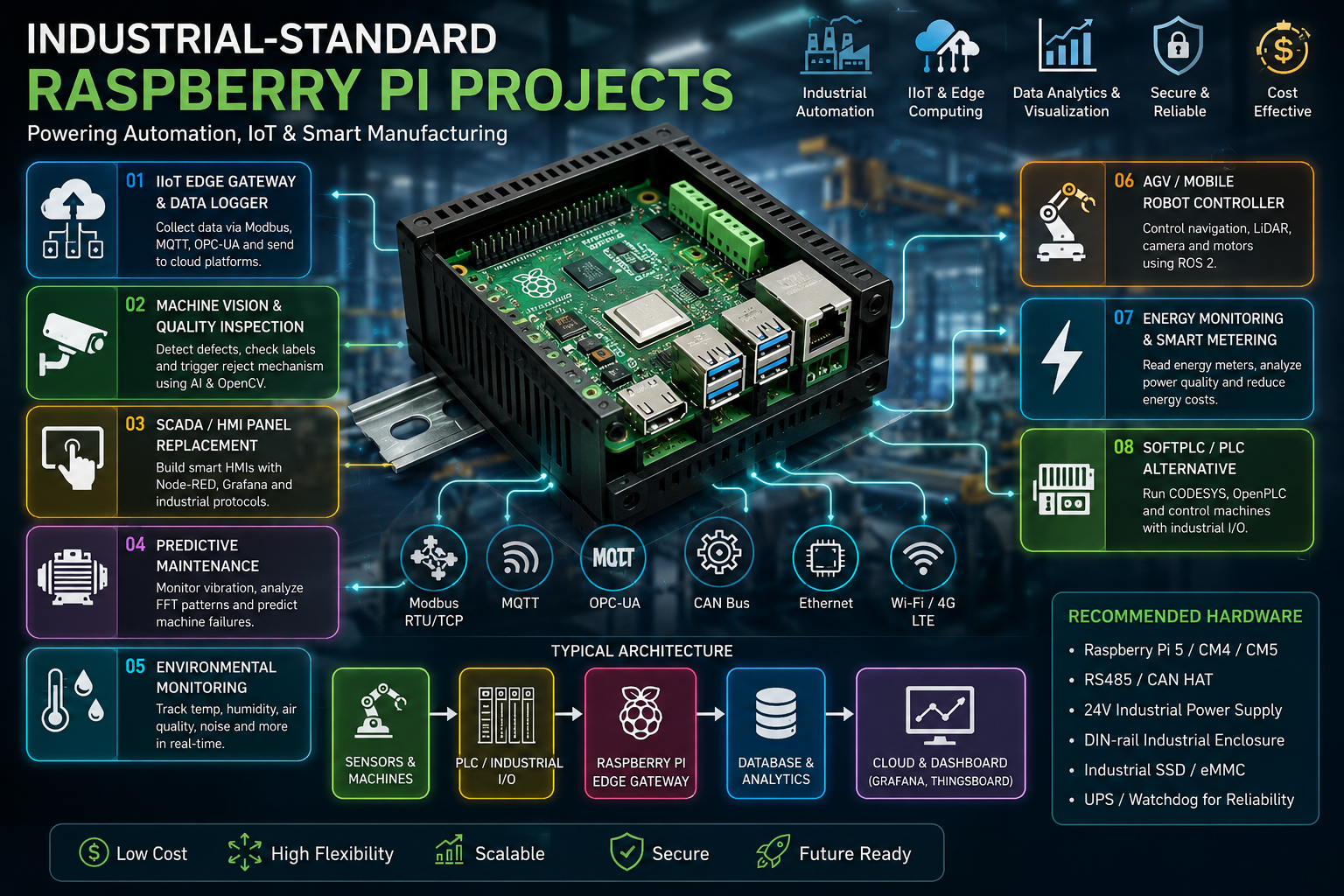
The Raspberry Pi has evolved far beyond a simple educational computer. With powerful processors, Ethernet connectivity, GPIO interfaces, industrial communication protocols, AI accelerators, and support for Linux-based industrial software, Raspberry Pi platforms can be used to build serious Industrial IoT (IIoT), automation, monitoring, machine vision, and edge-computing systems.
For engineers, automation students, system integrators, and industrial developers, Raspberry Pi provides a relatively low-cost platform for prototyping and deploying edge applications. With appropriate industrial power supplies, enclosures, I/O modules, watchdogs, storage, and communication interfaces, it can become part of a robust industrial control or monitoring architecture.
1. Industrial IoT Edge Gateway and Data Logger
One of the most useful industrial Raspberry Pi applications is an IIoT edge gateway. The Pi can collect information from multiple machines and sensors, process the information locally, store historical data, and forward selected information to a cloud platform.
Typical Sensors and Data Sources
- Temperature sensors
- Pressure transmitters
- Humidity sensors
- Vibration sensors
- Energy meters
- Motor current sensors
- Flow meters
- PLC registers
- Machine status signals
Industrial Communication Protocols
- Modbus RTU over RS485
- Modbus TCP
- MQTT
- OPC UA
- CAN bus
- HTTP/REST APIs
- Ethernet/IP where supported by the software and hardware stack
A typical architecture could be:
Sensors → PLC/Meter → RS485/Ethernet → Raspberry Pi → Edge Processing → Database → Cloud Dashboard
Software such as Node-RED, Python, MQTT brokers, InfluxDB and Grafana can be combined to create a complete monitoring platform.
2. Machine Vision and Automated Quality Inspection
Raspberry Pi can also act as an edge machine-vision controller. A camera continuously captures images of products moving along a production line. Computer-vision software then analyzes each image and determines whether the product meets predefined quality requirements.
Possible Applications
- Checking product dimensions
- Detecting scratches or surface defects
- Checking labels and barcodes
- Detecting missing components
- Checking package seals
- Counting products
- Reading text using OCR
- Checking component orientation
OpenCV can be used for traditional computer vision, while AI frameworks and accelerators can be used for more advanced object-detection applications.
A production-line system could operate as:
Camera → Raspberry Pi → Image Processing/AI → PASS/FAIL Decision → GPIO → PLC/Reject Mechanism
For demanding real-time AI workloads, the Raspberry Pi can be paired with an appropriate accelerator such as a Hailo-based AI accelerator or Coral TPU, depending on software compatibility and deployment requirements.
3. Raspberry Pi SCADA and HMI System
A Raspberry Pi can be used as a low-cost visualization terminal for industrial equipment. A touchscreen can display machine status, production counters, temperatures, alarms, energy consumption, and historical trends.
Possible Software Stack
- Node-RED Dashboard
- Grafana
- Custom HTML/JavaScript dashboard
- Python web applications
- MQTT
- InfluxDB
The Raspberry Pi can communicate with a PLC or industrial controller through Ethernet or serial interfaces and display the collected information on a browser-based HMI.
Example HMI Screen
- Machine RUN/STOP status
- Motor temperature
- Production count
- Current power consumption
- Alarm status
- Maintenance countdown
- Historical graphs
- Operator controls
4. Predictive Maintenance and Vibration Monitoring
Unexpected motor and pump failures can result in expensive production downtime. Raspberry Pi can be used as an edge device for continuously monitoring machine vibration and identifying abnormal operating conditions.
An accelerometer or industrial vibration sensor can be mounted on the machine. The Raspberry Pi collects vibration data and performs signal processing.
Typical Analysis
- RMS vibration
- Peak vibration
- Frequency analysis
- FFT analysis
- Temperature correlation
- Operating-hour analysis
- Anomaly detection
For example, a gradual increase in vibration at a characteristic frequency could indicate a developing mechanical problem. Instead of waiting for the machine to fail, the monitoring system can generate an early maintenance alert.
Sensor → Raspberry Pi → Signal Processing → Anomaly Detection → Database → Dashboard/Alert
5. Industrial Environmental Monitoring
Environmental monitoring is another excellent application for Raspberry Pi. A single system can monitor conditions across factories, warehouses, laboratories, server rooms, cold-storage facilities, or other controlled environments.
Parameters That Can Be Monitored
- Temperature
- Relative humidity
- Air quality
- CO₂
- Noise level
- Light intensity
- Differential pressure
- Door status
Multiple sensor nodes can send information to a central Raspberry Pi gateway using Ethernet, Wi-Fi, RS485, or LoRaWAN infrastructure.
The system can maintain historical records and generate alerts when predefined limits are exceeded.
6. AGV and Mobile Robot Controller
Raspberry Pi can serve as a high-level computing platform for an Automated Guided Vehicle (AGV) or mobile robot.
It can process data from cameras, LiDAR, IMUs, wheel encoders, and other sensors while running robotics software such as ROS 2.
Typical Architecture
- Raspberry Pi – high-level processing
- LiDAR – obstacle detection
- Camera – visual perception
- IMU – orientation and motion data
- Encoders – wheel position
- Motor controller – motor control
- Battery management system – power monitoring
For safety-critical motion control, a dedicated motor controller and appropriate safety hardware should be used rather than relying exclusively on the Raspberry Pi.
7. Industrial Energy Monitoring Gateway
Factories often have multiple energy meters distributed throughout a facility. A Raspberry Pi can collect readings from these meters and create a centralized energy-monitoring system.
Measurements Can Include
- Voltage
- Current
- Active power
- Reactive power
- Power factor
- Frequency
- Energy consumption
- Peak demand
Many industrial energy meters provide Modbus RTU or Modbus TCP, making them suitable for integration with a Raspberry Pi gateway.
The collected data can be stored locally and visualized using Grafana or another web-based dashboard.
8. Raspberry Pi as a SoftPLC / PLC Development Platform
Another interesting application is using Raspberry Pi as a software-based controller for machines, educational test benches, laboratory automation, and non-safety-critical control applications.
Platforms such as CODESYS and OpenPLC can provide PLC-style programming environments depending on the target platform and deployment requirements.
Possible I/O
- Digital inputs
- Digital outputs
- Analog inputs
- Analog outputs
- RS485
- CAN bus
- Ethernet
Industrial I/O modules are preferable to connecting industrial signals directly to Raspberry Pi GPIO pins.
9. Industrial MQTT Gateway
MQTT is widely used in IoT systems because it is lightweight and well suited to machine-to-machine communication.
A Raspberry Pi can operate as an MQTT gateway that receives information from machines and forwards it to local or cloud applications.
For example:
Machine 1 → MQTT → Raspberry Pi → MQTT Broker → Cloud Dashboard
Topics could be organized as:
factory/machine01/temperaturefactory/machine01/vibrationfactory/machine01/statusfactory/machine02/power
10. Industrial Barcode and QR Code Tracking
Raspberry Pi combined with a camera or industrial barcode scanner can be used to track products through different stages of manufacturing.
The system can record:
- Product ID
- Batch number
- Production time
- Machine number
- Inspection result
- Operator or station information
This can create a simple production traceability system for small and medium-sized manufacturing operations.
11. Industrial Server and Local Data Historian
A Raspberry Pi can also work as a small local server for collecting machine information. This is particularly useful where continuous internet connectivity is not guaranteed.
The Pi can store data locally and synchronize it with a cloud server when the network becomes available.
Example Software Stack
- Raspberry Pi OS Lite or another supported Linux distribution
- Python
- Node-RED
- MQTT
- InfluxDB
- Grafana
- SQLite/PostgreSQL where appropriate
- Docker where suitable for the deployment
12. Industrial Alarm and Notification Gateway
A Raspberry Pi can monitor machine alarms and forward notifications to operators or maintenance personnel.
For example, if a machine temperature exceeds a configured limit, the system can record the event and send a notification through an appropriate messaging, email, or industrial notification system.
Useful Alarm Conditions
- High temperature
- High vibration
- Motor overload indication
- Low pressure
- Power failure
- Communication failure
- Machine downtime
- Sensor failure
Industrial Raspberry Pi Hardware Recommendations
| Component | Recommended Approach |
|---|---|
| Compute Platform | Raspberry Pi 5 or Compute Module platform |
| Enclosure | Industrial enclosure / DIN-rail enclosure |
| Power | Regulated industrial power supply with suitable protection |
| Communication | Industrial Ethernet, RS485, CAN, Wi-Fi or cellular depending on application |
| Storage | High-endurance storage or SSD where appropriate |
| Backup Power | Industrial UPS or appropriately designed backup power |
| I/O | Industrial isolated digital/analog I/O modules |
| Cooling | Thermal solution suitable for the enclosure and ambient temperature |
Popular Industrial Raspberry Pi Platforms
- Raspberry Pi Compute Module platforms – useful for custom industrial products and carrier boards.
- Revolution Pi – industrial Raspberry Pi-based automation platform.
- UniPi – industrial I/O and automation hardware for Raspberry Pi-based systems.
- CODESYS – PLC-oriented automation software available for supported Raspberry Pi deployments.
- Node-RED – visual programming environment widely used for IoT and automation workflows.
Example Industrial Raspberry Pi Architecture
FIELD LEVEL
Sensors → Motors → Energy Meters → Machines
CONTROL LEVEL
PLC / Industrial I/O / RS485 / CAN
EDGE LEVEL
Raspberry Pi → Node-RED → Python → MQTT → Local Database
VISUALIZATION LEVEL
Grafana / HMI / Web Dashboard
CLOUD LEVEL
Cloud IoT Platform → Analytics → Reports → Alerts
How to Make a Raspberry Pi Project More Industrial
A normal Raspberry Pi hobby project and an industrial deployment are very different. Reliability, electrical protection, communication reliability, maintenance, and recovery need to be considered from the beginning.
1. Use Industrial Power
Instead of powering the Pi from an ordinary phone charger, use an appropriately rated and protected industrial power supply for the installation.
2. Protect Communication Interfaces
RS485, Ethernet, CAN, and external I/O may require suitable isolation, surge protection, grounding, and interface hardware depending on the electrical environment.
3. Add Watchdog and Recovery Mechanisms
Industrial systems should be designed to recover from software crashes, communication failures, or unexpected restarts whenever the application permits it.
4. Use Reliable Storage
Continuous logging can generate significant write activity. Storage selection and database design should account for write endurance and recovery after unexpected power loss.
5. Design for Network Failure
An industrial edge gateway should ideally continue collecting important information when the internet connection is unavailable and synchronize data after connectivity returns.
6. Separate Safety Functions
Emergency stops, safety interlocks, safety relays, and other safety functions should use appropriate certified safety hardware. Do not rely on a general-purpose Raspberry Pi application as the sole safety mechanism.
Which Raspberry Pi Project Is Best for a Real Business?
| Project | Difficulty | Business Potential |
|---|---|---|
| IIoT Data Logger | Medium | Very High |
| Machine Vision | High | Very High |
| SCADA/HMI | Medium | High |
| Predictive Maintenance | High | Very High |
| Environmental Monitoring | Medium | High |
| AGV Controller | Very High | Very High |
| Energy Monitoring | Medium | Very High |
Final Thoughts
Raspberry Pi is particularly valuable at the industrial edge, where sensor data needs to be collected, processed, visualized, and transferred between machines and higher-level software.
The most commercially interesting applications include industrial IoT gateways, machine vision, predictive maintenance, energy monitoring, environmental monitoring, and SCADA/HMI systems.
The key is not simply putting a Raspberry Pi inside a box. A production-ready system requires appropriate power, electrical protection, industrial I/O, reliable storage, software monitoring, secure networking, backup/recovery mechanisms, and proper separation of safety functions.
Related topics: Raspberry Pi Industrial Automation, Industrial IoT, IIoT Gateway, Modbus Raspberry Pi, Node-RED Industrial Automation, Raspberry Pi SCADA, Raspberry Pi Machine Vision, Predictive Maintenance, Energy Monitoring.