The Complete Guide to Supplement Combinations: What Works Great & What You Must Never Mix
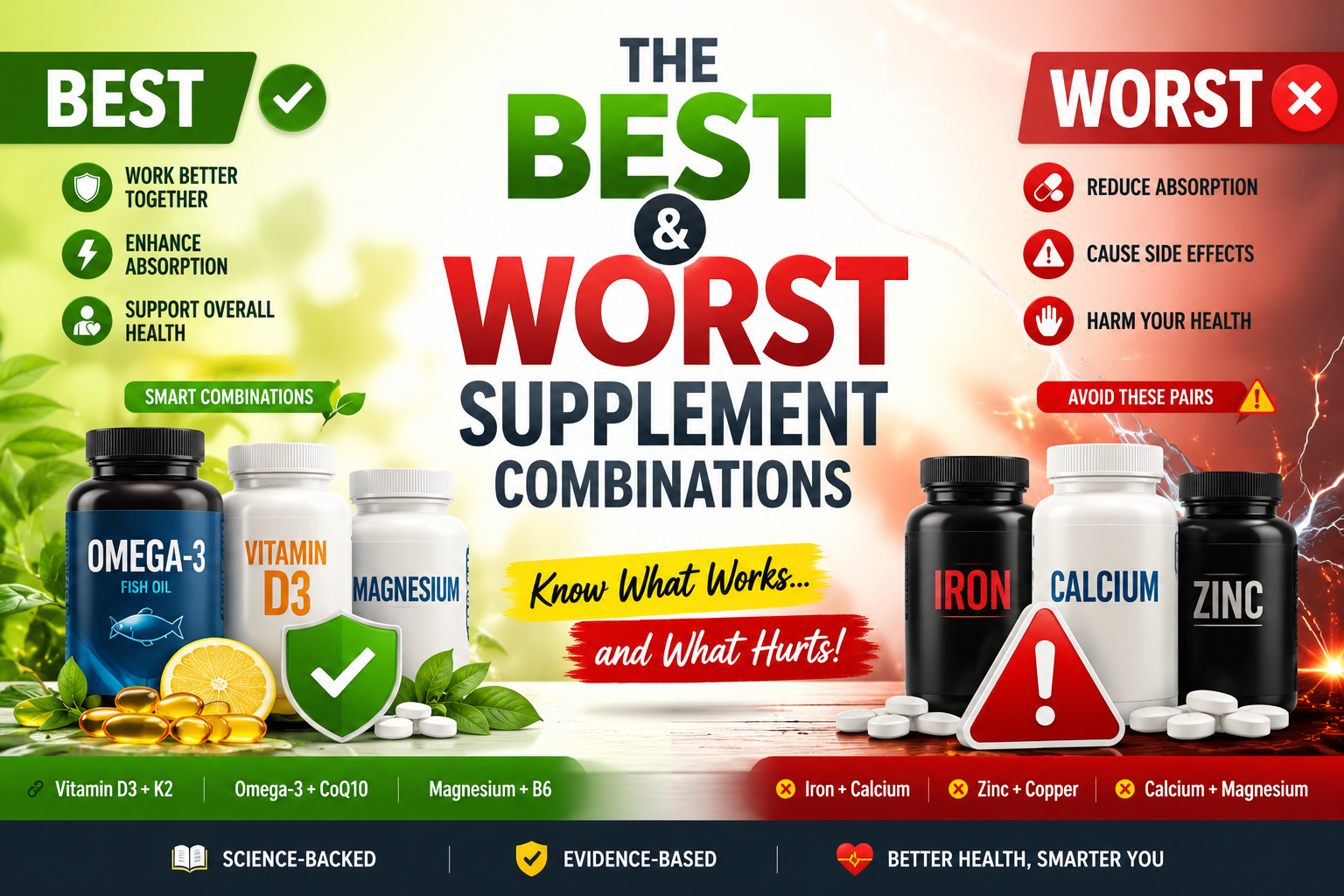
Iron, Creatine, Calcium, Vitamin C, D, K2, Zinc, Magnesium & More — Full Good vs Bad Chart + Smart Timing Plan
Taking supplements is easy. Taking them correctly is not. Many popular combinations either supercharge results or quietly sabotage absorption, cause stomach issues, or even create health risks. This is the most practical, science-based guide covering all major good and bad combinations you need to know in 2026.
1. Best Combinations (Synergies – Take These Together)
| Combination | Why It Works | How to Take |
|---|---|---|
| Iron + Vitamin C | Vitamin C converts iron to its absorbable form and can boost non-heme iron absorption 2–4× | Take together on empty stomach (or with orange juice) |
| Vitamin D3 + K2 | D3 increases calcium absorption; K2 directs calcium into bones instead of arteries | Together with a meal containing fat |
| Vitamin D3 + Magnesium | Magnesium is required to activate vitamin D in the body | Together with food (magnesium can also be taken at night) |
| Vitamin D3 + Calcium + K2 | Complete bone-health stack when properly balanced | With fatty meal; keep calcium moderate |
| Curcumin + Piperine (Black Pepper) | Piperine increases curcumin bioavailability up to 2000% | Always take curcumin with black pepper extract + fat |
| Omega-3 + Vitamin E | Vitamin E protects omega-3s from oxidation | With largest meal of the day |
| B-Complex vitamins | They work as a team in energy metabolism | Morning with food |
| Creatine + Protein / Carbs | Insulin response improves creatine uptake into muscles | Post-workout or with any meal |
| Probiotics + Prebiotics | Prebiotics feed the good bacteria for better colonization | According to product instructions |
| Zinc + Copper (balanced) | Prevents copper deficiency from long-term high-dose zinc | Use a ratio of roughly 10–15 mg zinc : 1–2 mg copper |
1. Iron + Vitamin C
2. Vitamin D3 + K2 (+ Magnesium)
3. Curcumin + Piperine + Fat
2. Worst Combinations (Conflicts – Separate These)
| Combination | Problem | Minimum Separation |
|---|---|---|
| Calcium + Iron | Calcium blocks iron absorption by 40–60% | 2–3 hours (Iron AM, Calcium PM) |
| Calcium + Zinc | Competes for absorption | 2 hours |
| Calcium + Magnesium (high doses) | Compete at high intakes (>500 mg each) | 2 hours or different meals |
| Iron + Zinc | High-dose iron reduces zinc absorption | 2 hours |
| Zinc + Copper (chronic high zinc) | High zinc depletes copper over time | Use balanced ratio or separate |
| Iron + Coffee / Tea | Polyphenols can cut absorption 50–80% | 2 hours |
| Minerals + Antibiotics (tetracyclines, quinolones) | Forms insoluble complexes → antibiotic fails | 2–6 hours depending on drug |
| Calcium / Iron / Magnesium + Thyroid meds | Blocks levothyroxine absorption | 4 hours |
| High-dose Vitamin E + Vitamin K | May interfere with clotting function | Caution with high-dose E |
| Fish Oil + Ginkgo + High Vitamin E / Garlic | Additive blood-thinning effect → bleeding risk | Medical supervision if on blood thinners |
• St. John’s Wort + SSRIs / SNRIs / 5-HTP / SAMe → Serotonin syndrome risk
• St. John’s Wort + Birth control / Warfarin / many drugs → Reduced effectiveness
• Multiple strong blood thinners together (Fish oil + Ginkgo + high Vitamin E + aspirin)
3. Iron + Creatine Special Section
There is no strong evidence that creatine blocks iron absorption. They use different pathways. However:
- Both can independently cause stomach discomfort (iron more than creatine).
- Taking them at the exact same time may worsen nausea or bloating for sensitive people.
- Best practice: Iron + Vitamin C in the morning. Creatine later with a meal or post-workout.
4. Other Important Interactions You Should Know
- Magnesium + Antibiotics / Bisphosphonates → Separate by several hours.
- Calcium + Bisphosphonates → Separate by several hours.
- High-dose Zinc long-term → Always balance with copper.
- Fat-soluble vitamins (A, D, E, K) → Always take with dietary fat for proper absorption.
- Fiber supplements → Can reduce absorption of many minerals; take away from iron, calcium, zinc, etc.
- Antacids / PPIs → Reduce iron and vitamin B12 absorption over time.
5. Perfect Daily Timing Schedule (Ready to Use)
| Time | What to Take | Why |
|---|---|---|
| Morning (empty stomach) | Iron + Vitamin C | Maximum absorption, low hepcidin |
| With Breakfast (fatty meal) | Vitamin D3 + K2 + Omega-3 + B-Complex + CoQ10 | Fat needed for absorption, energy support |
| Post-Workout / Midday | Creatine + Protein | Best for muscle uptake |
| With Dinner | Calcium (if needed) | Separated from iron |
| Evening / Bedtime | Magnesium Glycinate + Zinc (balanced with copper if needed) | Supports sleep and recovery |
Morning group: Iron + C, D3+K2, B vitamins, Omega-3, Creatine
Evening group: Calcium, Magnesium, Zinc
This single split solves 90% of common conflicts.
6. Quick Reference Cards
Iron + Vitamin C
D3 + K2
D3 + Magnesium
Curcumin + Piperine
Omega-3 + Vitamin E
Calcium ↔ Iron
Calcium ↔ Zinc
Iron ↔ Zinc
Minerals ↔ Antibiotics
Minerals ↔ Thyroid meds
High Zinc without Copper
Multiple blood thinners
St. John’s Wort with anything
High-dose Vitamin E + K
Final Takeaway
The difference between average and excellent results is often just timing and smart pairing.
Take iron with vitamin C. Take D3 with K2 and magnesium. Keep calcium away from iron and zinc.
Separate minerals from medications. Follow the schedule above and you will absorb far more of what you pay for — with fewer side effects.
⚠️ Important Medical Warning
This article is provided for educational and informational purposes only. It is NOT a substitute for professional medical advice, diagnosis, or treatment.
Never start, stop, increase, decrease, or combine any vitamin, mineral, herbal product, or dietary supplement based solely on information from this website.
Supplements can interact with prescription medications, over-the-counter medicines, and existing medical conditions. Even commonly used supplements may cause serious side effects, allergic reactions, organ damage, or dangerous drug interactions in some individuals.
Always consult a qualified physician, pharmacist, or registered dietitian before taking any supplement, especially if you:
- Take prescription or over-the-counter medications
- Have heart, liver, kidney, thyroid, or other medical conditions
- Are pregnant, planning pregnancy, or breastfeeding
- Are under 18 or over 65 years of age
- Are scheduled for surgery or have a chronic illness
Your health is unique. What is safe or effective for one person may be ineffective or even harmful to another.
By reading this article, you acknowledge that any health or supplement decisions should be made in consultation with a licensed healthcare professional.