Rakhi: A Sacred Thread That Connects Culture, Family and a Country
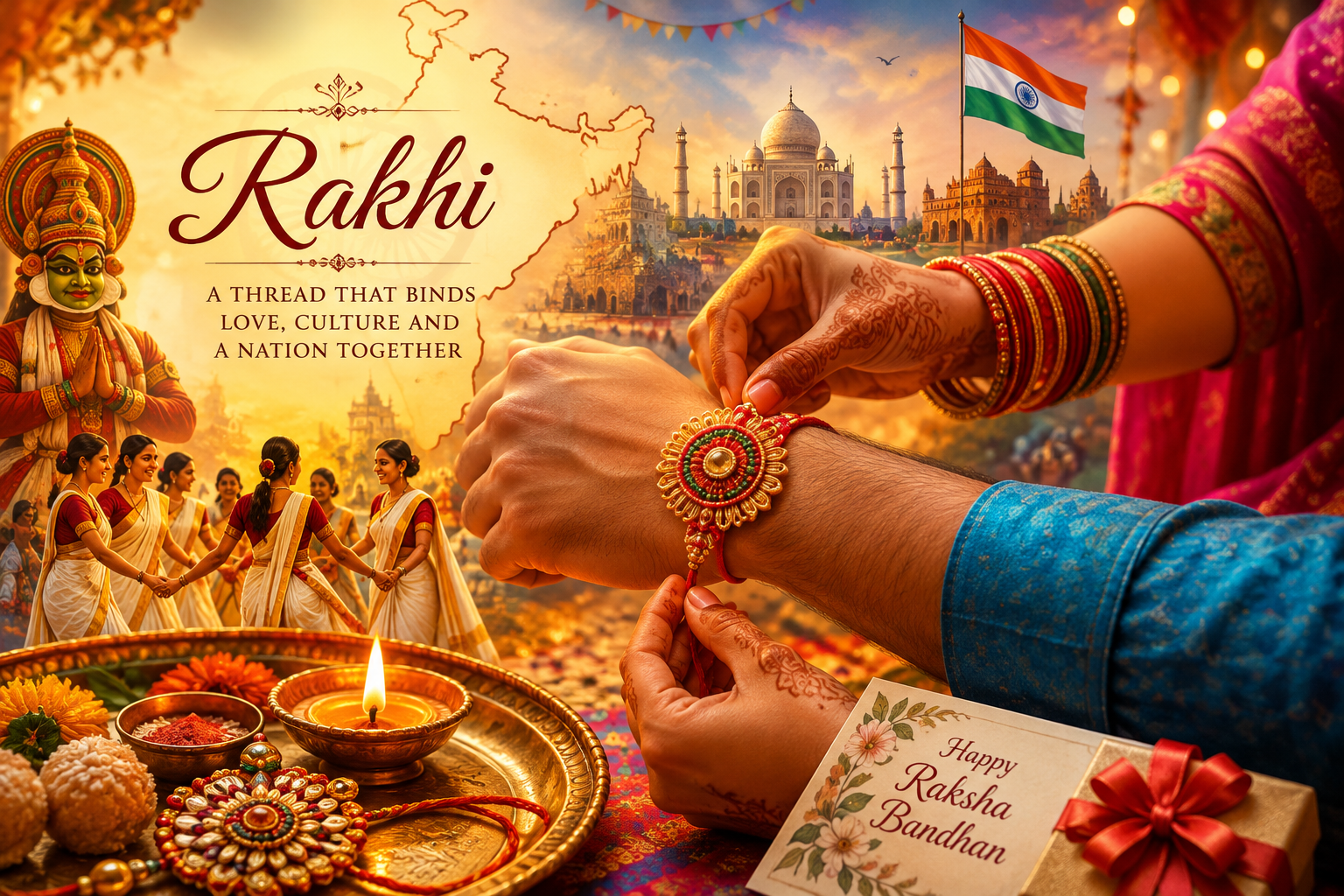
Every year, when Raksha Bandhan arrives, a simple thread becomes much more than a piece of decoration. Rakhi carries memories, family values, cultural traditions and the sacredness of relationships. It is a celebration of the bond between siblings, but its meaning can reach far beyond one family.
More Than Just a Thread
The word Rakhi is commonly associated with protection. A sister tying a rakhi on her brother’s wrist is a symbolic expression of love, trust, responsibility and a wish for his well-being. In return, the brother traditionally promises to stand by and protect his sister.
But the beauty of Raksha Bandhan lies in the fact that the thread itself has no power. Its significance comes from the emotions and promises attached to it.
A small thread can represent years of childhood memories, countless arguments, shared laughter and the invisible connection that remains even when siblings live far apart.
Rakhi and India’s Cultural Diversity
India is a country of many languages, religions, communities and traditions. Festivals often take different forms from one region to another, and Raksha Bandhan is no exception.
The festival is celebrated across different parts of India, with regional customs adding their own character. Families may follow different rituals, prepare different foods and celebrate in different ways, yet the central idea remains familiar: honouring a precious relationship through a sacred bond.
This is one of the remarkable characteristics of Indian culture. A tradition can have many regional expressions while still carrying a shared emotional meaning.
The Sacredness of the Relationship
Rakhi is sometimes described simply as a festival of brothers and sisters. But its deeper meaning is about responsibility within relationships.
The thread reminds us that relationships are not built only through blood. They are strengthened through care, respect, sacrifice and responsibility.
In many families, Rakhi is also tied to cousins and other people considered part of the family. In contemporary India, people may interpret the tradition in different ways, focusing on mutual protection and emotional support rather than a one-sided promise.
That makes the festival meaningful even as society changes.
From Family Tradition to Cultural Identity
Festivals become part of a country’s cultural identity when generations continue to pass them forward.
A child watching an elder prepare a rakhi learns more than a ritual. They see the importance given to family, remembrance and tradition. Later, that same child may continue the practice with their own family.
This is how culture survives—not only through monuments and historical books, but through small traditions repeated in ordinary homes.
A rakhi tied on a wrist may last only for a short time, but the memory associated with it can last for decades.
Rakhi in a Changing World
Modern life has changed the way families live. Brothers and sisters may live in different cities or even different countries. Yet technology has made it possible to continue the tradition through video calls, online gifts and rakhi deliveries.
Interestingly, this shows that culture does not necessarily disappear when society modernizes.
Instead, traditions can adapt while preserving their core meaning.
A sister may now send a rakhi across thousands of kilometres, but the emotion behind it can remain exactly the same.
A Symbol Beyond One Family
The idea represented by Rakhi can also be understood more broadly: society itself depends on people accepting responsibility for one another.
Protection does not always mean physical strength. It can mean standing beside someone during difficult times, respecting their dignity, helping them when they are vulnerable and remaining present when they need support.
In that sense, the rakhi can be seen as a reminder of a larger cultural value:
We are stronger when we care for one another.
Why Rakhi Still Matters
In an age of smartphones, social media and increasingly fast-paced lives, traditional festivals provide moments to pause.
Rakhi gives families a reason to meet, call, remember their childhood and express feelings that may otherwise remain unspoken.
The thread itself is simple.
Its meaning is not.
It carries affection, responsibility, memory and tradition from one generation to the next.
The Sacred Thread
Perhaps that is why Rakhi remains powerful.
It is not the thread that makes the relationship sacred. It is the love, trust and responsibility represented by the thread.
From a small family ceremony to a celebration observed across India and among Indian communities around the world, Rakhi demonstrates how a simple cultural symbol can preserve something deeply human.
A thread may be thin enough to break with a little force.
But the bond it represents can be strong enough to survive distance, time and generations.
Rakhi is therefore more than a festival. It is a reminder that culture lives through relationships—and that some of the most powerful traditions begin with something as simple as tying a thread around a wrist.