Soil Testing Centres in India for Agriculture
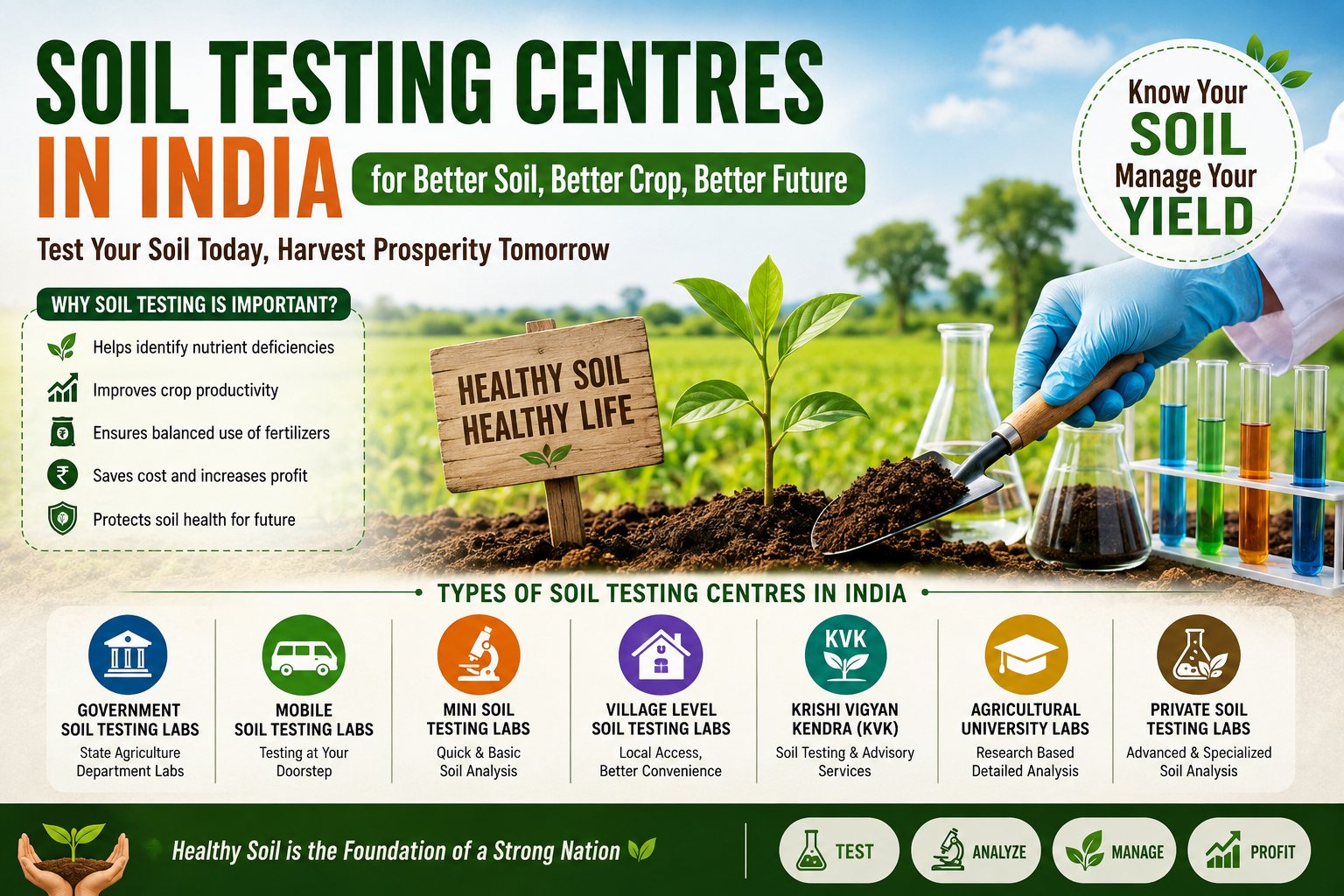
Healthy soil is one of the most important factors for successful agriculture.
Before applying fertilizers, manure or soil amendments, farmers should understand
the condition of their soil.
Soil testing helps determine nutrient availability, soil pH, salinity,
organic carbon and other important characteristics. India has a large network
of government and private soil-testing facilities that farmers can use.
Why Is Soil Testing Important?
Soil conditions can vary considerably even between nearby farms. Applying the same
fertilizer to every field may therefore not always be appropriate.
Soil testing can help farmers:
- Identify nutrient deficiencies
- Determine soil pH
- Check electrical conductivity and salinity
- Understand organic carbon levels
- Apply fertilizers more efficiently
- Reduce unnecessary fertilizer expenses
- Improve crop nutrition
- Maintain long-term soil fertility
- Make better crop-management decisions
Different Types of Soil Testing Centres in India
1. Government Soil Testing Laboratories
State Agriculture Departments operate soil-testing laboratories in many
agricultural regions of India. These laboratories commonly provide basic
soil-fertility analysis and fertilizer recommendations.
Common tests may include:
- Soil pH
- Electrical Conductivity (EC)
- Organic Carbon
- Nitrogen
- Phosphorus
- Potassium
- Sulphur
- Selected micronutrients
2. Mobile Soil Testing Laboratories
Mobile soil-testing laboratories bring testing facilities closer to farmers.
They may travel to villages, agricultural programmes and rural farming areas.
These facilities can be particularly useful for farmers who have difficulty
travelling to a permanent laboratory.
3. Mini Soil Testing Laboratories
Mini laboratories are smaller testing facilities designed to provide
basic soil analysis closer to farming communities.
They can be useful for:
- Individual farmers
- Farmer groups
- Local agricultural communities
- Rural agricultural service providers
4. Village-Level Soil Testing Laboratories
Village-level laboratories are intended to make soil testing more accessible
at the local level. Farmers may be able to submit samples without travelling
to a distant district laboratory.
5. Krishi Vigyan Kendra (KVK)
Krishi Vigyan Kendras are part of India’s agricultural extension and
technology-transfer network. Depending on the individual KVK, farmers may
receive soil-testing services and agricultural advice.
- Soil testing
- Fertilizer recommendations
- Crop-management advice
- Farmer training
- Agricultural demonstrations
6. Agricultural University Laboratories
State Agricultural Universities operate laboratories and research facilities
that can provide agricultural and soil-related services.
They can be especially useful for specialized requirements such as:
- Soil fertility analysis
- Crop nutrition
- Horticultural crops
- Plantation crops
- Soil acidity
- Salinity
- Micronutrient deficiencies
7. Private Soil Testing Laboratories
Private laboratories are also available in many parts of India.
Depending on the facility, they may provide basic or highly specialized
agricultural testing.
Additional tests may include:
- Detailed micronutrient analysis
- Soil texture
- Salinity analysis
- Water testing
- Heavy-metal testing
- Crop-specific analysis
What Does a Soil Test Usually Measure?
| Parameter | Why It Matters |
|---|---|
| pH | Indicates whether soil is acidic or alkaline. |
| Electrical Conductivity | Provides an indication of soluble salts in soil. |
| Organic Carbon | Provides an indication of soil organic matter and fertility. |
| Nitrogen | Important nutrient for plant growth and development. |
| Phosphorus | Important for root development and plant growth. |
| Potassium | Important for several plant physiological processes. |
| Zinc, Iron, Boron and other micronutrients | Required in smaller quantities but important for healthy crops. |
How to Collect a Soil Sample
The accuracy of a soil test depends heavily on collecting a representative
sample from the field.
- Divide the field into reasonably uniform areas.
- Avoid unusual locations such as manure piles and field boundaries.
- Collect soil from several representative points.
- Mix the collected soil thoroughly in a clean container.
- Remove stones, roots and visible debris.
- Take the required quantity of the mixed sample.
- Place the sample in a clean bag.
- Label it with the field and crop information.
- Submit it to the selected laboratory.
Sampling depth and procedure can vary depending on the crop and purpose
of testing. Follow the instructions provided by your local Agriculture
Department or soil-testing laboratory.
Information to Provide With the Soil Sample
- Farmer’s name
- Contact number
- Village and district
- Field identification
- Approximate field area
- Current crop
- Previous crop
- Proposed crop
- Irrigation source
- Previous fertilizer application, if known
Soil Health Card in India
The Government of India operates the Soil Health Card programme to help
farmers understand the nutrient status of their soil.
Soil analysis can provide information about important soil parameters
and support recommendations for fertilizer and soil amendments.
Visit Official Soil Health Card Portal
How to Find a Soil Testing Centre Near You
Farmers can find soil-testing facilities through government agricultural
services or by contacting local agricultural offices.
- District Agriculture Office
- Block Agriculture Office
- Krishi Bhavan
- Krishi Vigyan Kendra
- State Agricultural University
- Government Soil Testing Laboratory
- Registered Private Soil Testing Laboratory
Government vs Private Soil Testing Laboratories
| Feature | Government Lab | Private Lab |
|---|---|---|
| Basic soil testing | Usually available | Usually available |
| Fertilizer recommendations | Often available | Depends on laboratory |
| Specialized testing | Depends on facility | Often available |
| Crop-specific analysis | Depends on facility | May be available |
| Cost | May be subsidized | Varies by laboratory |
| Farmer guidance | Often available | Depends on provider |
How Much Does Soil Testing Cost?
There is no single fixed price for soil testing throughout India.
Charges depend on the state, laboratory, number of parameters and
type of testing required.
Government laboratories may provide testing at subsidized rates or
under agricultural programmes. Private laboratories generally have
their own pricing.
Always confirm the current testing fee, available parameters and
sample requirements directly with the laboratory before submitting
your soil sample.
When Should Farmers Test Soil?
- Before starting a new crop
- Before establishing an orchard
- When crop productivity decreases
- When nutrient deficiency is suspected
- Before changing fertilizer practices
- When developing new agricultural land
- Periodically as part of soil-fertility management
Why Avoid Applying Fertilizer Without Testing?
Applying fertilizer without understanding the soil nutrient status
may result in unnecessary expenditure and nutrient imbalance.
Soil testing can help farmers:
- Reduce unnecessary fertilizer use
- Improve nutrient management
- Control production costs
- Identify deficiencies
- Improve soil-fertility management
Conclusion
India has a large network of government soil-testing laboratories,
mobile laboratories, mini laboratories, village-level laboratories,
KVKs, agricultural universities and private testing facilities.
For basic farm soil testing, farmers can start with their local
Agriculture Department, Krishi Bhavan or nearby KVK. For specialized
analysis, an agricultural university or qualified private laboratory
may be more appropriate.
Soil testing is not simply about obtaining a report. The real benefit
comes from using the results to make better decisions about fertilizers,
manure, soil amendments and crop selection.
Frequently Asked Questions
Is soil testing necessary for every farmer?
Regular soil testing is highly useful because nutrient levels and
soil characteristics can vary between fields.
Where can I test agricultural soil in India?
You can approach a government soil-testing laboratory, mobile
laboratory, KVK, agricultural university or private laboratory.
Can soil testing determine which fertilizer I need?
Soil-test results can help determine nutrient requirements and
support fertilizer recommendations. Crop requirements should also
be considered.
Can irrigation water also be tested?
Yes. Many agricultural laboratories also offer water-quality
testing, although available parameters and charges vary.
Is a Soil Health Card the same as a soil-test report?
A Soil Health Card presents information based on soil analysis
and provides recommendations intended to help farmers manage
soil fertility.
How can I find the nearest soil-testing laboratory?
Contact your local Agriculture Department, Krishi Bhavan or
Krishi Vigyan Kendra, or use the official Soil Health Card
services to locate available laboratories.
This article is provided for general educational and informational
purposes. Soil-test recommendations can vary according to crop,
soil type, climate, irrigation and local conditions. Farmers should
consult a qualified agricultural officer, soil scientist or agronomist
for crop-specific recommendations.