20 Amazing Lesser-Known Festivals Around the World and India You Should Know About
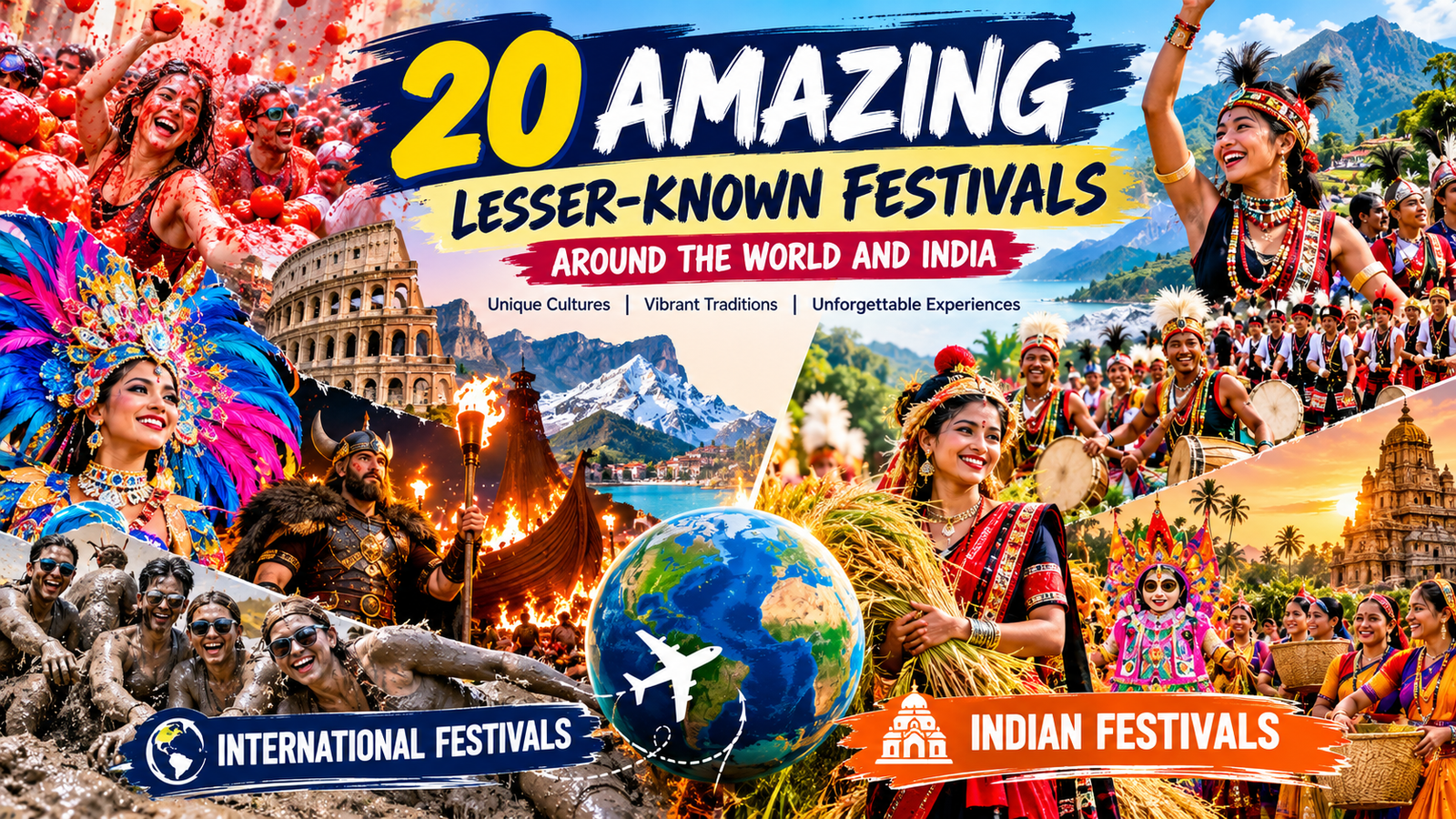
20 Amazing Lesser-Known Festivals Around the World and India You Should Know About
Festivals are one of the best ways to understand the culture, history and traditions of a place.
While celebrations such as Christmas, New Year, Diwali and Holi are famous around the world,
there are hundreds of fascinating festivals that receive far less international attention.
Some involve spectacular fire processions, colourful costumes, traditional dances, harvest
celebrations, food, music or unusual competitions. Many of them are also wonderful
experiences for travellers and content creators.
In this guide, we first explore 10 lesser-known international festivals,
followed by 10 fascinating Indian festivals.
🌍 Part 1: Lesser-Known International Festivals
1. Up Helly Aa – Scotland 🏴
Location: Lerwick, Shetland, Scotland
Usual timing: Last Tuesday of January
Up Helly Aa is one of the most spectacular fire festivals in Europe. It takes place in
Shetland and celebrates the islands’ strong Norse and Viking heritage.
Participants dress in elaborate Viking-inspired costumes and carry flaming torches through
the streets in a large procession. The event traditionally reaches its dramatic climax when
a replica Viking longship is surrounded by burning torches and set on fire.
Why it is special: A spectacular celebration of Shetland’s Viking heritage.
👨👩👧👦 Family note: Families can watch the celebrations, but the large
fire procession and crowds may not be suitable for very young children.
2. La Tomatina – Spain 🇪🇸
Location: Buñol, Spain
Usual timing: Last Wednesday of August
La Tomatina is one of the world’s most unusual food festivals. Thousands of people gather
in Buñol for a huge tomato fight.
Participants throw ripe tomatoes at each other in a colourful and messy celebration.
The streets can become covered with tomato pulp during the event.
Why it is special: A unique combination of food, colour and entertainment.
👨👩👧👦 Family note: Families can attend, but the main tomato fight is
very crowded and physical, so it may be better suited to older children and teenagers.
3. Cooper’s Hill Cheese-Rolling – England 🇬🇧
Location: Cooper’s Hill, Gloucestershire, England
Usual timing: Usually late May
Participants race down an extremely steep hill chasing a wheel of Double Gloucester cheese.
The first person to reach the bottom traditionally wins the race and the cheese.
Why it is special: One of the world’s strangest traditional races.
👨👩👧👦 Family note: Watching from a safe location can be a family
experience, but the race itself is physically dangerous and unsuitable for young children
to participate in.
4. Boryeong Mud Festival – South Korea 🇰🇷
Location: Boryeong, South Korea
Usual timing: July
The Boryeong Mud Festival turns the festival area into a giant playground of mud.
Visitors can enjoy mud wrestling, mud slides, mud pools, games and entertainment.
Why it is special: Visitors can enjoy a huge outdoor celebration
while getting covered in mineral-rich mud.
👨👩👧👦 Family-friendly: Yes – Families can enjoy the festival,
and dedicated family activities are available.
5. Jember Fashion Carnaval – Indonesia 🇮🇩
Location: Jember, East Java, Indonesia
Usual timing: Usually August
Jember Fashion Carnaval is one of Indonesia’s most spectacular cultural events.
It is a huge street parade featuring elaborate costumes, creative designs, music and performances.
Participants wear large handmade costumes inspired by nature, Indonesian culture,
traditional clothing, fantasy, wildlife and different artistic themes.
Unlike a conventional fashion show, the event takes place on the streets, with performers
walking, dancing and interacting with spectators.
Why it is special: A spectacular combination of street performance,
fashion, art and Indonesian cultural creativity.
👨👩👧👦 Family-friendly: Yes – A colourful cultural parade suitable
for families. Children also participate in dedicated carnival activities.
6. Takanakuy – Peru 🇵🇪
Location: Cusco region, Peru
Usual timing: December 25
Takanakuy is a traditional celebration in parts of the Peruvian Andes. One of its most
unusual features is organised one-on-one fighting between participants.
The fights are traditionally connected with settling personal disputes before the new year.
Music, dancing, costumes and community celebrations are also part of the event.
Why it is special: A distinctive cultural tradition involving symbolic
physical confrontations and community celebration.
⚠️ Not family-friendly: The fighting element makes this unsuitable for
a general family festival recommendation, particularly for young children.
7. Gerewol Festival – Niger 🇳🇪
Location: Niger and surrounding Sahel region
Usual timing: Generally around September–October
Gerewol is associated with the Wodaabe people of the Sahel. It is known for elaborate
clothing, makeup, singing, dancing and traditional beauty performances.
The celebration provides an opportunity to learn about the traditions of a nomadic
community of the Sahel.
Why it is special: Its distinctive costumes, dance and cultural traditions
make it very different from conventional festivals.
👨👩👧👦 Family note: Families interested in cultural tourism can attend,
but some traditional courtship elements may not be suitable for every young child.
8. Battle of the Oranges – Italy 🇮🇹
Location: Ivrea, Italy
Usual timing: February, during Carnival
Ivrea’s Battle of the Oranges is an unusual Carnival tradition in which teams throw
oranges at one another in a large-scale symbolic battle.
The tradition is connected to a historical story about resistance against tyranny.
Today, it has become one of Italy’s most distinctive Carnival celebrations.
Why it is special: A dramatic Carnival tradition with an unusual
historical story behind it.
👨👩👧👦 Family note: Families can watch from designated spectator areas,
but the orange-throwing battle itself can be intense and is not ideal for small children.
9. Wife Carrying World Championship – Finland 🇫🇮
Location: Sonkajärvi, Finland
Usual timing: July
The Wife Carrying World Championship is an unusual sporting event where competitors
race through an obstacle course while carrying their partners.
The course can include water, sand and obstacles, making the race much more challenging
than it initially appears.
Why it is special: A humorous local tradition that developed into
an international competition.
👨👩👧👦 Family-friendly: Yes – Families can watch the competition
and enjoy the surrounding festival atmosphere.
10. Monkey Buffet Festival – Thailand 🇹🇭
Location: Lopburi, Thailand
Usual timing: November
The Monkey Buffet Festival in Lopburi is one of Thailand’s most unusual celebrations.
Large quantities of fruit, vegetables and other food are arranged for local macaque monkeys.
The event is connected with local traditions and the long association between Lopburi
and its monkey population.
Why it is special: A festival where the main guests are monkeys rather
than humans.
👨👩👧👦 Family-friendly: Generally yes – Children may find the event
interesting, but parents should keep young children close to them around monkeys and crowds.
🇮🇳 Part 2: Lesser-Known Indian Festivals
India is often described as a country of festivals, but many of its regional celebrations
remain relatively unknown outside their home states and communities.
These festivals demonstrate how India’s tribal, agricultural and regional cultures have
preserved traditions that are very different from the country’s better-known celebrations.
11. Wangala – Meghalaya 🇮🇳
Region: Meghalaya
Usual timing: Generally September–December
Wangala is one of the most fascinating harvest festivals of Northeast India. It is
traditionally associated with the Garo community and is popularly known as the
Festival of the Hundred Drums.
The celebration marks the end of the agricultural season and includes traditional music,
dancing, colourful clothing and community gatherings.
Why it is special: Hundreds of drums and traditional dancing create
a spectacular cultural performance.
👨👩👧👦 Family-friendly: Yes – A community-oriented cultural festival
with music, dancing and traditional celebrations.
12. Mopin – Arunachal Pradesh 🇮🇳
Region: Arunachal Pradesh
Usual timing: March–April
Mopin is an important festival of the Galo community of Arunachal Pradesh.
It is associated with prosperity, fertility and the agricultural cycle.
Traditional clothing, community feasts, music and the Popir dance are among the
important elements of the celebration.
Why it is special: A colourful celebration showcasing Galo traditions.
👨👩👧👦 Family-friendly: Yes – Suitable for families interested
in cultural experiences.
13. Chapchar Kut – Mizoram 🇮🇳
Location: Mizoram
Usual timing: March
Chapchar Kut is one of Mizoram’s most important traditional festivals. It is connected
with the agricultural cycle and the period after jungle vegetation has been cleared
for jhum cultivation.
The festival is celebrated with traditional dances, music, costumes and community gatherings.
Why it is special: It showcases Mizo culture through music, dance
and traditional costumes.
👨👩👧👦 Family-friendly: Yes – A community celebration suitable
for families.
14. Nuakhai – Odisha 🇮🇳
Region: Western Odisha
Usual timing: August–September
Nuakhai is an important harvest festival of Western Odisha. The celebration is associated
with the consumption of newly harvested food and rice.
Families and communities come together to celebrate the new agricultural season and
express gratitude for the harvest.
Why it is special: A strong family and community harvest tradition.
👨👩👧👦 Family-friendly: Yes – A family-oriented harvest celebration.
15. Pawl Kut – Mizoram 🇮🇳
Location: Mizoram
Usual timing: December
Pawl Kut is a traditional harvest thanksgiving festival associated with Mizo communities.
The celebration follows the agricultural season and includes thanksgiving, food and
community gatherings.
Why it is special: It reflects traditional Mizo agricultural and
community life.
👨👩👧👦 Family-friendly: Generally yes – Families can enjoy the
cultural celebrations, although specific local customs may vary.
16. Gaan Ngai – Manipur 🇮🇳
Location: Manipur
Usual timing: December–January
Gaan Ngai is a major traditional festival of the Zeliangrong communities of Northeast India.
It includes religious ceremonies, traditional songs, dances and community gatherings.
Traditional clothing and group performances make it particularly interesting for
cultural photography.
Why it is special: A celebration focused on community, tradition,
music and cultural identity.
👨👩👧👦 Family-friendly: Yes – Suitable for families attending
cultural celebrations respectfully.
17. Nongkrem Dance Festival – Meghalaya 🇮🇳
Location: Meghalaya
Usual timing: Usually November
The Nongkrem Dance Festival is an important cultural celebration of the Khasi community.
It is associated with thanksgiving and traditional religious ceremonies.
One of the most striking aspects of the festival is its traditional dance performed
in elaborate clothing accompanied by traditional music.
Why it is special: A beautiful display of Khasi traditional dance,
music and ceremonial culture.
⚠️ Family note: Families can attend as respectful spectators, but
the festival includes traditional religious rituals that parents may wish to explain
to younger children beforehand.
18. Tusu Festival – Eastern India 🇮🇳
Region: Jharkhand, West Bengal and Odisha
Usual timing: Winter, generally December–January
Tusu is a harvest-related folk festival associated particularly with communities
in parts of eastern India.
Songs, folk performances, colourful decorations and traditional gatherings are
important features of the celebration.
Why it is special: It demonstrates the connection between agriculture,
folk music and community life.
👨👩👧👦 Family-friendly: Yes – Generally suitable for families.
19. Myoko Festival – Arunachal Pradesh 🇮🇳
Location: Ziro Valley, Arunachal Pradesh
Usual timing: March
Myoko is a traditional festival celebrated by the Apatani people of the Ziro Valley.
It is strongly connected with community relationships, prosperity and social bonds.
Traditional rituals, food, dances and gatherings are important parts of the celebration.
Why it is special: It provides an opportunity to experience Apatani
culture in its traditional environment.
👨👩👧👦 Family-friendly: Yes – Generally suitable for families
interested in cultural tourism.
20. Dree Festival – Arunachal Pradesh 🇮🇳
Location: Ziro Valley, Arunachal Pradesh
Usual timing: July
Dree is an important agricultural festival of the Apatani people. It is connected
with prayers for agricultural prosperity, protection from pests and a successful harvest.
Traditional rituals, songs, dances, food and community celebrations are central to the event.
Why it is special: A fascinating look at Apatani agricultural traditions.
👨👩👧👦 Family-friendly: Yes – Suitable for families interested
in traditional culture and community celebrations.
🌎 Why Lesser-Known Festivals Are Worth Exploring
Popular festivals are often the easiest to discover, but smaller regional celebrations
can provide a much deeper understanding of a country’s culture.
These festivals reveal how communities preserve their history through music, dance,
food, clothing, rituals, agriculture and storytelling.
They can also be excellent subjects for travel photography, documentaries, blogs and
short-form videos because many offer visual experiences that are very different from
conventional tourist attractions.
📅 Quick Festival Calendar
| Approx. Month | International Festival | Indian Festival |
|---|---|---|
| January | Up Helly Aa – Scotland | Gaan Ngai – Manipur |
| February | Battle of the Oranges – Italy | — |
| March | — | Mopin, Chapchar Kut, Myoko |
| May | Cooper’s Hill Cheese Rolling – England | — |
| July | Boryeong Mud Festival – South Korea Wife Carrying Championship – Finland |
Dree – Arunachal Pradesh |
| August | La Tomatina – Spain Jember Fashion Carnaval – Indonesia |
Nuakhai – Odisha |
| September–October | Gerewol – Niger | Wangala |
| November | Monkey Buffet – Thailand | Wangala, Nongkrem |
| December | Takanakuy – Peru | Pawl Kut, Tusu |
📸 Why These Festivals Are Great for Content Creators
- Unique traditional costumes
- Colourful street celebrations
- Traditional music and dance
- Local food and community traditions
- Interesting historical stories
- Beautiful cultural landscapes
- Unusual activities that attract viewers
⚠️ Important Note for Travellers
Festival dates can change from year to year. Some traditional festivals follow lunar,
agricultural or community calendars, while others are scheduled by local organisers.
Always check the official local tourism authority or festival organiser before planning
travel around a particular event.
Visitors should respect local customs, dress appropriately where required, follow
photography restrictions and avoid interfering with religious or ceremonial activities.
Conclusion
From Viking fire processions in Scotland and giant tomato fights in Spain to colourful
fashion parades in Indonesia and drum-filled harvest celebrations in Northeast India,
the world’s festivals show just how diverse human culture can be.
You do not always need to visit the most famous festival in a country to experience
its culture. Sometimes the smaller regional celebrations provide the most memorable
travel experiences.