Best Countries for Drone Travel: Where Can Tourists Fly Camera Drones Freely?
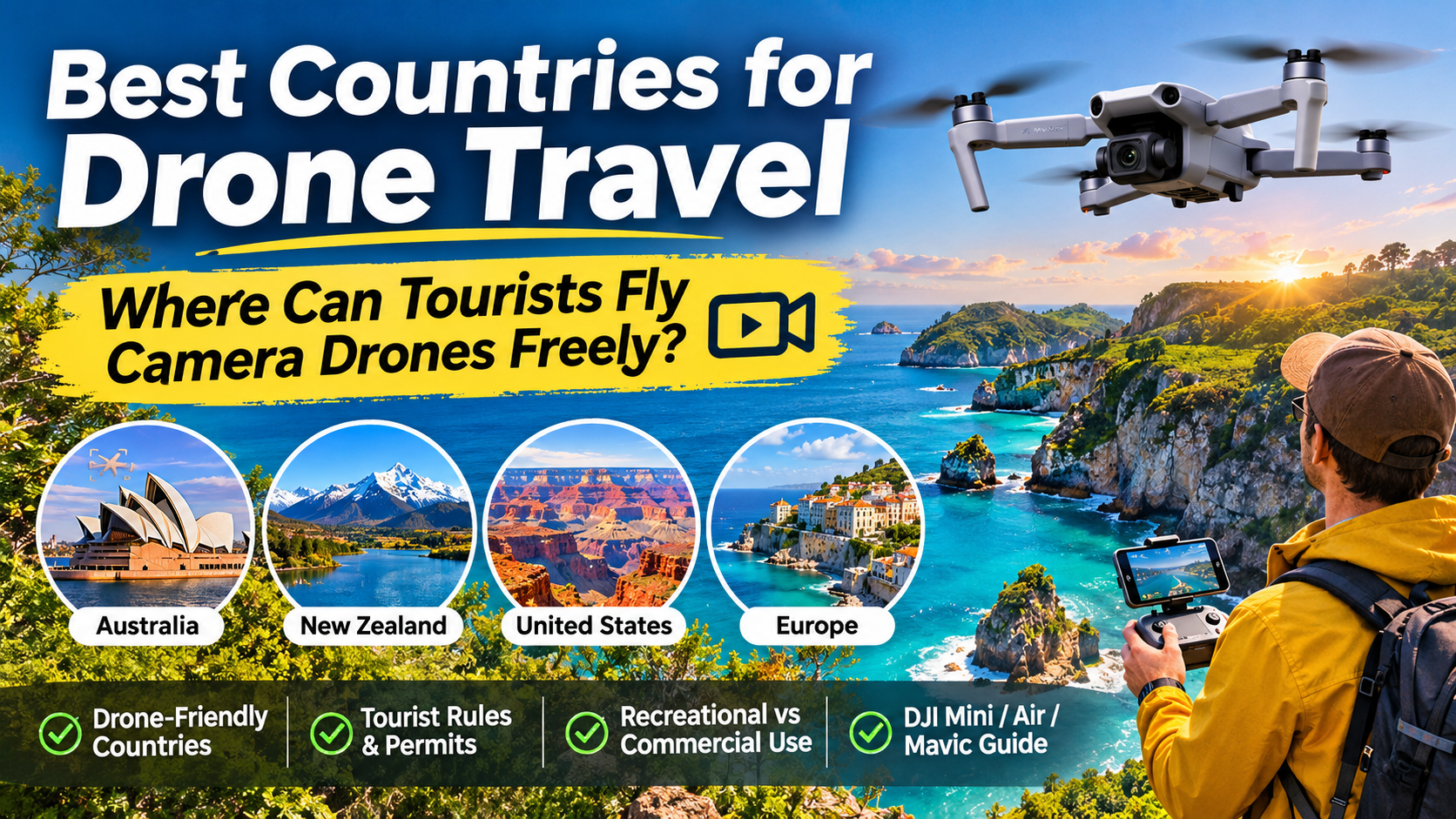
Best Countries for Drone Travel: Where Can Tourists Fly Camera Drones Freely?
Discover countries with relatively liberal drone regulations for tourists,
travel vloggers, photographers and freelance videographers. Explore
drone laws, registration requirements, tourist permissions and the
best destinations for aerial photography.
Introduction: Finding Countries Where You Can Fly a Drone More Freely
Camera drones have transformed travel photography and videography.
Travellers can now capture beautiful coastlines, mountains, deserts,
forests, islands and city skylines from unique perspectives.
For travel vloggers, photographers, YouTube creators and freelance
videographers, a drone is an important creative tool.
However, drone regulations differ significantly from one country
to another. Some countries have relatively straightforward
recreational drone rules, while others require registration,
pilot examinations, insurance, import permits or government approval.
This guide explores destinations where responsible recreational
drone flying is comparatively accessible.
1. Australia – A Great Destination for Recreational Drone Flyers
Australia is an attractive destination for people who enjoy travelling
with camera drones. Its Civil Aviation Safety Authority (CASA) provides
a relatively straightforward framework for recreational flying.
Recreational drone regulations
- Recreational pilots generally do not need a drone pilot licence.
- Recreational drones generally do not require registration.
- The standard maximum flying height is 120 metres.
- Airspace restrictions and safety requirements must be followed.
- Maintain a safe distance from people and other aircraft.
Why Australia is attractive for drone photography
- Beautiful coastal areas and beaches.
- Desert landscapes and remote locations.
- Mountains, islands and rural scenery.
- Excellent opportunities for travel documentaries.
National parks and popular tourist attractions can have additional
restrictions. Commercial operations also have different requirements.
Verdict: A strong option for recreational drone
enthusiasts who enjoy outdoor photography.
Official source:
Australian Civil Aviation Safety Authority
2. New Zealand – Mountains, Lakes and Natural Landscapes
New Zealand is famous for its mountains, lakes, coastlines and
spectacular countryside. It is an attractive destination for
travel filmmakers and aerial photographers.
Drone regulations
- Recreational operations are generally covered by Part 101.
- Do not fly higher than 120 metres.
- Maintain visual line of sight.
- Obtain required consent before flying over people.
- Obtain permission from landowners or responsible authorities
where required. - Follow airport and controlled airspace restrictions.
- Obtain permission for drone operations on conservation land.
Why choose New Zealand?
- Mountain ranges and valleys.
- Beautiful lakes and rivers.
- Coastal scenery and countryside.
- Remote natural environments.
Verdict: An excellent destination for nature
photography, outdoor adventures and travel documentaries.
Official source:
New Zealand Civil Aviation Authority
3. United States – A Large Market for Drone Creators
The United States offers enormous opportunities for drone photography
and video production. It has deserts, beaches, forests, mountains,
agricultural areas and spectacular natural landscapes.
Recreational drone regulations
- Complete the FAA TRUST safety test.
- Register recreational drones weighing 250 grams or more.
- Follow visual-line-of-sight requirements.
- Obtain airspace authorisation where required.
- Respect applicable altitude and safety restrictions.
Can tourists fly drones?
International visitors can participate in recreational flying
subject to applicable FAA requirements. Commercial operations
generally require compliance with Part 107 or other applicable
FAA requirements.
Important restriction
Many US national parks prohibit launching, landing and operating
drones without specific authorisation. Always check local rules.
Verdict: Excellent for creators who understand
the rules and plan their filming locations carefully.
Official source:
Federal Aviation Administration
4. Costa Rica – An Attractive Destination for Nature Filming
Costa Rica is famous for tropical forests, wildlife, beaches and
biodiversity. For travel filmmakers, it offers beautiful subjects
for aerial photography.
Important considerations
- Check the current requirements of the civil aviation authority.
- Check applicable registration and operating requirements.
- Respect airport and restricted airspace.
- Obtain permission where required.
- Check national park and protected-area restrictions.
- Avoid disturbing wildlife.
Why visit?
- Tropical coastline videos.
- Mountain and forest landscapes.
- Rural tourism photography.
- Nature documentaries.
Verdict: A promising destination for nature
and travel creators, subject to local permissions.
Official source:
Costa Rica Civil Aviation Authority
5. Ecuador – Mountains, Coastlines and Unique Landscapes
Ecuador offers Andes mountain landscapes, coastal scenery,
rural villages, volcanoes and beautiful natural environments.
It is an interesting destination for landscape filmmakers.
Before flying
- Check drone registration requirements.
- Check operational authorisation requirements.
- Confirm maximum flying altitude.
- Check restricted airspace.
- Confirm rules for foreign visitors.
- Check commercial filming permissions.
The Galápagos Islands deserve particular attention because of
their environmental protection requirements and restrictions.
Verdict: Interesting for landscape filmmakers,
but check location-specific rules before planning a shoot.
Official source:
Ecuador Civil Aviation Authority
6. Uruguay – A Destination Worth Exploring
Uruguay is an interesting destination for people who enjoy
coastal travel photography. Its beaches, countryside and
small coastal towns offer opportunities for travel content.
Before flying, check:
- Drone registration requirements.
- Pilot requirements.
- Airspace restrictions.
- Privacy regulations.
- Commercial filming requirements.
Consult Uruguay’s civil aviation authority, DINACIA,
before travelling with a drone.
Verdict: Worth considering, but do not assume
recreational drone use is permission-free.
7. Europe – A Shared Drone Regulatory Framework
Many European countries follow the European Union’s common
drone regulatory framework. This provides a shared regulatory
system across participating countries.
Popular European destinations
- Portugal
- Spain
- France
- Germany
- Italy
- Greece
- Austria
- Croatia
- Netherlands
- Sweden
- Finland
- Denmark
- Ireland
Is it easy for tourists to fly drones in Europe?
Non-EU residents visiting an EASA member country generally need
to register as drone operators in the first country where they
intend to operate, when registration is required.
This registration is recognised across the EASA system.
- Camera-equipped drones under 250 grams are not automatically
exempt from operator registration. - Low-risk operations can generally use the open category
when all applicable requirements are met. - Higher-risk operations may require additional authorisation.
- Local geographical restrictions must always be checked.
Why Europe is attractive
- Historic villages and architecture.
- Mountain scenery.
- Coastal landscapes.
- Beautiful islands.
- Countryside and rural tourism.
Verdict: Attractive for travel filmmaking,
but not necessarily the easiest region for registration-free flying.
Official source:
European Union Aviation Safety Agency
8. Mauritius – A Beautiful Destination with Drone Restrictions
Mauritius is famous for its beaches, lagoons and tropical
landscapes. It is an attractive destination for aerial travel videos.
However, its Civil Aviation (Unmanned Aircraft System)
Regulations 2024 introduced registration requirements for
camera-equipped drones and other data-capturing devices.
Check the latest guidance on registration, recreational operations,
airport restrictions and public-access areas before travelling.
Verdict: Beautiful for travel photography,
but do not treat it as a permission-free drone destination.
Official source:
Mauritius Department of Civil Aviation
Countries Where You Should Be Particularly Careful
Some countries impose significant restrictions on importing,
registering or operating camera drones.
- India: Follow the Digital Sky framework,
applicable drone categories and airspace restrictions. - UAE: Operations are subject to registration,
permissions and applicable national and local restrictions. - Egypt: Drone importation and operation are
heavily controlled. Obtain official clearance. - Morocco: Importation and operation can involve
significant restrictions and permissions. - Tanzania: Foreign visitors should arrange
relevant registration and operational permissions in advance. - Iran: Drone use can create serious legal
and security risks. Do not assume tourist flights are permitted.
Always distinguish between permission to import a drone
and permission to fly it.
Recreational Drone Flying vs Commercial Drone Filming
This is one of the most important points for anyone planning
to work with drones internationally.
Recreational drone flying
This generally means flying for personal enjoyment, photography
or hobby purposes, subject to each country’s definition.
- Recording your holiday.
- Capturing personal travel videos.
- Photographing landscapes.
- Making personal videos.
Commercial drone filming
Commercial activities may include:
- Producing videos for paying clients.
- Shooting tourism advertisements.
- Real estate aerial photography.
- Producing commercial video content.
- Selling aerial footage.
- Working for travel agencies and hotels.
A recreational flying exemption does not automatically permit
commercial operations. Check local aviation, business, work
permit and filming requirements.
Different Types of Camera Drones for International Travel
Camera drones are available in different sizes and weight categories.
The weight and technical capabilities of a drone can affect the
regulations that apply to it.
Small and lightweight camera drones
- Easy to carry during international travel.
- Convenient for personal travel photography.
- Suitable for many landscape and tourism videos.
- May benefit from simplified regulatory categories in some countries.
Medium-sized camera drones
- Suitable for advanced travel videography.
- Often offer additional camera capabilities.
- May require additional registration or qualifications.
- Useful for more demanding filming projects.
Professional camera drones
- Designed for professional aerial photography.
- Can be used for tourism and commercial video production.
- May require additional operational permissions.
- Insurance and pilot qualifications may be required.
Remember that a lightweight drone is not automatically exempt
from every country’s registration, privacy or airspace requirements.
Essential Checklist Before Taking a Drone Abroad
- Is importing a drone legally permitted?
- Is a tourist allowed to operate it?
- Does the drone need registration?
- Does the operator need registration?
- Is a pilot certificate or examination required?
- Are there restrictions on commercial filming?
- Are there local restrictions on beaches, parks and attractions?
- Is insurance required?
- Can you legally carry the batteries on your flight?
- Do you need to obtain permission before arriving?
Also check airline battery policies. Drone batteries generally
need to be carried in cabin baggage, subject to the airline’s
lithium-battery limits.
Final Conclusion: Finding the Right Country for Drone Travel
Drone-friendly travel is not simply about finding a country
where drones are legal. It is about finding a destination
where importation is permitted, tourist operation is accessible,
registration requirements are manageable and scenic filming
opportunities are available.
Australia and New Zealand are particularly attractive starting
points for recreational drone enthusiasts. The United States
offers enormous filming opportunities, while Europe provides
a wide range of landscapes under a shared regulatory framework.
For professional drone videographers, the situation is different.
A country that allows recreational flying may still require
additional approval for paid work.
The best destination is one where you can legally bring your
camera drone, obtain the necessary permissions and enjoy
filming beautiful places responsibly.
Always check the latest official aviation rules before booking
your flight or carrying your drone across an international border.