Ibex: The Master of the Mountains
WILDLIFE • MOUNTAIN ANIMALS • NATURE
Ibex: The Master of the Mountains
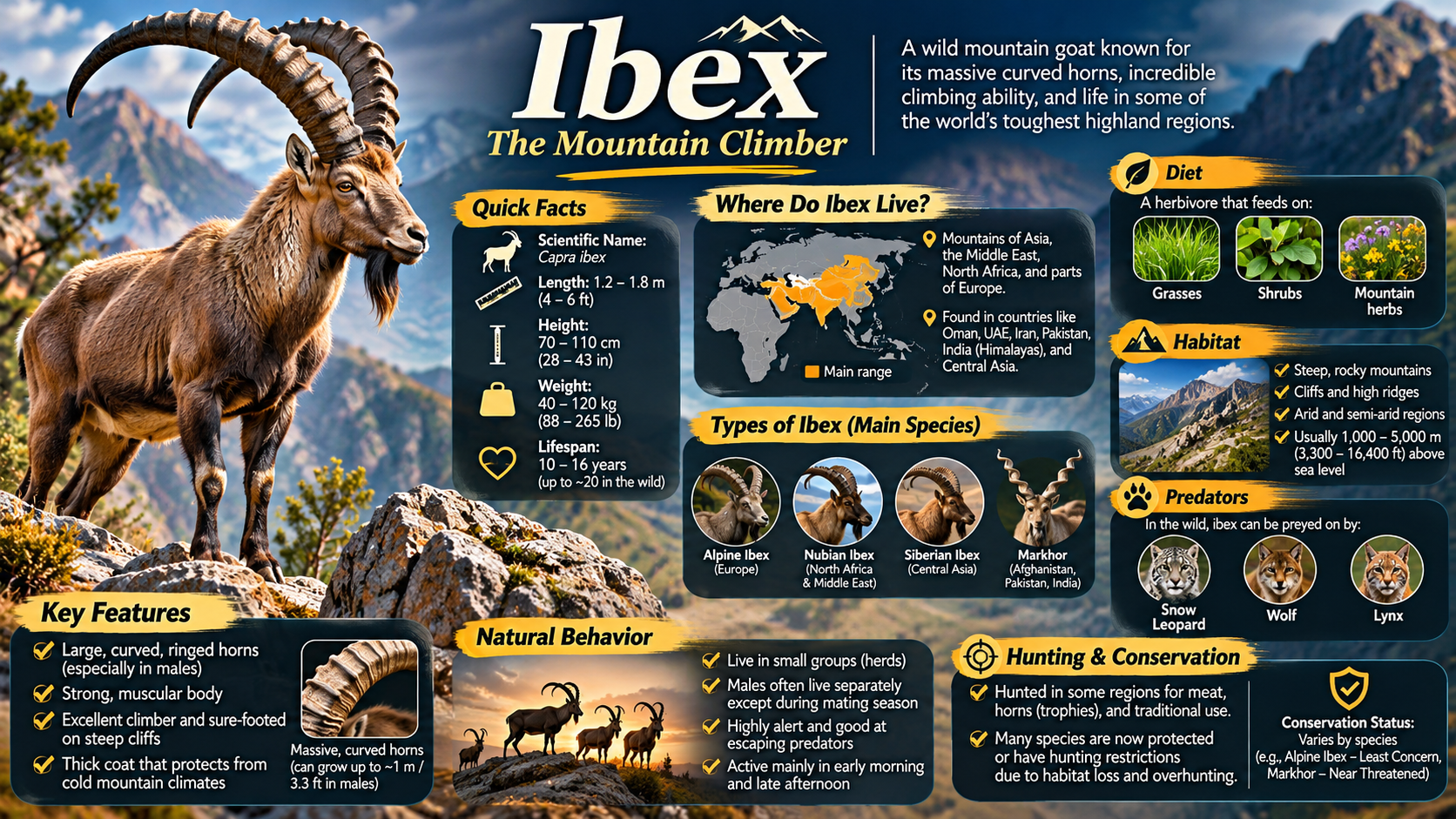
Explore the incredible world of ibex, from the snowy Himalayas to the rocky mountains of Arabia. Discover their habitats, species, predators, hunters, survival skills and conservation.
The ibex is one of the most fascinating wild animals on Earth. Famous for its enormous curved horns, powerful body and extraordinary climbing abilities, this wild mountain goat has adapted to some of the harshest environments on the planet.
From the European Alps to the Himalayan mountains and the deserts of the Middle East, ibex demonstrate remarkable strength, balance and adaptability.
1. What is an Ibex?
An ibex is a wild mountain goat belonging to the genus Capra. It belongs to the Bovidae family, which also includes cattle, sheep and other goats.
Its most recognisable feature is the long, curved horns of adult males. Female ibex also have horns, but they are generally smaller.
| Classification | Details |
|---|---|
| Kingdom | Animalia |
| Class | Mammalia |
| Order | Artiodactyla |
| Family | Bovidae |
| Genus | Capra |
| Diet | Herbivore |
| Habitat | Mountains and rocky cliffs |
2. Where are Ibex Found?
Ibex are found across parts of Europe, Asia and northeastern Africa. Their habitats include high mountain ranges, rocky valleys, alpine grasslands and desert mountains.
Europe
- Switzerland
- Italy
- France
- Austria
- Germany
- Spain
Asia
- India
- Pakistan
- Afghanistan
- Mongolia
- Kazakhstan
- Kyrgyzstan
- Tajikistan
- China
Middle East
- Oman
- Saudi Arabia
- Jordan
- Israel
- Yemen
Africa
The Nubian ibex is found in mountainous regions of northeastern Africa, including Egypt, Sudan and neighbouring areas.
3. Major Species of Ibex
Alpine Ibex
Capra ibex
Native to the European Alps. Famous for its enormous curved horns and extraordinary climbing ability.
Siberian Ibex
Capra sibirica
Found across Central Asia, including Mongolia, India, Pakistan and neighbouring countries. Also known as the Asiatic ibex.
Nubian Ibex
Capra nubiana
Lives in rocky desert mountains of the Middle East and northeastern Africa. Adapted to dry, hot environments.
Iberian Ibex
Capra pyrenaica
Native to Spain and Portugal. Recognised by its distinctive horns and mountainous habitat.
Walia Ibex
Capra walie
An endangered mountain goat found in Ethiopia’s Simien Mountains.
4. Himalayan Ibex – India’s Mountain Giant
The Himalayan ibex is a remarkable wild goat found in the northwestern Himalayan region.
It occurs in Ladakh, Jammu and Kashmir and Himachal Pradesh, as well as neighbouring parts of Central Asia.
These animals live in high-altitude valleys, rocky slopes and alpine grasslands. Their thick coats provide insulation against freezing temperatures.
They are also an important prey species for snow leopards in the Himalayan ecosystem.
5. Physical Characteristics
Ibex have muscular bodies, powerful legs and specialised hooves that help them survive on steep mountain terrain.
| Feature | General Description |
|---|---|
| Body length | 100–170 cm |
| Shoulder height | 65–110 cm |
| Weight | 30–120 kg, depending on species |
| Coat | Brown, grey or sandy |
| Horns | Long, curved and ridged |
| Diet | Grasses, herbs and shrubs |
These are approximate ranges across different species and sexes.
6. How Do Ibex Climb Almost Vertical Cliffs?
One of the most extraordinary abilities of ibex is their capacity to navigate steep rock faces and narrow ledges.
Specialised hooves
Their hooves have a hard outer edge and a softer, flexible inner pad that helps them grip uneven rock surfaces.
Powerful legs
Strong leg muscles allow them to jump between ledges and maintain balance.
Protection from predators
Steep cliffs offer escape routes that are difficult for many predators to follow.
Ibex have been photographed climbing steep artificial dams to reach mineral-rich deposits.
7. What Do Ibex Eat?
Ibex are herbivores. They feed on vegetation available in their mountain habitats.
- Mountain grasses
- Wild herbs
- Leaves
- Shrubs
- Alpine plants
- Mineral-rich vegetation
Their diet changes with the seasons. During winter, they may move to lower slopes where vegetation is more accessible.
8. Social Behaviour and Breeding
Ibex are social animals and often form separate male and female groups outside the breeding season.
During the breeding season, known as the rut, males compete for access to females using displays, intimidation and horn clashes.
After approximately five to six months of pregnancy, females usually give birth to one kid, although twins can occur.
9. Natural Predators of Ibex
Despite their excellent climbing skills, ibex are hunted by several natural predators.
- Snow leopards: Important predators of Himalayan and Central Asian ibex.
- Wolves: May hunt young, weak or isolated animals.
- Leopards: Predators of Nubian ibex in some Middle Eastern habitats.
- Lynx: May prey on young ibex in some regions.
- Golden eagles: Can occasionally take very young kids.
10. Human Hunters – Why Do People Hunt Ibex?
Humans have hunted ibex for thousands of years. Historically, hunting provided meat and useful animal materials to mountain communities.
Hunting for meat
Some communities have traditionally hunted wild goats for food. Modern hunting restrictions vary by country and region.
Trophy hunting
Trophy hunting involves hunting animals primarily for their horns or other trophies. Some international hunters travel to Central Asia to hunt large male ibex under regulated programmes.
Illegal hunting and poaching
Illegal hunting can threaten vulnerable populations. Animals may be killed for meat, horns and commercial wildlife trade.
Who hunts ibex?
- Traditional local hunters.
- Licensed recreational hunters.
- International trophy hunters.
- Illegal poachers.
Regulated hunting programmes are sometimes presented as a way to fund conservation and local livelihoods. However, their effectiveness depends on transparent monitoring, sustainable quotas and strict enforcement.
11. Countries Where Ibex Hunting Occurs
| Region | Species | General situation |
|---|---|---|
| Switzerland | Alpine ibex | Strictly regulated management |
| Spain | Iberian ibex | Regulated hunting in authorised areas |
| Tajikistan | Siberian ibex | Regulated trophy-hunting programmes in some areas |
| Kyrgyzstan | Siberian ibex | Permit-based regulations |
| Pakistan | Asiatic ibex | Regional wildlife regulations |
| Oman | Nubian ibex | Protected populations and restrictions |
Hunting laws and permits change. Always check the relevant national wildlife authority and protected-area rules.
12. Threats and Conservation
Ibex face several challenges despite their ability to survive in difficult environments.
- Illegal hunting and poaching.
- Habitat destruction and fragmentation.
- Competition with domestic livestock.
- Climate change.
- Livestock-related diseases.
- Human disturbance and uncontrolled tourism.
Conservation Status
| Species | General IUCN Status |
|---|---|
| Alpine ibex | Least Concern |
| Siberian ibex | Near Threatened |
| Nubian ibex | Vulnerable |
| Iberian ibex | Least Concern |
| Walia ibex | Endangered |
Conservation categories are assessment-date dependent and should be checked against current IUCN records before publication.
13. Amazing Facts About Ibex
- Ibex are extraordinary mountain climbers.
- Male horns can grow throughout their lives.
- Females also have horns.
- They can jump between narrow rocky ledges.
- Some species survive in extremely hot desert mountains.
- They are herbivores.
- They often live in separate male and female groups.
- Snow leopards hunt Himalayan ibex.
- Alpine ibex populations recovered after severe historical declines.
- Some ibex climb artificial structures to access mineral deposits.
14. Ibex vs Markhor – What Is the Difference?
Ibex and markhor are closely related wild goats belonging to the genus Capra, but they are different species.
Ibex
Ibex generally have backward-curving horns and are found across several mountain ranges in Europe, Asia and Africa.
Markhor
The markhor is famous for its distinctive twisted, spiral-shaped horns. It is native to mountainous regions of South and Central Asia.
Scientific name: Capra falconeri.
15. Why Are Ibex Important to Nature?
- They influence mountain vegetation through grazing.
- They provide food for mountain predators.
- They support healthy mountain food webs.
- They contribute to biodiversity.
- They support wildlife tourism and conservation economies.
Conclusion: The True Masters of the Mountains
The ibex is more than a wild goat with impressive horns. It is an extraordinary example of how wildlife adapts to extreme environments.
Whether climbing the European Alps, surviving in the Himalayas or navigating the dry cliffs of Arabia, ibex demonstrate incredible strength, balance and adaptability.
Yet their survival ultimately depends on humans. Responsible wildlife management, habitat protection and the prevention of illegal hunting are essential to ensure that future generations can continue to see these magnificent animals in the wild.
Protecting the ibex means protecting the mountains and the wildlife that depend on them.