Blue Whales: The Ocean’s Gentle Giants — Complete Facts, Food Habits & More
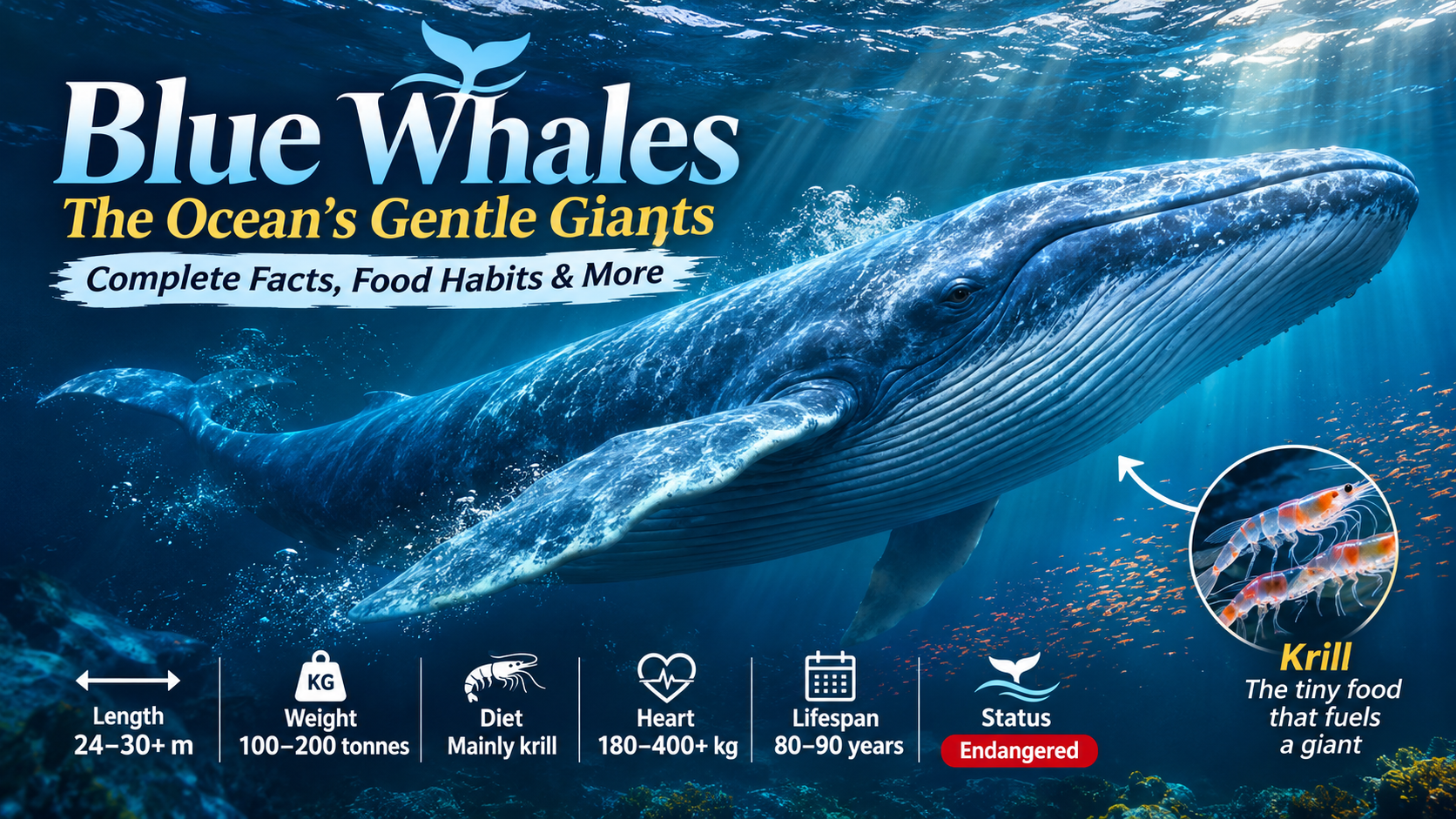
Blue Whales: The Ocean’s Gentle Giants — Complete Facts, Food Habits & More
The blue whale (Balaenoptera musculus) is the largest animal known to have ever lived on Earth. Bigger than any known dinosaur, this magnificent marine mammal can grow longer than a basketball court and weigh as much as approximately 30 elephants. Surprisingly, its main food is made up of tiny shrimp-like creatures called krill.
1. Physical Characteristics and Record-Breaking Size
Blue whales have long, streamlined bodies with mottled bluish-grey skin and lighter undersides. Their heads are broad and U-shaped, while their small dorsal fins are positioned far back on their bodies.
One of their most distinctive features is the series of expandable throat grooves, known as ventral pleats. These grooves allow the mouth and throat region to expand dramatically when the whale engulfs water and prey.
- Length: Adult blue whales commonly measure around 24–27 metres.
- Weight: Many adults weigh approximately 100–150 tonnes, with exceptional individuals estimated at considerably more.
- Heart: Their enormous heart can weigh hundreds of kilograms.
- Tongue: Their tongue can weigh as much as an elephant.
- Arteries: Some major blood vessels are exceptionally wide.
- Females: Females are generally larger than males.
Blue whales are the largest animals known to have existed, exceeding even the largest known dinosaurs in body mass.
2. Habitat, Distribution and Migration
Blue whales inhabit oceans around the world. They are found in the Atlantic, Pacific, Indian and Southern Oceans, generally spending much of their time in deep offshore waters.
Many populations follow seasonal migration patterns:
- Summer: They travel towards colder, high-latitude waters where krill is abundant.
- Winter: Many move towards warmer, lower-latitude waters associated with breeding and calving.
However, migration patterns differ between populations. Some individuals remain in particular regions for extended periods.
Blue whales are usually solitary or travel in pairs. Mothers and calves often remain together, while temporary feeding aggregations can form where food is plentiful.
3. Food Habits and Feeding Behaviour
Despite being the largest animal on Earth, the blue whale feeds mainly on tiny marine organisms called krill. These small, shrimp-like crustaceans are found in enormous swarms throughout many ocean ecosystems.
Their diet consists almost entirely of krill, although occasional small crustaceans and other prey may also be consumed.
How Do Blue Whales Eat?
Blue whales are baleen whales belonging to a group called rorquals. They use a specialised feeding technique known as lunge feeding.
- The whale locates a dense swarm of krill.
- It accelerates towards the swarm with its mouth open.
- Its expandable throat pleats stretch as it engulfs a huge quantity of water and krill.
- The whale closes its mouth and pushes the water out through its baleen plates.
- The baleen traps the krill, allowing the whale to swallow its food.
What Is Baleen?
Baleen consists of flexible plates made of keratin, the same structural protein found in human hair and fingernails. These plates hang from the upper jaw and act like a natural filtering system.
How Much Food Can a Blue Whale Eat?
Blue whales consume enormous quantities of krill during their feeding season. A large adult may eat several tonnes daily, and intensive feeding estimates for some individuals have reached approximately 16 tonnes in a day.
They build up energy reserves in the form of blubber during productive feeding seasons. These reserves help sustain them during migration and periods when feeding is limited.
Why Are Blue Whales Important to Ocean Ecosystems?
Blue whales contribute to ocean nutrient cycling. Their movements and feeding activities help redistribute nutrients, while their nutrient-rich waste can support microscopic marine organisms such as phytoplankton.
4. Anatomy and Special Adaptations
Blue whales have several remarkable physical adaptations that allow them to survive in the ocean.
- Baleen plates: Help filter krill from seawater.
- Expandable throat pleats: Allow the mouth and throat to accommodate enormous volumes of water.
- Blubber: Provides insulation and stores energy.
- Diving ability: Enables them to reach feeding grounds at considerable depths.
- Powerful tail: Provides the propulsion required to move their enormous bodies.
Typical feeding dives may last around 10–15 minutes, although dive duration and depth vary depending on feeding conditions and individual behaviour.
5. Behaviour, Communication and Senses
Blue whales produce some of the loudest and lowest-frequency sounds in the animal kingdom. Their calls often fall below the range of human hearing.
These powerful sounds can travel long distances underwater, potentially helping whales communicate across vast ocean environments.
Scientists believe their vocalisations play important roles in communication and reproduction. However, the precise meaning of many calls is still being studied.
Ocean noise from commercial shipping and other human activities can interfere with underwater communication.
6. Life Cycle and Reproduction
Blue whales reproduce slowly. Females generally give birth to a single calf after a long pregnancy.
- Sexual maturity: Commonly reached between approximately 5 and 15 years.
- Gestation: Around 10–12 months.
- Birth: Calves are approximately 6–7 metres long.
- Birth weight: Around 2–3 tonnes.
- Nursing: Mothers provide extremely rich milk that supports rapid growth.
- Weaning: Generally occurs after several months.
- Calving interval: Often approximately 2–3 years.
- Lifespan: Commonly estimated at 80–90 years or more.
Newborn calves grow rapidly, gaining substantial weight every day through their mother’s nutrient-rich milk.
Mother whales provide care and protection to their calves during the early stages of life.
7. Population History and Conservation Status
Before commercial whaling, blue whales were much more numerous than they are today. During the twentieth century, industrial-scale whaling caused catastrophic population declines.
Modern whaling technology made it possible to hunt these enormous animals on a large scale. International protection measures were introduced, including protection under the International Whaling Commission framework in 1966.
Are Blue Whales Endangered?
Yes. The blue whale is classified as Endangered on the IUCN Red List.
Although some populations are showing signs of recovery, blue whales still face several serious threats.
Major Threats
- Ship strikes: Collisions with large vessels can cause serious injuries or death.
- Ocean noise: Underwater noise can interfere with communication.
- Fishing gear: Entanglement can restrict movement and cause injuries.
- Pollution: Marine contaminants can affect ocean ecosystems.
- Climate change: Changes in ocean conditions can affect krill distribution and availability.
8. Fascinating Blue Whale Facts
- Blue whales are the largest animals known to have ever lived on Earth.
- Their hearts can weigh hundreds of kilograms.
- Their tongues can weigh as much as an elephant.
- They feed mainly on tiny krill.
- They communicate using powerful, low-frequency underwater sounds.
- Their scientific name is Balaenoptera musculus.
- The word musculus has a Latin meaning associated with a little mouse, an amusing contrast to their enormous size.
- They belong to the baleen whale group rather than the toothed whale group.
- Female blue whales are generally larger than males.
Conclusion: Protecting the Ocean’s Gentle Giants
Blue whales demonstrate the extraordinary diversity and scale of life in our oceans. Their enormous bodies, specialised feeding systems and remarkable migration journeys make them one of nature’s most fascinating animals.
Despite their immense size, they depend on tiny krill for survival. Their lives are closely connected to the health of ocean ecosystems.
After suffering devastating population declines due to commercial whaling, blue whales now benefit from international protection. However, ship collisions, pollution, underwater noise and climate change remain serious concerns.
Protecting blue whales means protecting the wider marine environment. Their survival is an important reminder of our responsibility to preserve the natural world for future generations.