The Giant of India’s Grasslands
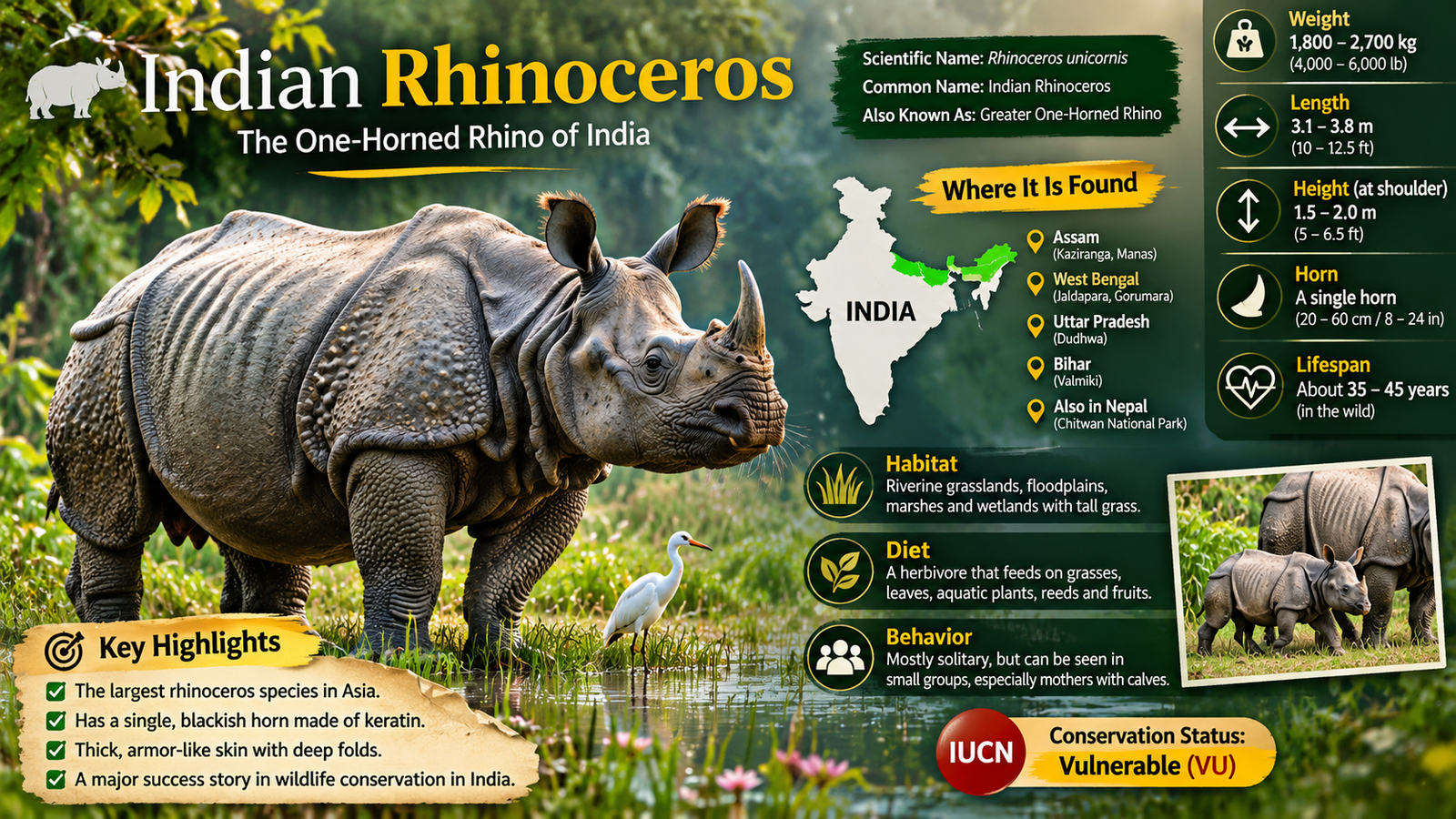
Indian Rhinoceros
The Magnificent Greater One-Horned Rhino
Rhinoceros unicornis
Introduction: The Giant of India’s Grasslands
The Indian rhinoceros, scientifically known as Rhinoceros unicornis, is one of the most remarkable wild animals of the Indian subcontinent. Also called the Greater One-Horned Rhinoceros, it is recognised by its enormous body, thick armour-like skin, and a single horn on its nose.
It is the largest of the three Asian rhinoceros species. Despite its massive appearance, this animal is primarily a peaceful herbivore that spends much of its time grazing, bathing, and moving through riverine grasslands.
Once widespread across the northern Indian subcontinent, the species suffered a dramatic population decline because of hunting, poaching, and habitat destruction. Strong conservation programmes in India and Nepal have helped it recover significantly.
Scientific Classification
| Classification | Details |
|---|---|
| Kingdom | Animalia |
| Phylum | Chordata |
| Class | Mammalia |
| Order | Perissodactyla |
| Family | Rhinocerotidae |
| Genus | Rhinoceros |
| Species | Rhinoceros unicornis |
| Common names | Indian Rhino, Greater One-Horned Rhino |
Where Are Indian Rhinoceroses Found?
Today, wild Indian rhinoceroses are found mainly in northeastern India, parts of northern India, and southern Nepal. They depend heavily on protected grasslands, floodplains, wetlands, and river systems.
Major Rhino Habitats in India
- Kaziranga National Park, Assam: The most important stronghold of the species and home to the world’s largest population of greater one-horned rhinos.
- Manas National Park, Assam: An important conservation landscape with grasslands, forests, and river habitats.
- Orang National Park, Assam: A protected floodplain landscape along the Brahmaputra system.
- Pobitora Wildlife Sanctuary, Assam: Famous for its high density of one-horned rhinoceroses.
- Jaldapara National Park, West Bengal: An important habitat in the eastern Himalayan foothills.
- Gorumara National Park, West Bengal: A protected forest and grassland habitat supporting rhinos.
- Dudhwa National Park, Uttar Pradesh: An important conservation area in the Terai region.
Outside India
Indian rhinoceroses are also found in Nepal, particularly in Chitwan National Park and other protected areas. Conservation and translocation programmes have helped establish and strengthen populations in suitable habitats.
Kaziranga National Park is particularly important because it protects the largest concentration of greater one-horned rhinoceroses.
Natural Habitat and Environment
Indian rhinoceroses prefer environments where water, food, and suitable vegetation are available throughout the year. Their natural habitats are mainly associated with the floodplains of major rivers.
Important Habitat Types
- Alluvial floodplain grasslands.
- Riverbanks and wetland ecosystems.
- Marshes and swampy areas.
- Tall elephant grass landscapes.
- Riverine forests and woodland edges.
- Shallow ponds and water bodies.
Seasonal flooding plays an important role in maintaining these ecosystems. Floods can replenish nutrients, create new grassland areas, and change the distribution of vegetation.
During the monsoon, rhinos may move towards higher ground when floodwaters rise. During dry periods, water availability and fresh vegetation become especially important.
Physical Characteristics
The Indian rhinoceros has a powerful body and a distinctive appearance. Its thick grey-brown skin forms deep folds that resemble the plates of protective armour.
| Feature | Approximate measurement |
|---|---|
| Body length | 3.1–3.8 metres |
| Shoulder height | 1.5–2 metres |
| Body weight | 1,800–2,700 kg |
| Horn length | 20–60 cm |
| Skin colour | Grey-brown |
| Body covering | Thick folded skin |
Why Does It Have Only One Horn?
Unlike African rhinoceroses, which generally have two horns, the Indian rhinoceros has a single nasal horn.
The horn is made of keratin, the same structural protein found in human hair and fingernails. It is not made of bone.
Rhinos use their horns in social interactions, defence, and sometimes while moving vegetation. The horn is also one of the main reasons the species has been targeted by illegal wildlife traders.
Armour-Like Skin
The deep folds around the neck, shoulders, and legs give the rhino its famous armoured appearance. Small raised bumps across its skin add to its distinctive texture.
Food Habits: What Does an Indian Rhino Eat?
The Indian rhinoceros is a herbivore. It mainly feeds on grasses, although its diet also includes several other types of vegetation.
Common Food Sources
- Tall grasses and fresh shoots.
- Aquatic plants.
- Leaves and young branches.
- Reeds and wetland vegetation.
- Fallen fruits.
- Other available herbs and shrubs.
It uses its flexible upper lip to grasp and pull vegetation. This specialised lip helps it collect grass and other food efficiently.
Rhinos often graze in open grasslands and may spend considerable time feeding near water bodies.
Why Are Rhinos Important to Nature?
As large herbivores, rhinos influence vegetation structure through grazing and browsing. Their movement, feeding, and dung also contribute to nutrient cycling and the wider grassland ecosystem.
Behaviour and Daily Activities
Indian rhinoceroses are generally solitary animals. Adult individuals usually move independently, although females are often seen with their calves. Several rhinos may also use the same grassland or water source.
Wallowing in Mud
One of their most recognisable activities is wallowing in mud. Rhinos regularly enter muddy pools and shallow water to cool their bodies, protect their skin, and reduce irritation caused by biting insects.
Communication
Although they may appear quiet, rhinos communicate through several sounds, including snorts, squeaks, whistles, and grunts. They also use scent marking and dung deposits to communicate information about their presence.
Territorial Behaviour
Adult males may establish territories and compete with other males, particularly during breeding periods. Conflicts can involve chasing, charging, and horn-related fighting.
Are They Dangerous?
Rhinos are powerful wild animals and should never be approached. They may charge when threatened, surprised, or protecting their young. Even an animal that appears calm can be dangerous at close range.
Predators and Natural Enemies
Because of their enormous size, adult Indian rhinoceroses have very few natural predators. Their thick skin, powerful body, and horn make them difficult animals to attack.
The Tiger
The Bengal tiger shares parts of the Indian rhinoceros’ habitat, particularly in the Terai and northeastern Indian landscapes. Tigers may occasionally prey on young or vulnerable rhino calves, but healthy adult rhinos are generally too large and powerful to be easy prey.
Crocodiles
Large crocodiles may pose a risk to very young animals near water, although this is not considered a major source of mortality for the species.
Humans: The Biggest Threat
Historically, hunting and poaching caused a dramatic decline in rhino numbers. Today, illegal hunting, habitat fragmentation, human-wildlife conflict, and environmental changes remain serious conservation concerns.
Reproduction and Baby Rhinos
Indian rhinoceroses reproduce throughout the year rather than following one strict breeding season.
Pregnancy
The gestation period is approximately 15–16 months. A female generally gives birth to one calf at a time.
Mother and Calf
Newborn rhinos are already relatively large and can stand and walk shortly after birth. The mother provides milk, protection, and guidance as the calf grows.
The young animal remains closely associated with its mother for an extended period, learning where to find food, water, and safe resting areas.
Growth and Maturity
- Usually one calf per birth.
- Pregnancy lasts around 15–16 months.
- Calves depend on their mothers for milk and protection.
- Females generally reach reproductive maturity earlier than males.
- Births are commonly separated by several years.
Threats Facing Indian Rhinoceroses
1. Illegal Poaching
Rhino horns are illegally traded because of demand in certain markets. Despite scientific evidence that the horn is made of keratin, illegal beliefs and commercial demand continue to threaten rhinos.
2. Habitat Loss
Expansion of agriculture, settlements, roads, and other human activities reduces and fragments natural habitats.
3. Floods and Climate Pressure
Severe flooding can force rhinos out of protected areas and into nearby settlements or roads. Changing rainfall patterns may also affect food and water availability.
4. Invasive Plant Species
Invasive vegetation can replace nutritious grassland plants, making some habitats less suitable for grazing animals.
5. Human-Wildlife Conflict
When rhinos move outside protected areas in search of food or safe ground, encounters with people can occur. Better habitat connectivity and community participation are important solutions.
Conservation: How India Protects the Rhino
The recovery of the greater one-horned rhinoceros is an important wildlife conservation achievement. Strong protection, habitat management, scientific monitoring, and cooperation between India and Nepal have helped the population recover.
Major Conservation Measures
- Protection of national parks and wildlife sanctuaries.
- Anti-poaching patrols and wildlife crime investigations.
- Grassland and wetland habitat restoration.
- Monitoring rhino populations and individual animals.
- Translocation programmes to establish populations in suitable habitats.
- Wildlife corridors and improved habitat connectivity.
- Community participation and conservation education.
Indian Rhino and Other Rhino Species
There are five living rhinoceros species in the world. The Indian rhinoceros belongs to the Asian group.
| Species | Natural range | Horns |
|---|---|---|
| Greater One-Horned Rhino | India and Nepal | One |
| Javan Rhino | Indonesia | One |
| Sumatran Rhino | Indonesia | Two |
| White Rhino | Africa | Two |
| Black Rhino | Africa | Two |
The Indian rhinoceros is particularly recognisable because of its single horn and deeply folded skin.
Interesting Facts About Indian Rhinoceroses
- It is the largest rhinoceros species in Asia.
- Its scientific name is Rhinoceros unicornis.
- It has only one horn.
- Its horn is made of keratin, not bone.
- It is an excellent swimmer.
- It regularly wallows in mud and water.
- It has relatively poor eyesight but strong senses of smell and hearing.
- It can run surprisingly fast despite its massive body.
- It is primarily a grassland and wetland animal.
- Kaziranga is its most important stronghold in India.
- Its recovery is considered a major conservation success in Asia.
Best Places to See Indian Rhinoceroses in India
Visitors interested in observing these magnificent animals in their natural environment can explore several protected areas.
- Kaziranga National Park, Assam: The leading destination for observing wild one-horned rhinos.
- Pobitora Wildlife Sanctuary, Assam: Known for its high rhino density.
- Manas National Park, Assam: A diverse wildlife destination with rhino conservation programmes.
- Orang National Park, Assam: Known for its riverine grassland ecosystem.
- Jaldapara National Park, West Bengal: A well-known habitat for Indian rhinoceroses.
- Dudhwa National Park, Uttar Pradesh: An important Terai wildlife landscape.
Wildlife sightings are never guaranteed. Visitors should follow park regulations, maintain a safe distance, and avoid disturbing animals.
Conclusion: Protecting India’s One-Horned Giant
The Indian rhinoceros is more than just a magnificent wild animal. It is an important part of the riverine grassland ecosystems of the Indian subcontinent.
Its recovery from the edge of extinction demonstrates what strong conservation policies, protected habitats, scientific research, and community participation can achieve.
However, the future of this species still depends on protecting its natural environment, stopping illegal wildlife trade, and maintaining healthy connections between protected areas.
Protecting the Indian rhinoceros means protecting the grasslands, rivers, wetlands, and countless other species that share its world.
Save Wildlife. Protect Nature.
The future of the Indian rhinoceros depends on the choices we make today.
Respect Wildlife • Protect Habitats • Preserve Biodiversity