Moving to the UAE: Can You Own a Home, Start a Business and Get a Driving Licence?
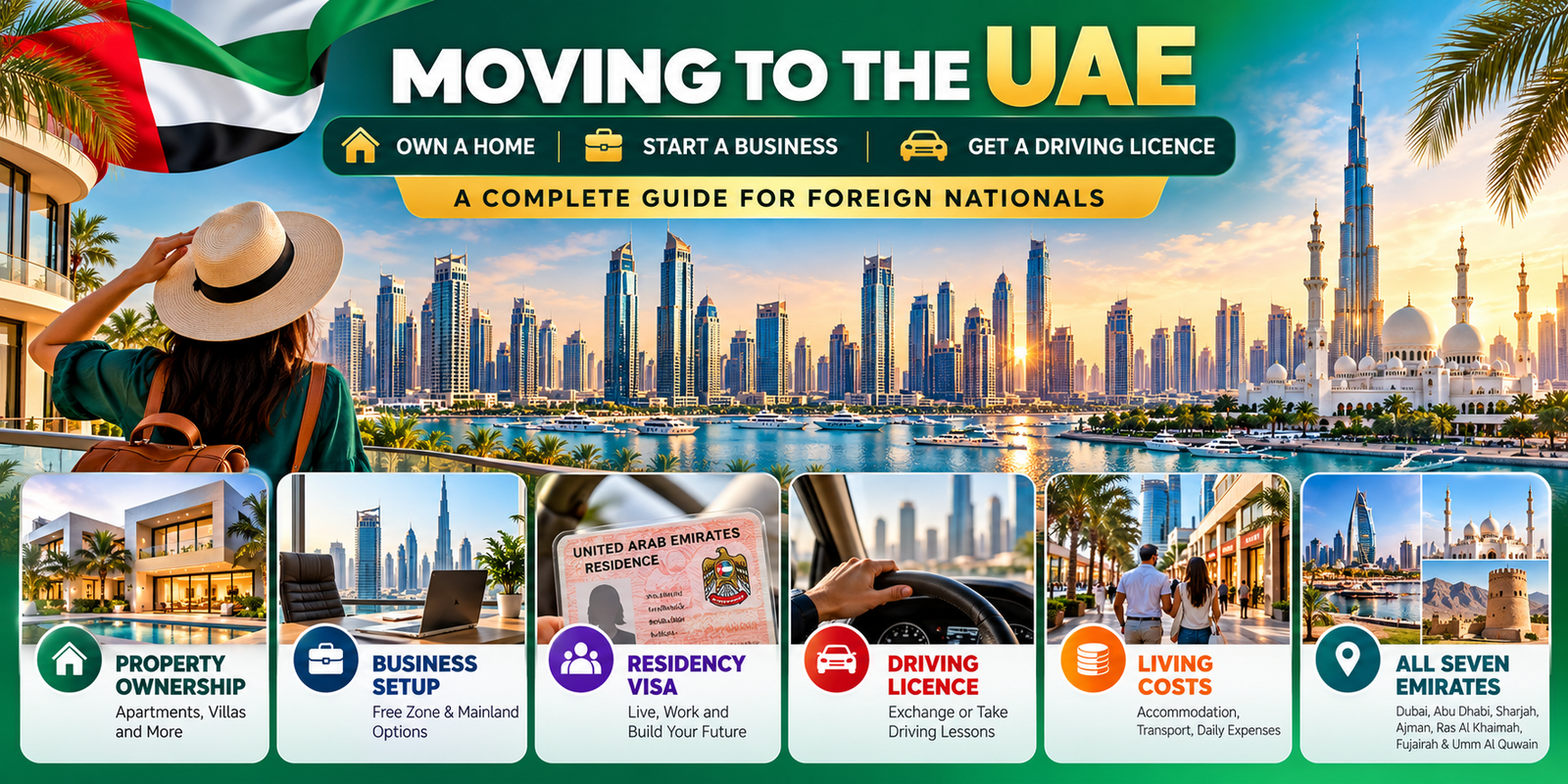
Moving to the UAE: Can You Own a Home, Start a Business and Get a Driving Licence?
A complete guide to property ownership, business setup, residency visas, living expenses and driving licences across the United Arab Emirates.
Understand the costs and requirements before planning your move.
The United Arab Emirates (UAE) attracts people from around the world who want to build a business, purchase a home, find employment or enjoy a different lifestyle. Its seven emirates offer different property markets, business opportunities and living arrangements.
However, moving to the UAE involves more than booking a flight. You need to understand residency rules, accommodation expenses, business licensing, driving requirements and the money required to support yourself during the first few months.
This guide explains the main considerations for foreign nationals, whether you are planning to move to Dubai, Abu Dhabi, Sharjah, Ajman, Ras Al Khaimah, Fujairah or Umm Al Quwain.
- Foreign nationals can purchase eligible properties in designated areas.
- Business setup costs depend on the activity, emirate and licensing authority.
- A residence visa is separate from property ownership.
- Eligible foreign driving licences may be exchangeable; other applicants generally need driving lessons and tests.
- Renting first can reduce the financial risk of relocating.
1. Understanding the Seven Emirates
The UAE consists of seven emirates. Dubai is internationally recognised for its commercial districts and tourism, while other emirates may offer different accommodation options, industrial areas and business environments.
Dubai
A major destination for international businesses, tourism, technology, media and professional services. Property and rental costs vary significantly by neighbourhood.
Abu Dhabi
The federal capital, with opportunities in energy, finance, government-related sectors, technology and other industries. Foreign property ownership is permitted in designated investment areas under applicable rules.
Sharjah
Known for residential communities, education, manufacturing and cultural attractions. Foreign property ownership and long-term property rights depend on the applicable areas and rules.
Ajman
Worth researching if you want to compare residential costs and access to neighbouring emirates. Property eligibility and business activities must be checked before making commitments.
Ras Al Khaimah
Offers tourism, industrial and business opportunities, as well as residential developments. Check the specific free zone, licensing authority and property ownership arrangements.
Fujairah
An emirate on the Gulf of Oman with opportunities associated with ports, logistics, tourism and other sectors.
Umm Al Quwain
A smaller emirate that may suit certain industrial, commercial and residential requirements. Verify available facilities and licensing arrangements for your activity.
The cheapest place to live is not necessarily the best place for your business. Consider your customers, transport requirements, office location and the time needed to travel between emirates.
2. Can Foreign Nationals Own a Home in the UAE?
Yes, foreign nationals can own eligible properties in the UAE, but property ownership laws differ between emirates.
In Dubai, foreign nationals can acquire freehold ownership in designated areas. Abu Dhabi also permits foreign ownership in designated investment areas under its applicable legal framework.
Other emirates may provide different ownership structures, including usufruct or long-term property rights in specified areas. Do not assume that the ownership rules in Dubai automatically apply throughout the country.
Illustrative Property Price Ranges
The following figures are broad planning estimates, not verified current listings. Actual prices depend on the location, building, size, condition and property type.
Budget studio apartment
Approximately US$68,000–$123,000.
Investigate smaller apartments and more affordable communities where foreign ownership is permitted.
One-bedroom apartment
Approximately US$123,000–$218,000.
A potential option for an individual or couple looking for additional living space.
Mid-range apartment
Approximately US$191,000–$354,000.
Suitable properties may be available in various residential communities, depending on current market conditions.
Townhouse or villa
Approximately US$327,000–$681,000 or more.
Larger homes usually require a greater investment, particularly in premium developments.
These examples primarily illustrate possible price brackets and should not be interpreted as UAE-wide averages. Currency conversions use approximately US$1 = AED 3.67.
Additional Property Purchase Expenses
The purchase price is not the only expense. Registration fees, trustee or administrative charges, agency commissions, furnishing and annual property service charges may apply.
| Example expense | Illustrative amount |
|---|---|
| Apartment price | AED 350,000 |
| Registration fee at 4%, where applicable | AED 14,000 |
| Trustee and administrative charges | AED 2,000–5,000 |
| Potential agent fee | AED 7,000–8,000 |
| Basic furniture and setup | AED 5,000–15,000 |
| Illustrative total | AED 378,000–392,000 |
This is an example of a cash purchase, not a quotation. Fees differ by emirate and transaction, and the 4% registration assumption should not be applied automatically to every property purchase.
3. Does Buying a Home Give You UAE Residency?
No. Buying a home does not automatically grant permission to live in the UAE.
Depending on your circumstances, possible residence routes may include:
- Employment-sponsored residency.
- Qualifying business-owner or investor residency.
- Eligible property-investor residence routes.
- Other residence categories for which you meet the requirements.
Some property-investor programmes have minimum property-value requirements and other eligibility conditions. The rules differ by programme, and owning an inexpensive property does not automatically qualify you for a long-term residence visa.
A business licence is also not proof that your residence visa has been approved. Confirm the visa route, medical examination, Emirates ID, insurance and other requirements with the relevant authorities.
4. Renting a Home in the UAE
Renting first may be a practical choice if you are entering the UAE for the first time. It allows you to understand the local market and establish your income before purchasing a property.
The following are illustrative rental budgets for planning, not current verified quotations.
| Accommodation | Annual rent estimate |
|---|---|
| Shared room | AED 12,000–24,000 |
| Budget studio | AED 25,000–45,000 |
| One-bedroom apartment | AED 40,000–70,000 |
Actual rent varies by emirate, neighbourhood, building, furnishing and lease terms. You may also need to pay a security deposit, agency fees, utility deposits, internet charges and cooling costs.
Illustrative Monthly Living Budget
| Expense | Monthly estimate |
|---|---|
| Budget studio rent | AED 2,100–3,750 |
| Food and groceries | AED 800–1,200 |
| Utilities and internet | AED 400–800 |
| Public transport | AED 200–400 |
| Phone and personal expenses | AED 300–600 |
| Total | AED 3,800–6,750 |
This is a basic planning example for one person, excluding visa costs, insurance, business expenses and emergencies. Actual living costs may be higher.
5. Starting a Small Business in the UAE
Foreign entrepreneurs can establish businesses in the UAE, subject to the applicable ownership, licensing and immigration rules. Your first decision is to identify the business activities you intend to perform.
Option A: Free-Zone Company
A free-zone company may suit technology services, international trading, creative services and certain professional activities. Free zones commonly provide company registration, workspace packages and immigration support.
However, each free zone has its own rules. A free-zone licence does not automatically authorise every form of business activity throughout the UAE mainland.
Option B: Mainland Company
A mainland company may be suitable for businesses serving customers across the UAE. Many activities permit full foreign ownership, but some sectors have additional ownership or approval requirements.
Check the appropriate licensing authority in the emirate where you plan to establish the company. A business licence, premises and sector-specific approvals may be required.
Illustrative Basic Business Setup Budget
| Expense | Planning estimate |
|---|---|
| Licence and registration | AED 5,000–15,000 |
| Visa and related formalities | AED 3,000–7,000 |
| Workspace or business address | AED 3,000–10,000 |
| Equipment and software | AED 3,000–10,000 |
| Website and initial marketing | AED 1,000–3,000 |
| Illustrative initial total | AED 15,000–45,000 |
These estimates are not official prices. They may exclude licence renewal, insurance, accounting, immigration establishment fees, premises deposits, special approvals and working capital. Some packages include only the licence, so request an itemised quotation.
Small Businesses Worth Investigating
- Video editing and social media content production.
- Graphic design and digital marketing.
- Website development and technology services.
- Product photography and promotional video services.
- Online consultancy in a permitted professional activity.
- Printing and custom merchandise, subject to applicable activity and premises requirements.
Digital services may need less physical infrastructure than a shop or workshop. Physical printing businesses can require additional equipment, materials, workspace and approvals.
6. How to Obtain a UAE Driving Licence
A UAE driving licence can be useful if you intend to live, work or operate a business in the country. The procedure depends on whether you already hold a valid driving licence from another country.
The UAE government states that the minimum age for a standard car or light-vehicle driving licence is 18. New applicants generally need to take lessons at a registered driving institute and pass the required tests. Eligible licence holders from certain countries may be able to exchange their existing licence.
Route A: You Already Have a Foreign Driving Licence
Some countries have licences that may be exchanged for a UAE licence under the applicable rules. Eligibility depends on the country that issued your licence, your residency status and current requirements.
Route B: You Do Not Have an Exchangeable Licence
If you are not eligible for direct exchange, you will generally need to register with a recognised driving institute and complete the required training and assessments.
Confirm your age, required identification and residence documentation.
Register with an approved driving institute or the authorised transport authority.
Use an approved provider according to the authority’s requirements.
Complete the required theory and practical training. The number of lessons can depend on your previous driving experience and assessment.
These may include theory, parking and road tests, depending on the applicable process.
After meeting the requirements and paying the relevant fees, the authority can issue your driving licence.
How Much Does a UAE Driving Licence Cost?
The total cost varies by emirate, driving institute, number of lessons, test attempts and whether you qualify for licence exchange.
| Expense | Budgeting guidance |
|---|---|
| Eye test | Check current provider fees |
| Driving file and registration | Depends on the authority |
| Theory and training | Depends on the institute and course |
| Practical lessons and tests | Depends on experience and test attempts |
| Licence issue or exchange | Check the current official fee schedule |
For initial planning, a learner may reserve approximately AED 4,500–8,000 or more for a standard car-licence course, but this is not an official fee quotation. The final amount may be lower or higher depending on the package, training requirements and additional tests.
Eligible licence exchange may cost considerably less than completing the full training process. Confirm the exact fee with the relevant authority before budgeting.
Can You Drive With Your Existing Foreign Licence?
Permission to drive as a visitor is different from obtaining a UAE driving licence as a resident. Visitor eligibility depends on the licence’s issuing country, the type of licence and any applicable international driving permit requirements.
Once you become a resident, check the rules applicable to your circumstances rather than assuming that a foreign licence or international driving permit will remain sufficient.
Where Do You Apply?
- Dubai: Roads and Transport Authority (RTA).
- Abu Dhabi: TAMM government services portal.
- Other emirates: Check the relevant local transport or police authority and its authorised driving institutes.
Procedures, fees and service providers can differ between emirates. Check the official authority before enrolling or paying an agent.
7. Taxes and Ongoing Business Costs
The UAE offers a competitive business environment, but businesses must comply with applicable tax and reporting rules.
- Corporate tax: The general framework applies 0% to taxable income up to AED 375,000 and 9% to taxable income above that threshold, subject to applicable rules.
- Free-zone tax treatment: A qualifying free-zone person may receive 0% corporate tax on qualifying income if all applicable conditions are met. Free-zone companies are not automatically exempt from corporate tax.
- VAT: The standard rate is 5%. Mandatory registration generally applies when taxable supplies and imports exceed AED 375,000, subject to the applicable rules.
- Licence renewal: Most businesses must renew their licences according to the relevant authority’s rules.
- Insurance and accounting: Budget for applicable insurance, bookkeeping and compliance costs.
Tax obligations depend on the legal structure, activities and income. Seek qualified professional advice where necessary.
8. How Much Money Should You Save Before Moving?
The following scenarios are illustrative budgets for a single person moving to the UAE. They are not official minimum capital requirements.
Option 1: Explore the Market
Approximately US$5,450–$9,540.
A lean exploratory budget for travel, initial accommodation and research. It may not cover a full business setup, residence arrangements and an adequate emergency reserve.
Option 2: Launch a Small Business
Approximately US$10,900–$19,100.
A more substantial planning range for relocation, a basic business setup, equipment, accommodation and some working capital.
Option 3: Buy a Home and Start a Business
Approximately US$109,000–$123,000 or more.
A possible budget for a lower-priced studio, purchase expenses and a basic business launch. Additional living and emergency funds may be required.
Example Relocation Budget
| Expense | Illustrative amount |
|---|---|
| Business licence and registration | AED 10,000 |
| Visa and related formalities | AED 5,000 |
| Equipment and workspace | AED 7,000 |
| Travel and relocation | AED 2,000 |
| Rental deposit and moving expenses | AED 4,000 |
| Three months of living expenses | AED 15,000 |
| Emergency and operating reserve | AED 10,000 |
| Total | AED 53,000 |
This example does not include purchasing a property or obtaining a driving licence. Your actual costs will depend on your circumstances, and some expenses may be included in company packages.
9. Should You Buy a Home or Start a Business First?
Buying property can be a long-term investment, but it may tie up funds needed to run a business. If your income is uncertain, renting first may offer greater flexibility.
Business-First Approach
- Research your target market and licensing requirements.
- Rent affordable accommodation.
- Set up the business legally.
- Build stable income and emergency savings.
- Consider purchasing a property when financially comfortable.
Property-First Approach
- Verify property ownership eligibility.
- Arrange the purchase funds or mortgage.
- Pay transaction expenses and furnishing costs.
- Keep business capital separate.
- Maintain enough money for living expenses and emergencies.
For a first-time entrepreneur, renting first and testing the market may reduce financial pressure. You can evaluate property ownership later, after understanding your actual living and business expenses.
10. Step-by-Step Relocation Checklist
11. Official UAE Resources
- UAE Government Portal: u.ae — Government information on residency, transport, property and business.
- Dubai Land Department: dubailand.gov.ae — Dubai property ownership and registration.
- Invest in Dubai: investindubai.gov.ae — Business setup and licensing.
- Abu Dhabi TAMM: tamm.abudhabi — Government services, including relevant transport services.
- Dubai RTA: rta.ae — Driving licence and transport services in Dubai.
- UAE Federal Tax Authority: tax.gov.ae — Corporate tax and VAT guidance.
Conclusion: Is Moving to the UAE Worth Considering?
The UAE can offer opportunities for people who want to own property, establish a business or develop their careers. However, the best emirate and the amount of money required depend on your objectives, legal eligibility and financial circumstances.
Property ownership may require a substantial investment, while some service businesses can start with a smaller initial budget. A driving licence can improve mobility, but the process and costs depend on whether your existing licence is eligible for exchange.
The most practical approach is to research the emirates, understand the residency and licensing requirements, prepare a realistic relocation budget and maintain enough savings to cover unexpected expenses.