Modern Cosmetic Treatments: Belly Fat Removal, Face Surgery, Skin Treatments & Body Contouring
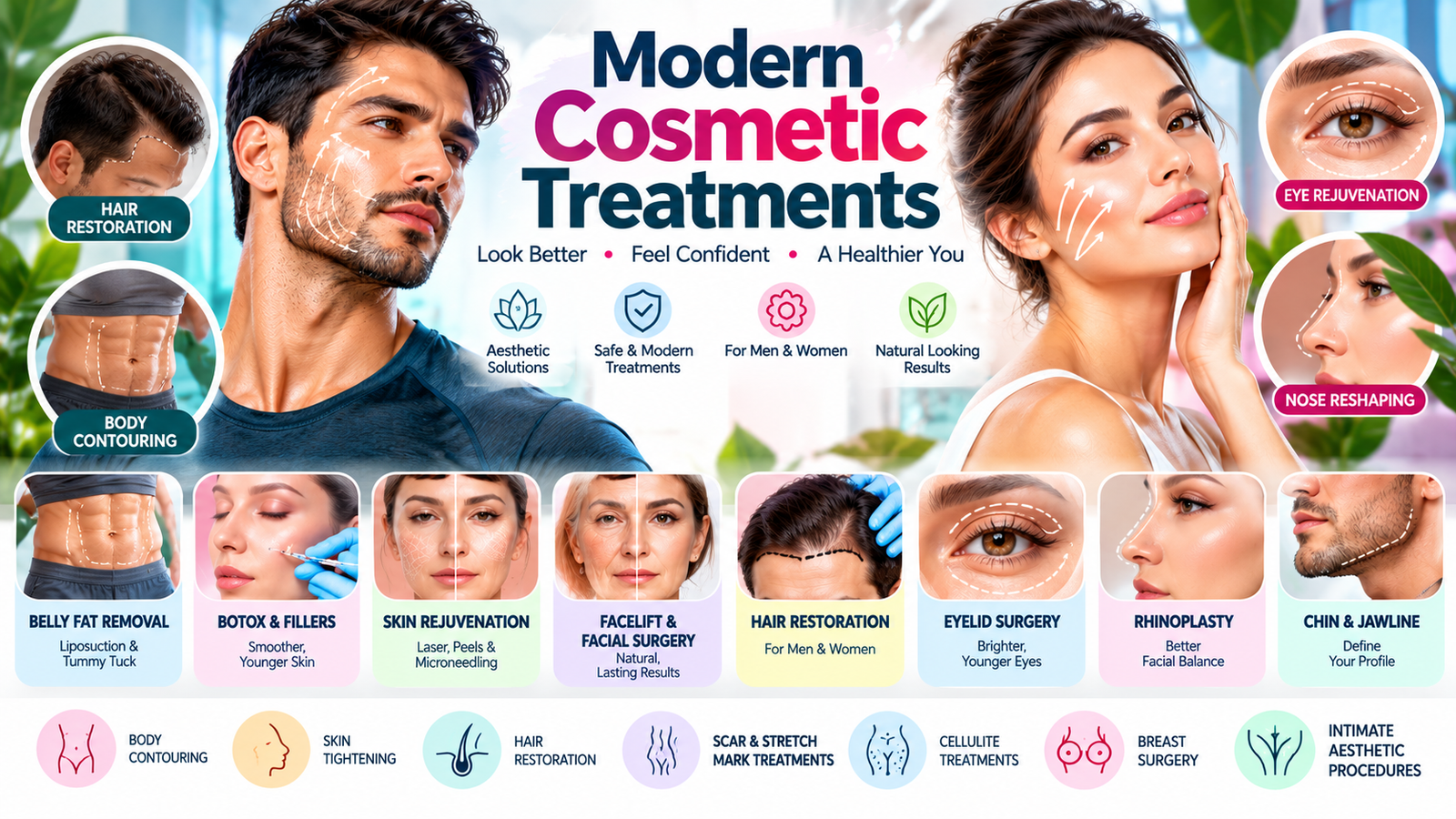
Modern aesthetic medicine has changed dramatically. Today, people can choose from
surgical and non-surgical procedures designed to improve body shape, facial appearance,
skin texture, hair and other aesthetic concerns.
This guide explains some of the most popular and modern cosmetic treatments,
including belly-fat reduction, liposuction, tummy tuck, facelift, fillers,
Botox, laser treatments, hair restoration and body contouring.
Important Medical Information:
Cosmetic procedures are medical procedures. They can have complications and
individual results vary. This article is intended for general educational
information and is not a substitute for consultation with a qualified
medical professional.
What Is Modern Aesthetic Medicine?
Aesthetic medicine includes a wide range of procedures designed to improve
appearance or address specific cosmetic concerns.
Modern treatments can include:
- Surgical cosmetic procedures
- Minimally invasive treatments
- Injectable treatments
- Laser procedures
- Radiofrequency treatments
- Ultrasound-based procedures
- Skin resurfacing
- Body contouring
- Hair restoration
1. Belly Fat Removal and Abdominal Body Contouring
Belly fat is one of the most common cosmetic concerns. However, it is important
to distinguish between subcutaneous fat, which is located beneath
the skin, and visceral fat, which surrounds internal organs.
Cosmetic procedures primarily target localized subcutaneous fat. They are not
substitutes for treating obesity or improving overall metabolic health.
Liposuction
Liposuction is a surgical procedure that removes localized deposits of fat through
small incisions. It is primarily a body-contouring procedure rather than a general
weight-loss treatment.
Liposuction may be used to reshape areas such as:
- Abdomen
- Waist
- Hips
- Thighs
- Arms
- Back
- Chin
- Selected areas of the male chest
Tummy Tuck / Abdominoplasty
A tummy tuck, medically known as abdominoplasty, is different from liposuction.
It can remove excess abdominal skin and, when appropriate, repair or tighten
separated abdominal muscles.
It is commonly considered by people who have significant loose skin after
pregnancy or substantial weight loss.
Liposuction and Tummy Tuck
In selected patients, surgeons may combine liposuction with abdominoplasty to
address localized fat, excess skin and abdominal contour.
primarily addresses excess abdominal skin and abdominal contour. They are not
interchangeable procedures.
2. Non-Surgical Fat Reduction
People who do not want surgery may consider non-invasive or minimally invasive
body-contouring technologies.
Depending on the technology, treatments may use:
- Controlled cooling
- Radiofrequency energy
- Ultrasound
- Heat-based technologies
- Electromagnetic energy
These treatments generally focus on localized areas rather than producing
major overall weight loss.
Cryolipolysis
Cryolipolysis, commonly called fat freezing, uses controlled cooling to affect
fat cells in selected treatment areas.
Depending on the device, it may be used on areas such as the abdomen,
flanks and thighs.
Radiofrequency Body Contouring
Radiofrequency devices use electromagnetic energy to heat tissue. Depending
on the device, the objective may include improving skin appearance,
tightening tissue or reducing localized fat.
Ultrasound-Based Body Contouring
Certain ultrasound technologies are designed to target tissue beneath the skin.
Results and suitability depend on the specific technology and treatment area.
3. Facelift and Facial Surgery
Modern facial surgery focuses not only on removing excess skin but also on
repositioning underlying tissues and maintaining natural-looking facial proportions.
Facelift
A facelift, or rhytidectomy, is designed to address signs of facial aging such as:
- Sagging cheeks
- Jowls
- Loose facial skin
- Reduced jawline definition
- Certain forms of neck laxity
Mini Facelift
A mini facelift generally uses a smaller surgical approach and may be considered
for selected patients with less extensive tissue laxity.
Neck Lift
A neck lift focuses on loose neck skin and neck contour. It may be performed
alone or together with facial surgery.
4. Eyelid Surgery
Eyelid surgery, also known as blepharoplasty, addresses excess skin and/or
fat around the eyes.
- Upper eyelid surgery
- Lower eyelid surgery
- Combined upper and lower eyelid surgery
In some people, excess upper-eyelid skin may also affect the field of vision.
5. Rhinoplasty and Nose Reshaping
Rhinoplasty changes the shape or structure of the nose and can be performed
for cosmetic or functional reasons.
Possible areas of change include:
- Nose size
- Nose profile
- Nasal tip
- Nasal bridge
- Nostril shape
- Overall facial balance
Functional rhinoplasty may address structural problems that affect breathing.
6. Dermal Fillers
Dermal fillers are injectable products used to add or restore volume in
selected facial areas.
Depending on the product and approved indication, fillers may be used for:
- Lips
- Cheeks
- Chin
- Certain facial wrinkles and folds
- Selected facial contouring applications
Important:
Dermal fillers are medical procedures and are not risk-free. Accidental
injection into a blood vessel can cause serious complications, including
tissue damage and vision problems.
7. Botox and Other Neuromodulators
Botulinum toxin products are injected into selected muscles to temporarily
reduce muscle activity.
They are commonly used to improve the appearance of:
- Forehead lines
- Frown lines
- Crow’s feet
Unlike dermal fillers, neuromodulators do not primarily add volume.
Their effect comes from reducing targeted muscle activity.
8. Skin Resurfacing Treatments
Skin resurfacing treatments are used for a variety of cosmetic skin concerns.
Possible treatment goals include:
- Acne scars
- Fine lines
- Uneven pigmentation
- Sun damage
- Uneven skin texture
- Certain scars
Laser Resurfacing
Laser treatments can affect selected layers of the skin depending on the
technology used.
Laser technologies include:
- Ablative lasers
- Non-ablative lasers
- Fractional laser systems
Chemical Peels
Chemical peels use carefully selected chemical solutions to exfoliate or
affect controlled layers of skin.
Different chemicals and strengths have very different risk profiles.
Microdermabrasion
Microdermabrasion provides superficial exfoliation and generally has less
downtime than deeper resurfacing procedures.
9. Microneedling
Microneedling uses very small needles to create controlled micro-injuries
in the skin.
It may be used for concerns such as:
- Acne scars
- Uneven skin texture
- Fine lines
- Certain pigmentation concerns
10. Skin Tightening
Skin laxity can sometimes be treated using energy-based technologies.
- Radiofrequency
- Ultrasound
- Laser-based technologies
- Other heat-based devices
These procedures generally aim to stimulate tissue remodeling or improve
the appearance of loose skin.
11. Facial Fat Grafting
Facial fat grafting uses fat harvested from another part of the patient’s
body and transfers it to selected facial areas.
It may be used for areas such as:
- Cheeks
- Temples
- Selected facial depressions
- Other areas requiring volume restoration
12. Chin and Jawline Contouring
Facial proportions are strongly influenced by the chin and jawline.
Modern treatments may include:
- Chin implants
- Chin surgery
- Dermal fillers
- Submental liposuction
- Neck lift
- Skin tightening
13. Double-Chin Treatments
A double chin can be caused by subcutaneous fat, loose skin, genetics,
aging, weight changes or facial structure.
Possible treatments include:
- Submental liposuction
- Selected injectable treatments
- Non-invasive fat reduction
- Neck lift
- Combination procedures
14. Breast Cosmetic Procedures
Breast Augmentation
Increases breast volume using implants or, in selected cases,
fat transfer.
Breast Lift
Reshapes and raises breast tissue without necessarily increasing
breast volume.
Breast Reduction
Removes selected breast tissue and reshapes the breast.
15. Arm, Thigh and Body Lifts
After significant weight loss, some people are left with substantial
amounts of loose skin.
Possible procedures include:
- Arm lift / Brachioplasty
- Thigh lift
- Lower body lift
- Upper body lift
- Abdominoplasty
16. Hair Restoration
Hair Transplantation
Modern hair transplantation commonly uses techniques such as FUE
(Follicular Unit Extraction) and FUT (Follicular Unit Transplantation).
Non-Surgical Hair Treatments
Depending on the cause of hair loss, doctors may consider medications,
platelet-based treatments and other therapies.
The cause of hair loss should be evaluated before choosing a cosmetic
hair-restoration procedure.
17. Scar Treatment
Modern scar management can include:
- Laser treatment
- Microneedling
- Chemical treatments
- Steroid injections for selected raised scars
- Surgical scar revision
- Silicone-based scar management
- Combination treatments
Different scars require different approaches. Acne scars, surgical scars,
burn scars and keloids should not automatically be treated in the same way.
18. Stretch Mark Treatments
Stretch marks, also called striae, can develop after pregnancy, rapid
weight changes, growth or muscle gain.
Possible treatment options include:
- Laser treatments
- Microneedling
- Radiofrequency-based treatments
- Selected topical treatments
Complete removal is generally unrealistic. Treatment is usually intended
to reduce their visibility.
19. Cellulite Treatments
Cellulite is extremely common and can occur even in people who are otherwise
lean.
Possible treatment approaches include:
- Energy-based devices
- Mechanical treatments
- Subcision-type procedures
- Certain minimally invasive techniques
20. Intimate Aesthetic Procedures
Aesthetic medicine also includes procedures marketed for intimate areas.
These can include surgical and non-surgical approaches.
Patients should be particularly careful with procedures marketed with
broad claims about “rejuvenation”, tightening or sexual function.
A qualified medical professional should distinguish cosmetic concerns
from genuine medical conditions.
21. Modern Combination Treatments
Modern aesthetic medicine increasingly uses combinations of procedures
to address multiple concerns.
Face Rejuvenation
Facelift + eyelid surgery + selected fat grafting.
Body Contouring
Liposuction + tummy tuck in appropriately selected patients.
Jawline Enhancement
Submental liposuction + appropriate skin-tightening treatment.
Skin Rejuvenation
Laser treatment + microneedling + appropriate skincare.
22. Surgical vs Non-Surgical Treatments
| Category | Examples | Typical Purpose |
|---|---|---|
| Surgical | Liposuction | Remove localized fat |
| Surgical | Tummy tuck | Remove excess abdominal skin and reshape the abdomen |
| Surgical | Facelift | Address facial and neck laxity |
| Surgical | Rhinoplasty | Reshape the nose |
| Surgical | Eyelid surgery | Address eyelid skin and/or fat |
| Injectable | Botulinum toxin | Temporarily reduce expression lines |
| Injectable | Dermal fillers | Restore or add facial volume |
| Energy-Based | Laser | Skin resurfacing and selected skin concerns |
| Energy-Based | Radiofrequency | Skin tightening and selected body-contouring applications |
| Energy-Based | Ultrasound | Selected tissue and body-contouring applications |
| Minimally Invasive | Microneedling | Skin texture and selected scar concerns |
| Hair Restoration | FUE / FUT | Hair restoration |
23. How to Choose a Cosmetic Procedure
1. Identify the Actual Problem
For example, what appears to be “belly fat” may actually involve fat,
loose skin, abdominal muscle separation, bloating or overall excess weight.
2. Ask Whether Surgery Is Necessary
Some concerns can be addressed with non-surgical treatments, while others
may require surgery for substantial changes.
3. Understand How Long Results May Last
Some cosmetic treatments are temporary. Neuromodulators and many fillers
eventually wear off or are absorbed. Some body-contouring treatments may
require maintenance.
4. Understand the Risks
Potential complications can include:
- Infection
- Bleeding
- Scarring
- Swelling
- Pain
- Nerve injury
- Asymmetry
- Pigment changes
- Anesthesia complications
- Blood-vessel complications
- Need for revision procedures
5. Check the Practitioner
Aesthetic procedures should be treated as medical procedures rather than
ordinary beauty services. Choose an appropriately qualified medical
professional with relevant training and experience.
24. Questions to Ask Before Treatment
- What exactly is being treated?
- What evidence supports this procedure?
- What are the possible complications?
- How many treatments may be required?
- How long could the result last?
- What is the expected recovery time?
- What happens if I am unhappy with the result?
- Who will perform the procedure?
- What qualifications and experience does the practitioner have?
25. Be Careful With “Instant Beauty” Claims
Social media has made cosmetic treatments extremely visible. Advertisements
sometimes use phrases such as:
- “Zero risk”
- “Permanent fat removal”
- “No downtime”
- “Instant facelift”
- “100% safe”
- “Guaranteed results”
- “No side effects”
Such claims should be approached carefully. Medical procedures have
limitations and individual results vary.
26. The Importance of Realistic Expectations
Cosmetic medicine can change appearance, but it cannot completely stop
aging or guarantee a particular idealized appearance.
A good consultation should explain:
- What can realistically be changed
- What cannot be changed
- How much improvement may be possible
- What recovery is involved
- What complications can occur
- Whether the procedure is medically appropriate
27. The Future of Aesthetic Medicine
Aesthetic medicine continues to evolve toward more personalized treatments
and combinations of technologies.
Important areas of development include:
- Personalized facial analysis
- Combination procedures
- Less invasive body contouring
- Advanced laser systems
- Improved fat-transfer techniques
- Advanced skin-resurfacing technologies
- Personalized treatment planning
- Natural-looking aesthetic results
- Body contouring after significant weight loss
Conclusion
Modern cosmetic medicine offers many options for people who want to
change or improve specific aspects of their appearance.
For abdominal concerns, options range from lifestyle and medical weight
management to non-invasive body contouring, liposuction and tummy-tuck surgery.
For the face, modern options include facelifts, eyelid surgery,
rhinoplasty, fat grafting, dermal fillers, neuromodulators, lasers
and skin-resurfacing treatments.
There is no single cosmetic treatment that is appropriate for everyone.
The right approach depends on the individual’s anatomy, goals, health,
skin quality, expectations and risk factors.
Cosmetic procedures should be approached as medical decisions rather
than ordinary beauty treatments. Proper consultation, qualified
practitioners, evidence-based technology and realistic expectations
are important for making an informed decision.
- India
- Plastic / Cosmetic Surgeons (Belly Fat Removal, Body Contouring, Face Surgery)
- Dr. Vipul Nanda – Delhi NCR / Gurugram (Fortis Memorial Research Institute / Artemis) – Liposuction, body contouring, tummy tucks, facelifts, rhinoplasty
- Dr. Lokesh Kumar – Delhi (BLK-Max Super Specialty Hospital) – Cosmetic surgery, breast & body contouring
- Dr. Rajat Gupta – Delhi (RG Aesthetics) – High-definition liposuction, 360° body contouring, VASER techniques
- Dr. Raghav Mantri – Delhi NCR (Max Super Speciality Hospital, Saket) – Liposuction & body contouring specialist
- Dr. Milan Doshi – Mumbai (Allure MedSpa) – Liposuction, gynecomastia, tummy tuck
- Dr. Ajaya Kashyap – Delhi (KASMed / MedSpa) – Face, breast & body contouring
- Dr. Sunil Choudhary – Delhi NCR (Max Institute) – Aesthetic & reconstructive surgery
- Dr. Aditya Aggarwal – Gurugram (Medanta) – Body contouring & facial procedures
- Dr. Debraj Shome – Mumbai – Facial plastic surgery
- Dr. Anil Tibrewala – Mumbai – Aesthetic plastic surgery
- Dr. Priti Shukla – Hyderabad – Female cosmetic surgery, mommy makeovers
- Cosmetic Dermatologists (Skin Treatments)
- Dr. Jaishree Sharad – Mumbai (Skinfiniti Clinic) – Injectables, lasers, regenerative treatments
- Dr. Rinky Kapoor – Mumbai / Hyderabad (The Esthetic Clinics) – Lasers, fillers, skin rejuvenation
- Dr. Rashmi Shetty – Mumbai (Ra Aesthetics & Dermatology) – Regenerative aesthetics, injectables
- Dr. Chytra V Anand – Bengaluru (Kosmoderma Clinics) – Cosmetic dermatology, lasers, skin & hair
- Dr. D.M. Mahajan – Delhi (Apollo Hospitals) – Botox, fillers, long experience in cosmetic dermatology
- Dr. Kiran Lohia – Delhi – Aesthetic dermatology
- Dr. Geetika Mittal Gupta – Related aesthetic dermatology practices
- Plastic / Cosmetic Surgeons (Belly Fat Removal, Body Contouring, Face Surgery)
- Other Countries
- United States
- Dr. Rod J. Rohrich – Dallas, Texas – Rhinoplasty, facelift, eyelid surgery, liposuction
- Various Beverly Hills / New York specialists (frequently ranked for deep-plane facelifts, body contouring, and regenerative aesthetics)
- United Kingdom
- Mr. Rajiv Grover – London (Harley Street) – Facelifts, facial rejuvenation
- Dr. Julian De Silva – London – Oculo-facial plastic surgery (eyes, face, neck)
- Body contouring specialists at clinics such as Cadogan Clinic (e.g., tummy tuck & liposuction experts)
- Dermatologists such as Dr. Maryam Zamani – Facial aesthetics
- UAE (Dubai)
- VASER / HD liposuction and body contouring specialists (including early adopters like Dr. Hasan Ali)
- Aesthetic dermatologists offering regenerative treatments, non-surgical lifts, lasers, and injectables (e.g., practices associated with Dr. Radmila Lukian)
- Colombia
- Dr. Alfredo Hoyos – Bogotá – Pioneer of High-Definition Liposculpture (VASER HD), 4D Dynamic Definition, advanced body contouring
- Other Hubs
- Turkey (Istanbul) – High-volume specialists for liposuction, tummy tuck, and body contouring
- Singapore – Precision clinics for ethnic rhinoplasty, body contouring, and combined surgical/non-surgical care
- Thailand – Experienced international-trained surgeons for body contouring and facial procedures
- United States