Coffee Explained: History, Origins, Types, Beans and Famous Coffee Drinks Around the World
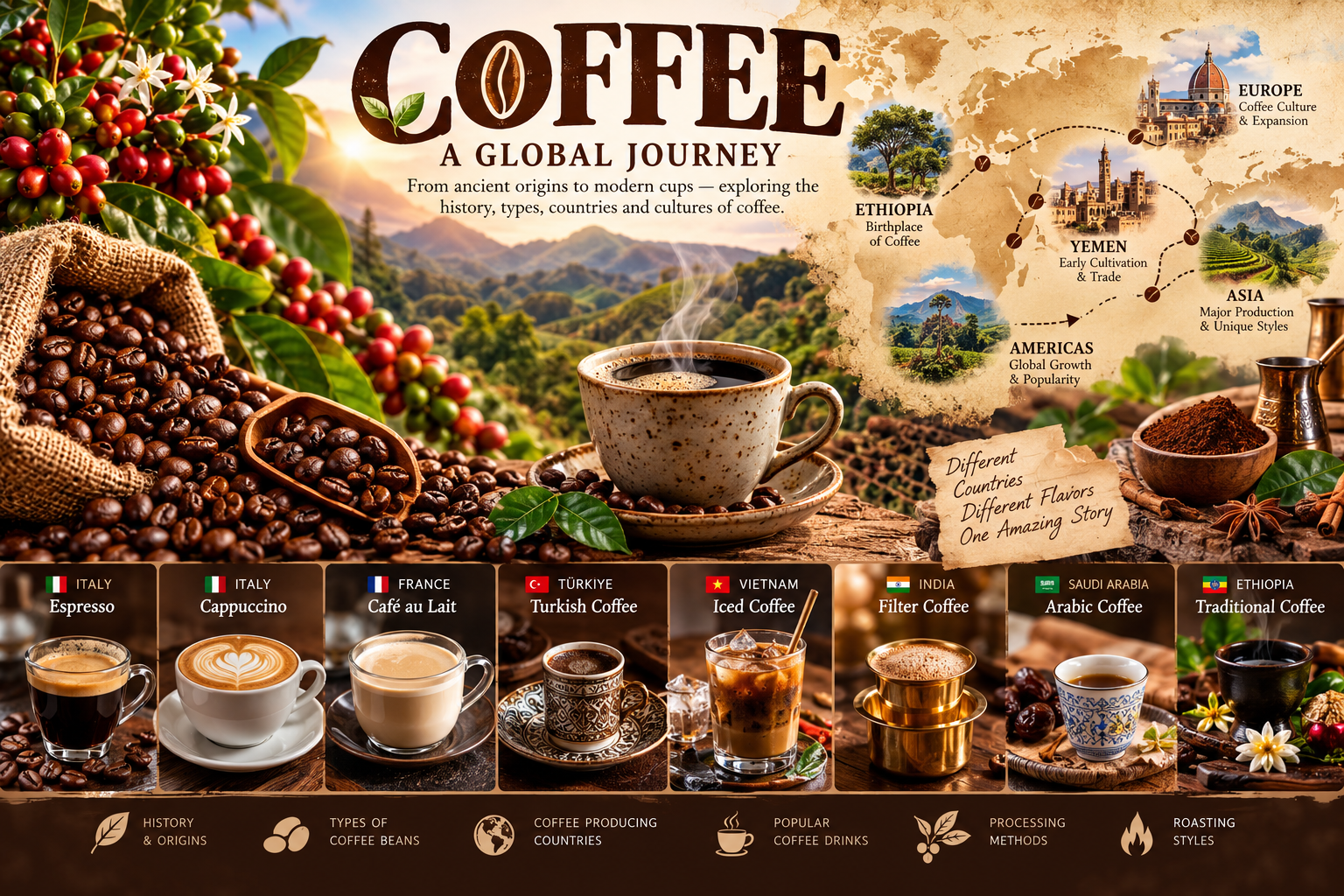
Coffee is one of the world’s most popular beverages. From a strong cup of espresso in Italy to traditional coffee ceremonies in Ethiopia and South Indian filter coffee, coffee has become an important part of everyday life and culture across the world.
But coffee is much more than a drink. It has a fascinating history involving Ethiopia, Yemen, Arabia, Europe, Asia and the Americas. Today, coffee is grown in tropical regions across several continents.
In this guide, we will explore where coffee originated, the major coffee species, different types of coffee beans, popular coffee drinks, coffee-producing countries, processing methods and roasting styles.
🌱 What Is Coffee?
Coffee is a beverage made from the roasted seeds of the fruit of a coffee plant.
The fruit is commonly called a coffee cherry. Inside the cherry are usually two seeds. These seeds are processed, dried and roasted before they are ground and brewed to make coffee.
There are more than 100 species in the Coffea genus, but two species dominate commercial coffee production:
- Coffea arabica – commonly known as Arabica
- Coffea canephora – commonly known as Robusta
🌍 Where Did Coffee Originate?
🇪🇹 Ethiopia – The Birthplace of Arabica Coffee
Ethiopia is widely regarded as the birthplace of Coffea arabica, the species responsible for much of the world’s specialty coffee.
Wild Arabica coffee has its natural origins in the forests of Ethiopia. From Ethiopia, coffee eventually reached Yemen across the Red Sea, where it became cultivated as an important crop.
The famous story of a goat herder named Kaldi discovering coffee after seeing his goats become energetic is a popular legend. However, there is no strong historical evidence confirming the story as fact.
🇾🇪 Yemen – The Country That Helped Spread Coffee
Although Arabica originated in Ethiopia, Yemen played a major role in the early cultivation and international spread of coffee.
Coffee was cultivated in Yemen and became an important agricultural and commercial product. The historic Yemeni port of Mocha (Al-Makha) became closely associated with the international coffee trade.
☕ The Two Major Coffee Species
Scientific name: Coffea arabica
Origin: Ethiopia
Arabica is one of the world’s most important coffee species and is particularly important in specialty coffee.
Arabica coffees can often have:
- Sweet flavors
- Fruity characteristics
- Floral aromas
- Higher perceived acidity
- Complex flavor profiles
Important Arabica-growing countries include Ethiopia, Colombia, Brazil, Kenya, Guatemala, Costa Rica, Panama, Yemen and India.
Scientific name: Coffea canephora
Origin: Central and western Africa
Robusta is generally more vigorous and adaptable than Arabica and is an important commercial coffee crop.
Robusta is commonly associated with:
- Stronger bitterness
- Heavier body
- Earthy or woody notes
- Higher caffeine content
- Good crema formation in espresso blends
Major Robusta-producing countries include Vietnam, Brazil, Indonesia, Uganda, India and Côte d’Ivoire.
🫘 Arabica vs Robusta
| Feature | Arabica | Robusta |
|---|---|---|
| Scientific name | Coffea arabica | Coffea canephora |
| Origin | Ethiopia | Central & western Africa |
| Flavor | Often sweeter and more complex | Stronger and more bitter |
| Acidity | Usually higher | Usually lower |
| Body | Generally lighter | Generally heavier |
| Caffeine | Lower | Higher |
| Common uses | Specialty coffee and single-origin coffees | Espresso blends, instant coffee and blends |
🌎 Major Coffee-Producing Countries
🇪🇹 Ethiopia
Ethiopia is famous for distinctive coffees that can display floral, citrus and fruit-like characteristics.
Important coffee regions include:
- Yirgacheffe
- Sidamo
- Guji
- Harrar
- Jimma
🇨🇴 Colombia
Colombia is one of the world’s best-known coffee-producing countries and is particularly associated with Arabica coffee.
Colombian coffees are often described as balanced and aromatic, although flavor varies according to region, variety and processing method.
🇧🇷 Brazil
Brazil is one of the world’s largest coffee-producing countries and produces both Arabica and Robusta.
Brazilian coffees can display chocolate, nutty, caramel and fruity characteristics depending on the region and processing method.
🇻🇳 Vietnam
Vietnam is particularly famous for Robusta coffee and is one of the world’s major producers of the species.
Vietnamese coffee culture is also famous for strong coffee prepared with a traditional metal filter called a phin.
🇮🇳 India
India produces both Arabica and Robusta coffee. Major coffee-growing areas include Karnataka, Kerala and Tamil Nadu, along with emerging production in other parts of the country.
India is also known for Monsooned Malabar, a distinctive style of coffee associated with the humid monsoon conditions of the Malabar region.
☕ Different Types of Coffee Drinks
The term “coffee” can refer to the coffee bean itself or to the beverage prepared from it. Around the world, people have developed hundreds of different coffee preparations.
🇮🇹 Espresso
Espresso is a concentrated coffee prepared by forcing hot water under pressure through finely ground coffee.
Espresso is the foundation for many popular drinks including cappuccino, latte, Americano and macchiato.
🇮🇹 Cappuccino
Cappuccino traditionally combines:
Espresso + steamed milk + milk foam
It provides a combination of strong coffee flavor, creamy milk and foam.
🇮🇹 Caffè Latte
A latte generally combines espresso with a larger quantity of steamed milk and a small amount of milk foam.
It is usually smoother and milkier than a traditional cappuccino.
🇮🇹 Macchiato
The Italian word macchiato means “marked” or “stained.”
An espresso macchiato is traditionally an espresso marked with a small amount of milk or milk foam.
🇺🇸 Americano
An Americano is generally made by combining espresso with hot water.
It produces a longer drink while retaining the characteristics of espresso.
🇦🇺 Flat White
Flat white is strongly associated with Australian and New Zealand coffee culture.
It generally combines espresso with steamed milk and fine microfoam.
🇫🇷 Café au Lait
Café au lait combines brewed coffee with warm milk and is strongly associated with French café culture.
🇹🇷 Turkish Coffee
Turkish coffee is prepared using extremely fine coffee grounds and is traditionally cooked in a small pot known as a cezve or ibrik.
The grounds remain in the cup rather than being filtered out.
🇸🇦 Arabic Coffee
Arabic coffee has a distinctive preparation style and is often lightly roasted. Cardamom is commonly used for flavoring, while some preparations may include other spices.
Coffee is also an important part of hospitality and social traditions across the Arabian Peninsula.
🇮🇳 South Indian Filter Coffee
South Indian filter coffee is particularly popular in southern India.
It commonly uses a coffee blend that may contain chicory. Coffee is brewed through a traditional metal filter and combined with hot milk and sugar.
The result is a strong, aromatic and creamy beverage.
🇻🇳 Vietnamese Coffee
Vietnamese coffee is famous for strong coffee and sweetened condensed milk.
One popular preparation is Cà phê sữa đá, which combines coffee and condensed milk and is served over ice.
Vietnam is also famous for egg coffee, particularly associated with Hanoi.
🇪🇹 Ethiopian Coffee Ceremony
Coffee has deep cultural importance in Ethiopia. Traditional coffee ceremonies can involve roasting the beans, grinding them and brewing the coffee in front of guests.
The ceremony is not simply about drinking coffee. It is also an important social and cultural tradition.
🌿 How Coffee Beans Are Processed
The flavor of coffee depends on much more than the country where it was grown. Processing has a major influence on the final cup.
1. Washed Process
In the washed process, the coffee fruit is removed from the seed before drying.
Washed coffees are often associated with clean and clearly defined flavor characteristics.
2. Natural Process
In the natural process, coffee cherries are dried with the fruit surrounding the seeds.
Natural coffees can develop fruity, sweet and sometimes wine-like characteristics.
3. Honey Process
In honey processing, some of the sticky fruit mucilage is left on the coffee seed while it dries.
This method can produce characteristics between those commonly associated with washed and natural coffees.
🔥 Coffee Roasting Levels
Light Roast
Light roasting generally preserves more of the coffee’s origin characteristics.
- Fruity notes
- Floral aromas
- Bright acidity
Medium Roast
Medium roasting can provide a balance between the characteristics of the original coffee and flavors produced during roasting.
Dark Roast
Dark roasting produces stronger roast characteristics and may feature flavors such as chocolate, caramel, smokiness and bitterness.
🌍 Why Does Coffee Taste Different Around the World?
The country where coffee is grown is only one part of the story.
Coffee flavor is influenced by:
Species → Variety → Altitude → Soil → Climate → Processing → Drying → Roasting → Brewing
This means two coffees from the same country can taste completely different.
This is one reason specialty coffee is often identified by its farm, region, variety, altitude and processing method rather than simply by country.
🌱 Other Coffee Species
Coffea liberica
Liberica is a less common commercially cultivated coffee species. It is particularly associated with parts of Southeast Asia and the Philippines.
The coffee cherries and beans can be significantly larger than those of Arabica and Robusta.
Excelsa
Excelsa was historically treated as a separate coffee species. Modern botanical classification generally places it within Coffea liberica.
It remains a niche coffee compared with Arabica and Robusta.
🗺️ Coffee’s Journey Around the World
🇪🇹 Ethiopia
↓
🇾🇪 Yemen
↓
Arabian Peninsula
↓
Middle East
↓
Europe
↓
Asia
↓
Caribbean & Central America
↓
South America
↓
Modern Global Coffee Industry
☕ Conclusion
Coffee has travelled an extraordinary journey from the forests of Ethiopia to become one of the world’s most important beverages.
Its history involves Ethiopia’s wild Arabica coffee, Yemen’s early cultivation and trade, European coffee culture, Asian production and the enormous coffee industries of Latin America and Africa.
Today, coffee can mean very different things depending on where you are. It could be Ethiopian coffee ceremony, Turkish coffee, Italian espresso, French café au lait, South Indian filter coffee or Vietnamese iced coffee.
Yet all of these traditions share the same remarkable ingredient: the coffee plant and its seeds.
Coffee is therefore much more than a beverage. It is a combination of agriculture, history, trade, science, culture and tradition — all contained in a cup.
🔎 Frequently Asked Questions About Coffee
Where did coffee originate?
Arabica coffee originated in Ethiopia. Coffee was later cultivated and developed into a major traded crop in Yemen.
What are the two main types of coffee beans?
The two major commercially important species are Arabica and Robusta, also known botanically as Coffea arabica and Coffea canephora.
Which country is famous for espresso?
Espresso is strongly associated with Italian coffee culture, although espresso-based drinks are now consumed worldwide.
What is South Indian filter coffee?
South Indian filter coffee is a traditional coffee beverage made by brewing coffee through a metal filter and combining the resulting decoction with hot milk and sugar. Chicory is also commonly included in blends.
What is the difference between Arabica and Robusta?
Arabica is generally associated with more complex, sweet and aromatic flavor profiles, while Robusta is generally stronger, more bitter and higher in caffeine. Actual flavor depends on variety, growing conditions, processing and roasting.
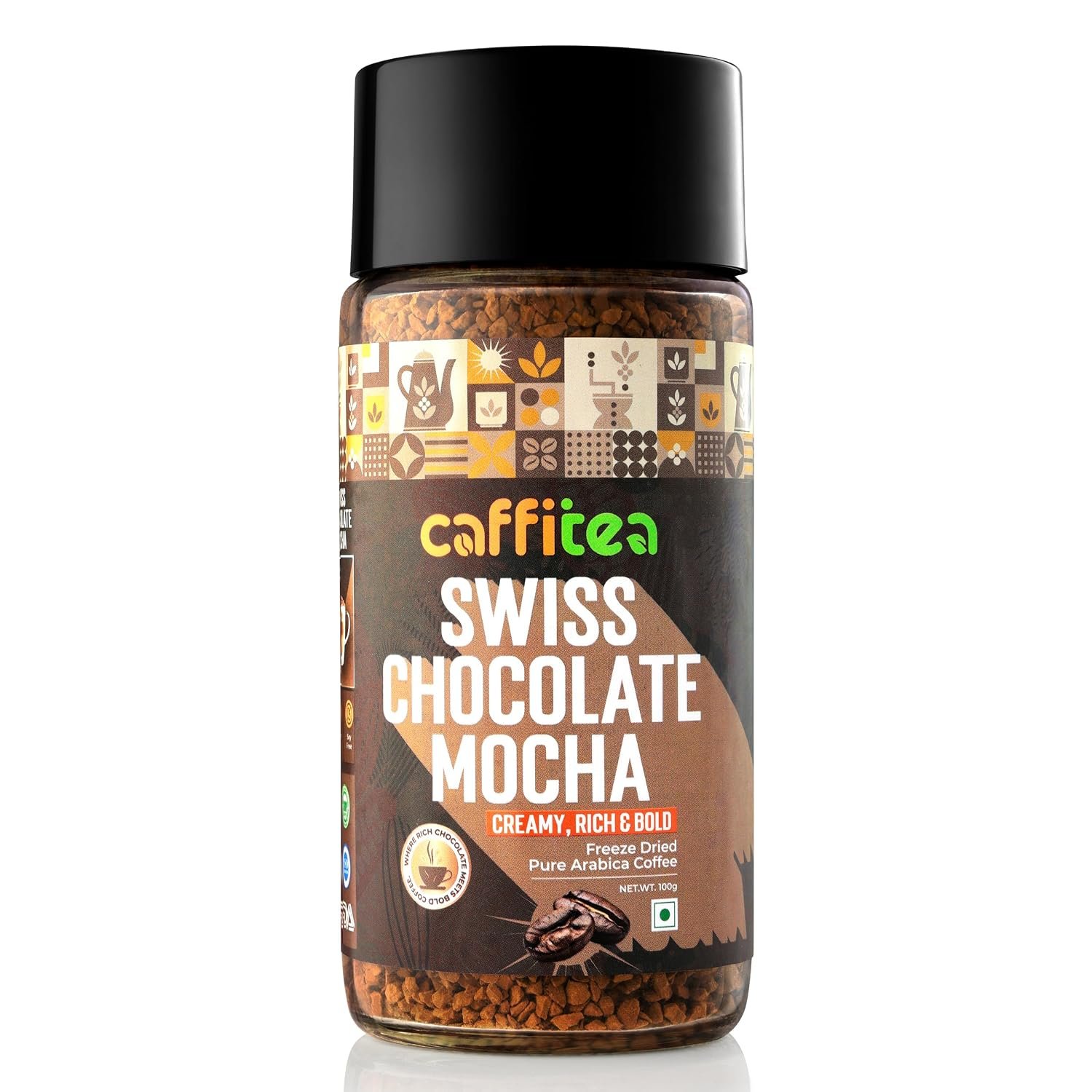
Caffitea Swiss Chocolate Mocha | 100% Pure Freeze Dried Arabica Coffee | Premium Instant Coffee | Creamy, Rich & Bold Flavour | 100g
- Brand Name: caffitea
- Item Form: Granule
- Flavor: Creamy, Rich & Bold
- Caffeine Content Description: Caffeinated
- Coffee Roast Level: Medium Roast
- Container Type: Jar
- Unit Count: 100.0 Grams
- Number of Items: 1
- Country of Origin: India
- Certificate Type: Whole Trade Guarantee
- Allergen Information: Allergen-Free
- Coffee Type: Instant Coffee
- Variety: Mocha