Pan-Indian Festivals: Celebrations That Connect the Diversity of India
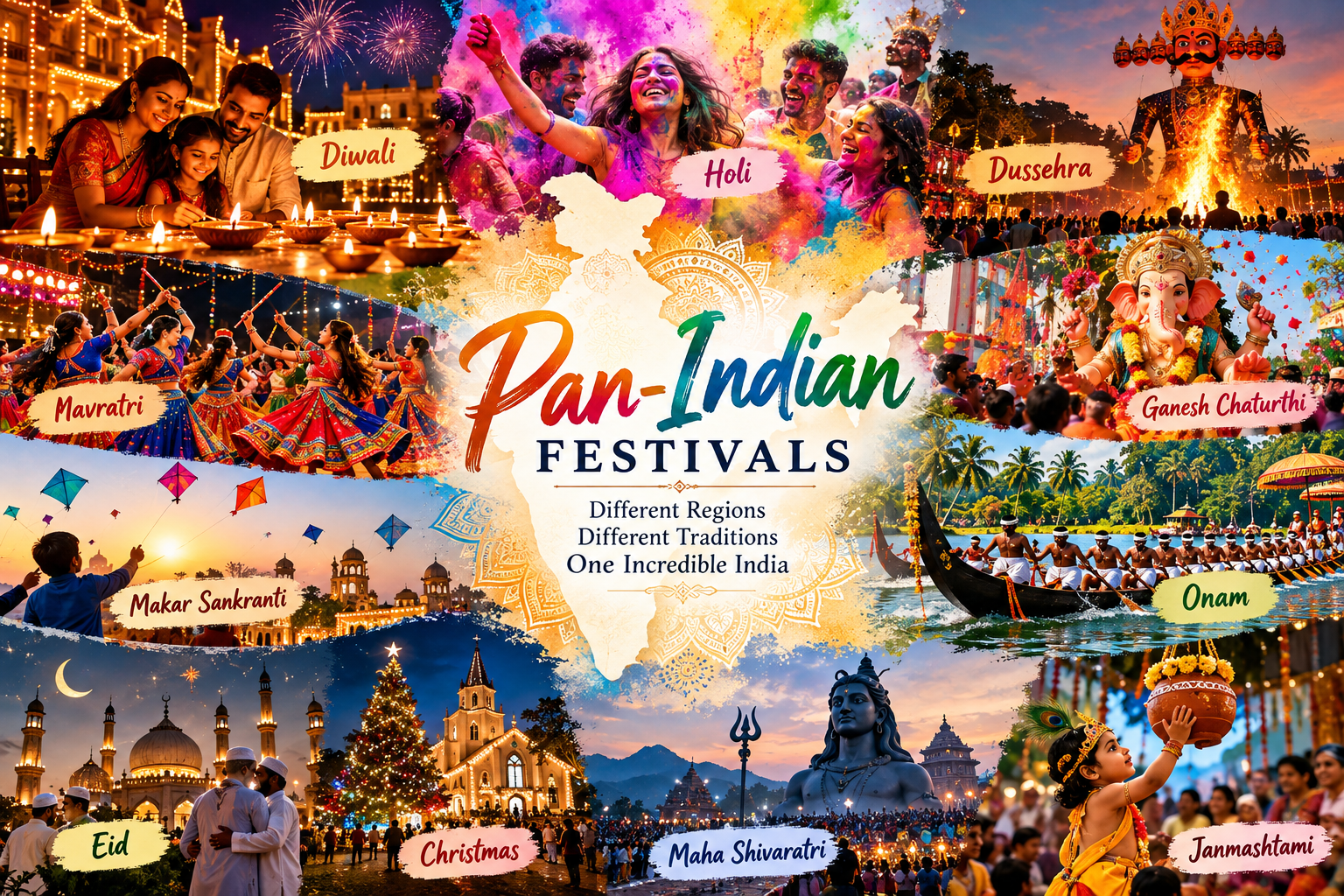
India is one of the world’s most culturally and linguistically diverse countries.
With hundreds of languages, numerous regional traditions, and many religious and
cultural communities, festivals play an important role in bringing people together.
A Pan-Indian festival is a festival or celebration that has a
significant presence across multiple regions of India. However, it does not mean
that everyone celebrates it in exactly the same way.
The same festival can have completely different names, foods, rituals, music,
clothing and traditions from one state to another. This regional diversity is
one of the most fascinating aspects of India’s festival culture.
Major Pan-Indian Festivals in 2026
“`
| Festival | 2026 Date / Period | Commonly Associated Regions |
|---|---|---|
| Makar Sankranti / Pongal | 14 January 2026 | South, West, North and Northeast India |
| Maha Shivaratri | 15 February 2026 | Across India |
| Holi | 4 March 2026 | North, West, Central and other regions |
| Eid al-Fitr | 21 March 2026* | Across India |
| Eid al-Adha / Bakrid | 27 May 2026* | Across India |
| Onam | 26 August 2026 | Kerala and Malayali communities |
| Janmashtami | 4 September 2026 | Across India |
| Ganesh Chaturthi | 14 September 2026 | Maharashtra, Karnataka, Goa and other regions |
| Sharad Navratri | 11–19 October 2026 | North, West, East, South and Central India |
| Dussehra / Vijayadashami | 20 October 2026 | Across India |
| Diwali / Deepavali | 8 November 2026 | Across India |
| Guru Nanak Jayanti | 24 November 2026 | Punjab and Sikh communities across India |
| Christmas | 25 December 2026 | Across India |
* Islamic festival dates can vary depending on local moon sighting and
official announcements.
“`
What Does “Pan-Indian” Mean?
The term Pan-Indian means something that extends across India
as a whole or across many parts of the country.
A Pan-Indian festival therefore refers to a festival that has a significant
presence in several regions of India rather than being limited to one particular
state or local community.
However, a Pan-Indian festival does not have to be celebrated identically
everywhere. Regional communities often give the festival their own identity.
1. Diwali – The Festival of Lights
Celebration Period: Usually several days
Season: October–November
Diwali, also known as Deepavali, is one of India’s most widely
recognized festivals.
The festival is associated with different stories and traditions in different
parts of India. In many North Indian traditions, Diwali is associated with the
return of Lord Rama to Ayodhya after his exile and victory over Ravana.
In some parts of South India, Deepavali is particularly associated with the
victory of Krishna over Narakasura.
In western India, the festival is also associated with Lakshmi worship and
traditional business practices.
Common Diwali Traditions
- Lighting oil lamps and candles
- Decorating homes
- Creating rangoli
- Wearing new clothes
- Exchanging sweets
- Visiting family and friends
- Performing religious ceremonies
- Giving gifts
- Fireworks in many areas
2. Holi – The Festival of Colours
Holika Dahan: 3 March 2026
Celebration Period: Usually 1–2 main days
Season: February–March
Holi is one of India’s most recognizable festivals.
It is particularly associated with North India but is celebrated in many
other parts of the country.
The most recognizable tradition is the use of coloured powders and
coloured water. People gather with friends and family, play with
colours, enjoy traditional foods and participate in music and celebrations.
Major Holi Regions
- Uttar Pradesh
- Bihar
- Rajasthan
- Delhi
- Madhya Pradesh
- Maharashtra
- Gujarat
- West Bengal
- Karnataka and other states
3. Dussehra / Vijayadashami
Sharad Navratri: 11–19 October 2026
Celebration Period: Approximately 10 days in many traditions
Season: September–October
Dussehra, also known as Vijayadashami,
is celebrated in many parts of India.
The festival is associated with the victory of good over evil, but its stories
and customs vary by region.
In North India, Dussehra is strongly associated with the story of
Rama and Ravana. Large effigies of Ravana are traditionally
burned during public celebrations.
In Karnataka, Mysuru Dasara is famous for grand processions,
decorations and cultural programs.
In West Bengal and parts of eastern India, the same period is closely connected
with Durga Puja.
4. Navratri
Vijayadashami / Dussehra: 20 October 2026
Duration: 9 nights and 10 days
Navratri refers to a period of nine nights and is observed
in several parts of India.
Gujarat
Gujarat is particularly famous for Garba and
Dandiya Raas, with large community celebrations, traditional
clothing and dancing.
West Bengal
The festive period is closely associated with Durga Puja,
featuring elaborate idols, artistic pandals and community celebrations.
Karnataka
The period is connected with Mysuru Dasara and other
regional traditions.
5. Makar Sankranti and India’s Harvest Festivals
Celebration Period: Usually 1–4 days depending on the region
Season: January
Makar Sankranti represents an important seasonal celebration in India and is
associated with harvest traditions and the Sun’s transition into Makara
(Capricorn).
| Region | Festival | 2026 Date |
|---|---|---|
| Tamil Nadu | Pongal | 14 January |
| Punjab | Lohri | 13 January |
| Assam | Magh Bihu | January |
| Gujarat | Uttarayan | 14 January |
| Karnataka | Sankranti | 14 January |
| Maharashtra | Makar Sankranti | 14 January |
| West Bengal | Poush Sankranti | January |
6. Ganesh Chaturthi
Celebration Period: Commonly several days, with immersion on a
chosen day depending on local tradition
Season: August–September
Ganesh Chaturthi is particularly famous in Maharashtra but
is celebrated in many other parts of India.
The festival involves the installation of Ganesha idols,
religious ceremonies, cultural programs and eventually immersion of the idols.
Major Celebration Areas
- Maharashtra
- Karnataka
- Goa
- Telangana
- Andhra Pradesh
- Gujarat
- Madhya Pradesh
- Tamil Nadu
7. Onam
Celebration Period: Several days
Region: Kerala and Malayali communities worldwide
Season: August–September
Onam is primarily associated with Kerala and the Malayali
community.
It is one of Kerala’s most important cultural celebrations and is known for
its traditional food, decorations and community events.
- Pookalam flower decorations
- Onam Sadya
- Traditional clothing
- Vallam Kali boat races
- Pulikali
- Cultural programs
- Family gatherings
8. Eid
Eid al-Adha / Bakrid 2026: 27 May 2026*
Celebration: Dates depend on the Islamic lunar calendar
Eid is celebrated by Muslim communities throughout India.
Eid al-Fitr
Eid al-Fitr marks the completion of Ramadan. Common traditions include special
prayers, visiting family and friends, wearing new clothes, sharing food,
giving gifts and charitable activities.
Eid al-Adha
Eid al-Adha is associated with the Islamic tradition of sacrifice and is also
marked by prayers, family gatherings and charitable activities.
Food traditions can vary considerably between Kerala, Hyderabad, Delhi,
Kashmir, Mumbai and other parts of India.
9. Christmas
Christmas Eve: 24 December 2026
Celebration Period: Usually begins in the days or weeks before
Christmas and continues through Christmas Day
Christmas is celebrated by Christian communities throughout
India and is also widely visible as a cultural celebration in many Indian cities.
Kerala
Christmas traditions may include Christmas stars, cribs, Midnight Mass,
cakes, family gatherings and carol singing.
Goa
Goa is particularly famous for its Christmas atmosphere, church celebrations,
decorations and cultural events.
Northeast India
Several northeastern states have large Christian populations and distinctive
Christmas traditions.
10. Maha Shivaratri
Celebration Period: Primarily one day and night
Season: February
Maha Shivaratri is observed by Hindus throughout India.
Devotees may visit temples, fast, perform prayers and participate in
night-long religious observances.
Important Shiva temples across India attract large numbers of devotees during
this festival.
11. Janmashtami
Celebration Period: Usually one to two main days
Season: August–September
Janmashtami, celebrating the birth of Krishna, is observed
across India.
Maharashtra
The famous Dahi Handi tradition involves teams forming
human pyramids to reach and break a pot suspended above the ground.
Uttar Pradesh
Mathura and Vrindavan are particularly associated with Krishna traditions
and attract pilgrims and visitors.
Gujarat
Dwarka has major religious significance associated with Krishna.
Why Do Pan-Indian Festivals Look So Different?
India’s geography, history and cultural diversity have produced thousands of
local traditions.
A festival can travel between regions and be adapted to local culture.
Therefore, the same festival may have:
- A different name
- Different food
- Different clothing
- Different music
- Different religious rituals
- Different decorations
- Different public celebrations
- Different regional stories and traditions
Festivals and Indian Food
Food is one of the most visible ways regional differences appear during
Indian festivals.
Diwali
Different parts of India prepare different sweets and snacks. Popular
examples include laddoo, barfi, gulab jamun, murukku and mixture.
Pongal
Tamil Nadu is famous for sweet and savory Pongal dishes prepared during
the harvest festival.
Onam
Kerala’s Onam Sadya consists of numerous vegetarian dishes
traditionally served on a banana leaf.
Eid
Different parts of India have distinctive biryanis, meat dishes, sweets
and snacks associated with Eid.
Christmas
Cakes, breads and regional festive dishes vary significantly between Kerala,
Goa, the Northeast and other regions.
Festivals and Traditional Clothing
Festivals also provide an opportunity to wear traditional clothing.
- Sarees
- Dhotis
- Mundus
- Kurtas
- Sherwanis
- Lehengas
- Salwar suits
- Traditional regional dresses
Festivals and Music
Music and dance are another major part of Indian celebrations.
- Garba in Gujarat
- Bhangra in Punjab
- Dandiya during Navratri
- Traditional percussion performances in Kerala
- Folk performances during harvest festivals
- Classical and devotional music during religious festivals
Festivals in Modern Indian Cities
The concept of Pan-Indian festivals has become even more visible because of
migration and urbanization.
People frequently move between states for education, employment, business,
technology, government jobs, manufacturing and tourism.
As a result, cities such as Bengaluru, Mumbai, Delhi, Hyderabad,
Chennai and Pune contain communities from many parts of India.
A person living in Bengaluru might celebrate Onam with Malayali friends,
Ganesh Chaturthi with local communities, Diwali with colleagues, Durga Puja
at a Bengali association, Pongal with Tamil friends, Christmas with Christian
friends and Eid with Muslim friends.
Are All Major Indian Festivals Pan-Indian?
Not necessarily. Some festivals have a particularly strong regional identity.
- Onam – strongly associated with Kerala
- Bihu – strongly associated with Assam
- Lohri – particularly associated with Punjab and northern India
- Durga Puja – especially prominent in West Bengal and eastern India
- Pongal – strongly associated with Tamil Nadu
At the same time, people from these communities celebrate their festivals
throughout India and abroad.
Therefore, Indian festivals can be understood as existing on a
spectrum from local to regional to widely national.
The Real Meaning of Pan-Indian Festival Culture
The most interesting feature of Indian festivals is not that every Indian
celebrates the same festival.
Instead, India’s different communities can celebrate their own traditions
while participating in a broader shared cultural environment.
One country → many communities → many traditions → shared celebrations.
Conclusion
Pan-Indian festivals are an important reflection of India’s cultural diversity.
Diwali, Holi, Dussehra, Navratri, Ganesh Chaturthi, Janmashtami, Eid,
Christmas and several other celebrations have significant presence across
different parts of India. Yet each region adds its own traditions, food,
music, clothing and customs.
India’s festival culture therefore cannot be understood simply by looking
at a list of national festivals. The real story is the
regional diversity within shared celebrations.
From the lamps of Diwali to the colours of Holi, the Garba of Gujarat,
the Pongal celebrations of Tamil Nadu, the Bihu traditions of Assam,
the Onam Sadya of Kerala and the Christmas celebrations of Goa and the
Northeast, India’s festivals demonstrate how different cultures can coexist
within a single country.
That combination of diversity and shared cultural experience is what makes
Indian festivals unique.
Note: Festival dates can differ according to regional calendars, local
traditions and religious calculations. Islamic festival dates are especially
subject to moon sighting and official announcements.