Major Ayurvedic Brands and Institutions in India: Doctors, Treatments & Specialities
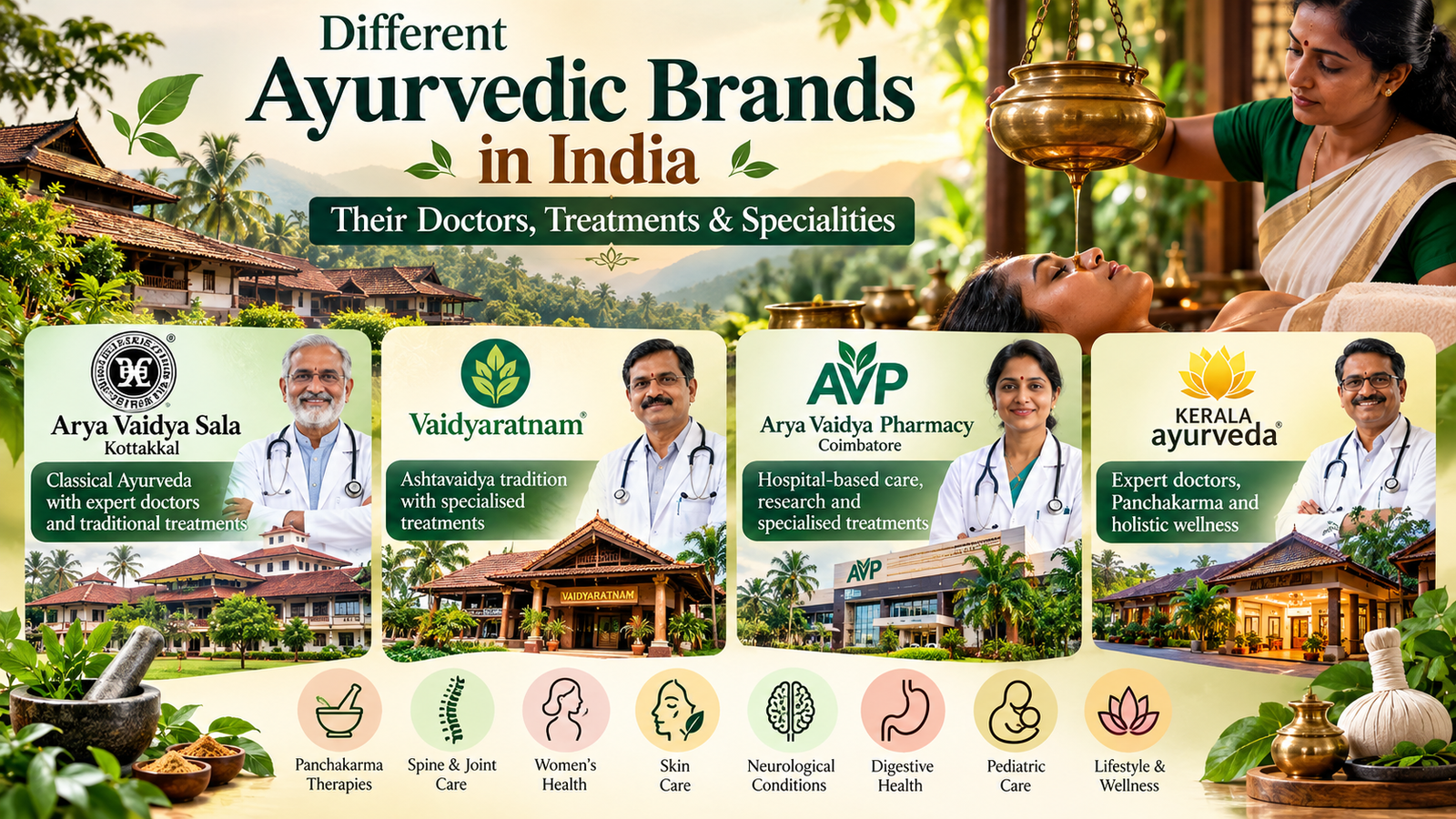
India has a long and diverse tradition of Ayurveda, with many established
institutions combining traditional Ayurvedic knowledge with physician-led
clinical care, hospitals, research and education.
When people search for an “Ayurvedic brand”, they often think about medicines
and consumer products. However, Ayurveda in India also includes large
healthcare institutions where patients can consult qualified Ayurvedic
physicians and receive supervised treatments.
This article focuses mainly on the doctors, clinical traditions,
hospitals, treatment approaches and specialities associated with
major Ayurvedic institutions rather than their individual products.
1. Arya Vaidya Sala Kottakkal
Kerala Ayurveda
A century-old Ayurvedic healthcare institution
Arya Vaidya Sala (AVS), Kottakkal is one of India’s
best-known Ayurvedic institutions. It was founded by
Vaidyaratnam P.S. Varier in 1902.
The organization developed beyond medicine manufacturing and became involved
in Ayurvedic hospitals, clinical care, research and education.
Doctors and clinical care
AVS operates hospitals and branch clinics where patients can consult
Ayurvedic physicians. Depending on the centre, physicians provide general
Ayurvedic consultation as well as specialized consultations.
Major treatment areas
- Spine and joint disorders
- Diabetes-related Ayurvedic care
- Migraine and headache-related complaints
- Skin disorders
- Women’s health
- Infertility-related care
- Postpartum care
- Pediatric care
- Eye-related conditions
- Anorectal conditions
- General Ayurvedic medicine
Panchakarma and traditional therapies
AVS is particularly associated with classical Ayurveda and Kerala Ayurvedic
therapies. Its hospitals provide physician-supervised treatments including
Panchakarma and other traditional procedures.
The organization has hospitals and clinical centres in locations including
Kottakkal, Kochi and Delhi, along with a wider network of branch clinics.
2. Vaidyaratnam
Ashtavaidya Tradition
A traditional Kerala physician lineage
Vaidyaratnam is closely associated with the traditional
Ayurvedic physician heritage of Kerala.
Its medical history is connected with the
Thaikkattu Mooss family, a physician lineage associated with
the Ashtavaidya tradition.
Vaidyaratnam Oushadhasala was established in 1941 by
Ashtavaidyan E.T. Neelakandhan Mooss.
Doctors
Vaidyaratnam treatment centres provide consultations with Ayurvedic
physicians. Its centres list doctors with experience in areas including
general Ayurveda, neurological conditions, dermatology and other specialities.
Major treatment areas
- Paralysis-related conditions
- Stroke rehabilitation-related Ayurvedic care
- Cervical spondylosis
- Lumbar spondylosis
- Sciatica
- Osteoarthritis
- Rheumatoid arthritis
- Ankylosing spondylitis
- Slip-disc-related complaints
- Migraine
- Sinus-related complaints
- Skin disorders
- Digestive disorders
- Women’s health
- Pediatric care
Traditional therapies
- Abhyangam
- Shirodhara
- Pizhichil
- Kizhi therapies
- Sirovasthi
- Ksheeradhara
- Udwarthanam
- Kativasthi
- Herbal steam therapies
- Panchakarma procedures
3. Arya Vaidya Pharmacy, Coimbatore
Clinical Ayurveda & Research
Hospital-based Ayurvedic care
Arya Vaidya Pharmacy (AVP), Coimbatore is another
well-known name in Indian Ayurveda.
Its healthcare activities include hospitals, treatment centres, education
and Ayurvedic research in addition to its pharmaceutical activities.
Clinical centres
AVP has treatment centres and healthcare facilities in several Indian cities,
including Coimbatore, Chennai, Bengaluru, Mumbai, Thrissur, Kolkata,
Delhi and Vijayawada.
Treatment approach
The organization combines Ayurvedic physician consultation with traditional
treatments and hospital-based care. Its healthcare institutions also have
an emphasis on education and research.
Areas of care
- General Ayurvedic medicine
- Musculoskeletal conditions
- Traditional Panchakarma
- Lifestyle-related conditions
- Chronic health complaints
- Ayurvedic rehabilitation
- Wellness and preventive care
4. Kerala Ayurveda
Kerala Ayurveda & Wellness
Doctor consultation combined with traditional therapies
Kerala Ayurveda is another established name associated
with Ayurvedic healthcare and wellness.
Its clinics combine Ayurvedic physician consultation with traditional
therapies, lifestyle guidance and wellness programmes.
Services may include
- Ayurvedic doctor consultation
- Panchakarma
- Spine care
- Women’s health
- Infertility-related care
- Skin care
- Weight-management programmes
- Dietary guidance
- Lifestyle modification
- Meditation and wellness programmes
5. Understanding the Ashtavaidya Tradition
One of the most interesting aspects of Indian Ayurveda is the existence of
traditional physician families and lineages.
The Ashtavaidya tradition is particularly associated with
Kerala. Historically, Ashtavaidyas were physicians traditionally trained
across the major branches of Ayurveda.
The traditional eight branches
- Kaya Chikitsa – General medicine
- Bala Chikitsa – Pediatrics
- Graha Chikitsa
- Urdhvanga Chikitsa – Diseases of the head and neck
- Shalya Chikitsa – Surgery
- Damshtra Chikitsa – Toxicology
- Jara Chikitsa – Geriatrics
- Vrisha Chikitsa – Reproductive and related therapies
6. How Ayurvedic Doctors Approach Treatment
A physician-led Ayurvedic consultation is different from simply purchasing
an Ayurvedic product from a shop.
Patient history
The physician may ask about the patient’s symptoms, lifestyle, food habits,
sleep, digestion, previous illnesses and previous treatments.
Ayurvedic assessment
Depending on the physician and clinical tradition, traditional Ayurvedic
assessment methods may be used to understand the patient’s condition.
Individual treatment plan
Treatment may include combinations of:
- Internal Ayurvedic medicines
- External therapies
- Panchakarma
- Dietary modifications
- Lifestyle changes
- Yoga or other supportive practices
Follow-up
The physician may modify the treatment plan according to the patient’s
response and progress.
7. Panchakarma in Kerala Ayurveda
Panchakarma is one of the most recognized components of traditional Ayurveda.
It should not simply be treated as a spa package. Traditional Panchakarma
involves assessment and supervision by an Ayurvedic physician.
Traditional procedures may include
- Abhyanga
- Swedana
- Vamana
- Virechana
- Basti
- Nasya
Common Kerala therapies
- Shirodhara
- Pizhichil
- Kizhi
- Kativasthi
- Njavara Kizhi
- Sirovasthi
The exact treatment should be determined by the physician rather than
selected solely because a particular therapy is popular.
8. Ayurveda and Musculoskeletal Conditions
Musculoskeletal treatment is an important area offered by several Ayurvedic
institutions.
- Back pain
- Cervical spondylosis
- Lumbar spondylosis
- Sciatica
- Arthritis
- Osteoarthritis
- Rheumatoid arthritis
- Joint stiffness
- Some chronic musculoskeletal complaints
Institutions such as Vaidyaratnam and Arya Vaidya Sala list spine and joint
care among their clinical services.
9. Ayurveda and Women’s Health
Several Ayurvedic institutions provide specialized consultation related to
women’s health.
- Menstrual problems
- PCOS/PCOD-related concerns
- Menopause-related complaints
- Infertility-related care
- Postpartum care
- Gynecological conditions
Important:
An institution offering Ayurvedic treatment for a particular condition does
not automatically mean that Ayurveda has been scientifically established
as a cure for that condition. Patients should discuss diagnosis and treatment
options with appropriately qualified healthcare professionals.
10. Ayurveda and Skin Conditions
Some Ayurvedic institutions operate specialized dermatology or skin-care
services.
- Psoriasis
- Eczema
- Acne
- Pigmentation problems
- Hair loss
- Dandruff
- Some allergic skin complaints
Persistent or serious skin problems should be properly diagnosed because
different medical conditions can produce similar symptoms.
11. Ayurveda and Neurological Conditions
Some traditional Ayurvedic institutions have specialized experience in
conditions involving neurological complaints.
Treatment areas listed by certain institutions can include:
- Paralysis-related conditions
- Stroke rehabilitation-related care
- Migraine
- Bell’s palsy
- Parkinsonism-related complaints
- Other neurological conditions
Emergency warning
Sudden weakness, facial drooping, difficulty speaking, loss of consciousness
or suspected stroke requires immediate emergency medical attention.
Ayurvedic treatment should not delay emergency diagnosis and treatment.
12. Comparison of Major Ayurvedic Institutions
| Institution | Clinical Identity | Important Areas |
|---|---|---|
| Arya Vaidya Sala Kottakkal | Classical Kerala Ayurveda |
Spine, joints, skin, women’s health, migraine, diabetes-related care and Panchakarma |
| Vaidyaratnam | Ashtavaidya physician tradition |
Neurological, musculoskeletal, spine, skin, digestive and women’s health |
| Arya Vaidya Pharmacy | Clinical Ayurveda, research and education |
Hospital-based Ayurveda, therapies, research and physician consultation |
| Kerala Ayurveda | Kerala Ayurveda and wellness |
Panchakarma, spine care, women’s health, lifestyle and wellness |
| Traditional Ashtavaidya clinics | Classical physician-led Ayurveda | Multiple branches of Ayurvedic clinical practice |
13. Brand vs Doctor: What Should Patients Look At?
If the objective is medical treatment rather than purchasing an
Ayurvedic product, the individual doctor and clinical centre can
be more important than the brand name.
1. Physician qualification
Check whether the physician has recognized Ayurvedic qualifications such as:
- BAMS
- MD (Ayurveda)
- Other recognized postgraduate Ayurvedic qualifications
2. Clinical experience
Ask whether the physician regularly treats the type of condition for which
you are seeking care.
3. Hospital facilities
For complicated or chronic conditions, a properly established hospital or
clinical centre may provide more comprehensive support than a wellness-only
facility.
4. Diagnosis
A responsible healthcare professional should recognize situations where
additional investigations or referral to another medical specialist are
required.
5. Treatment explanation
Patients can ask:
- What is the diagnosis?
- What treatment is being recommended?
- How long is treatment expected to continue?
- What are the possible risks?
- Could the treatment interact with existing medicines?
- What follow-up is required?
14. Why Doctor Consultation Matters
Ayurvedic treatment is not necessarily a simple one-product-for-one-disease
system.
Two people with similar symptoms may receive different treatment plans based
on their individual assessment, constitution, symptoms, lifestyle and other
factors considered by the physician.
This is why choosing an Ayurvedic healthcare institution should involve
looking at its physicians, treatment facilities and clinical approach rather
than focusing only on the products associated with the institution.
15. Safety Considerations
“Natural” does not automatically mean risk-free.
Patients should tell their Ayurvedic doctor about all medicines and
treatments they are currently receiving.
- Prescription medicines
- Diabetes medicines
- Blood-thinning medicines
- Blood-pressure medicines
- Pregnancy
- Kidney disease
- Liver disease
- Allergies
- Previous surgeries
- Other ongoing treatments
Do not stop prescribed medicines without discussing the decision with the
doctor who prescribed them.
16. Final Thoughts
India’s Ayurvedic healthcare system is much larger than the Ayurvedic
products found in pharmacies and supermarkets.
Institutions such as Arya Vaidya Sala Kottakkal, Vaidyaratnam,
Arya Vaidya Pharmacy and Kerala Ayurveda have developed clinical
networks involving Ayurvedic physicians, hospitals, treatment centres,
research and traditional therapies.
Their clinical areas can include musculoskeletal conditions, neurological
complaints, women’s health, skin conditions, digestive problems,
lifestyle-related concerns and traditional Panchakarma therapies.
The most useful way to compare Ayurvedic healthcare institutions is therefore
not simply to ask which brand has the most products.
A practical approach
Qualified Doctor → Appropriate Diagnosis → Clinical Experience →
Treatment Approach → Hospital/Clinic Facilities → Follow-up & Safety
Patients should consider their individual medical circumstances and seek
appropriate professional medical advice before beginning treatment,
particularly for serious, persistent or emergency conditions.
Official Sources & Further Reading
-
Arya Vaidya Sala Kottakkal —
Official Website
-
Vaidyaratnam —
Official Website
-
Arya Vaidya Pharmacy —
Official Website
-
Kerala Ayurveda —
Official Website