Popular Gemstones and Their Traditional Associations
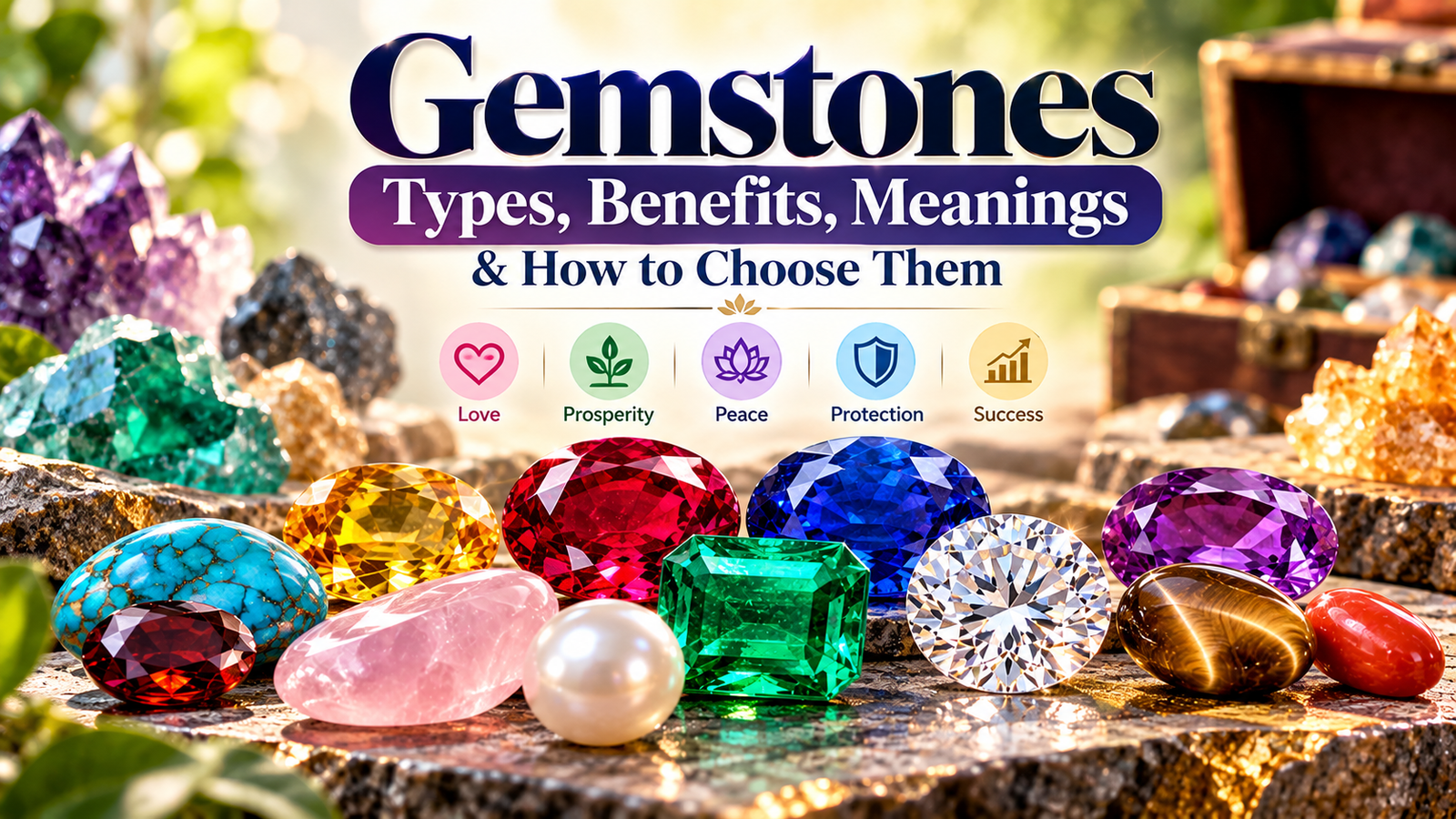
💎 Gemstones: Types, Traditional Benefits, Meanings & How to Choose Them
Explore popular gemstones, their colors, traditional meanings,
Vedic astrology associations, gemstone varieties and important buying tips.
Gemstones have fascinated people for thousands of years. They are valued
for their colors, brilliance, rarity and cultural significance. Different
civilizations have associated gemstones with protection, prosperity,
spirituality, love, courage and other symbolic qualities.
The benefits described in this article are traditional, cultural or
spiritual associations. They should not be considered scientifically
proven medical treatments. Gemstones should not be used as a replacement
for professional medical care.
🌟 What Is a Gemstone?
A gemstone is a mineral, rock or organic material that can be cut,
polished and used for jewellery or decoration. Some gemstones are
formed naturally through geological processes, while others have
biological origins.
Popular mineral gemstones include ruby, sapphire, emerald, amethyst,
garnet, topaz, tourmaline and peridot. Pearl, coral and amber are
examples of organic gems.
Ruby
Color: Red
Traditional associations: Confidence, courage, leadership, vitality and passion.
Vedic association: Sun
Blue Sapphire
Color: Blue
Traditional associations: Discipline, focus, wisdom and responsibility.
Vedic association: Saturn
Emerald
Color: Green
Traditional associations: Communication, learning, creativity and intelligence.
Vedic association: Mercury
Diamond
Color: Usually colorless, but many colors occur.
Traditional associations: Love, beauty, relationships and luxury.
Vedic association: Venus
Pearl
Type: Organic gemstone
Traditional associations: Calmness, peace, emotional balance and compassion.
Vedic association: Moon
Red Coral
Color: Red to orange-red
Traditional associations: Courage, energy, determination and action.
Vedic association: Mars
Yellow Sapphire
Color: Yellow
Traditional associations: Knowledge, wisdom, optimism and prosperity.
Vedic association: Jupiter
Hessonite Garnet
Color: Honey to orange-brown
Traditional associations: Confidence, ambition, focus and determination.
Vedic association: Rahu
Cat’s Eye
Special feature: Chatoyancy
Traditional associations: Intuition, protection, awareness and concentration.
Vedic association: Ketu
💜 Other Popular Gemstones
Amethyst
Traditionally associated with calmness, meditation, relaxation and spiritual awareness.
Rose Quartz
Traditionally associated with love, compassion, friendship and emotional harmony.
Tiger’s Eye
Traditionally associated with courage, confidence, grounding and determination.
Citrine
Traditionally associated with positivity, creativity, motivation and abundance.
Moonstone
Traditionally associated with intuition, calmness, reflection and emotional harmony.
Aquamarine
Traditionally associated with peace, communication, courage and emotional clarity.
Opal
Traditionally associated with creativity, imagination, inspiration and individuality.
Lapis Lazuli
Traditionally associated with wisdom, creativity, communication and self-expression.
Onyx
Traditionally associated with strength, grounding, stability and self-control.
Turquoise
Traditionally associated with protection, peace, friendship and communication.
Peridot
Traditionally associated with renewal, positivity, growth and harmony.
Tourmaline
Available in many colors and traditionally associated with creativity, balance and individuality.
🔮 The 9 Traditional Vedic Gemstones – Navaratna
Navaratna means “nine gems.” In Indian traditions, nine gemstones are
traditionally connected with the nine Navagraha influences.
🔬 Gemstone Benefits vs Scientific Evidence
Gemology and traditional gemstone beliefs are two different subjects.
Modern gemology scientifically examines gemstones according to their
physical and chemical characteristics.
Gemology can examine:
- Mineral composition
- Hardness
- Refractive index
- Specific gravity
- Color
- Clarity
- Natural or synthetic origin
- Gemstone treatments
- Geographic origin in certain cases
Traditional gemstone systems discuss:
- Astrological associations
- Spiritual symbolism
- Protection
- Prosperity
- Emotional symbolism
- Meditation and personal reflection
These traditional associations should not be confused with
scientifically established medical effects.
💎 Natural, Synthetic and Treated Gemstones
1. Natural Gemstones
Natural gemstones are formed through natural geological or biological
processes. They may still undergo cutting, polishing or other treatments
after being mined.
2. Synthetic Gemstones
Synthetic gemstones are produced by humans but can have essentially the
same chemical composition and crystal structure as their natural
counterparts.
3. Simulants
A simulant is a different material that resembles another gemstone.
Appearance alone is therefore not always enough to identify a gemstone.
4. Treated Gemstones
Some gemstones are treated to improve their color, clarity or overall
appearance. Treatments may include heating, filling, oiling and other
processes.
💰 What Determines a Gemstone’s Value?
🎨 Color
Color is one of the most important factors in evaluating many
colored gemstones.
🔍 Clarity
Internal characteristics and inclusions can influence the
appearance and value of a gemstone.
✂️ Cut
A suitable cut can improve a gemstone’s brilliance, appearance
and overall beauty.
⚖️ Carat Weight
Larger gemstones can be more valuable, but size alone does not
determine price.
🌍 Origin
Geographic origin can be important for certain gemstones and
may influence market interest.
✨ Treatments
Treatments can significantly affect the characteristics and
market value of a gemstone.
🛍️ Things to Check Before Buying a Gemstone
🌟 How to Choose a Gemstone
You don’t necessarily have to choose a gemstone because of astrology.
Gemstones can also be selected according to personal preference,
jewellery style and practical considerations.
- Favorite color
- Birthstone tradition
- Cultural significance
- Personal symbolism
- Jewellery design
- Durability
- Budget
- Rarity
- Natural appearance
💍 Which Gemstones Are Suitable for Everyday Jewellery?
If you plan to wear a gemstone every day, physical durability is an
important consideration. Rings generally experience more impact and
abrasion than pendants or earrings.
Harder gemstones are generally better suited to jewellery that receives
frequent wear, while softer or more delicate gems may require additional
care.
🌍 Why Are Gemstones So Popular?
Gemstones combine natural beauty, geology, history, culture,
craftsmanship and symbolism. A gemstone can therefore be interesting
from both a scientific and cultural perspective.
A ruby represents a naturally formed mineral with a fascinating
geological history. Sapphire can occur in several colors. Opal can
display remarkable flashes of color, while pearls have a biological
origin that makes them very different from mineral gemstones.
📌 Conclusion
Gemstones have been valued throughout history for their beauty,
rarity and cultural significance. From ruby, sapphire and emerald
to amethyst, moonstone, turquoise and tiger’s eye, each gemstone
has its own unique characteristics and traditional associations.
Vedic astrology and other cultural traditions give particular
gemstones symbolic planetary meanings. Modern gemology, meanwhile,
focuses on their physical properties, composition, treatments,
quality and origin.
The best way to appreciate gemstones is to understand both sides:
their scientific characteristics and their cultural history.
Traditional gemstone benefits can be meaningful as personal or
cultural beliefs, but they should not be treated as scientifically
established medical effects.
This article is for general educational and cultural information.
Traditional gemstone claims are not a substitute for professional
medical advice, diagnosis or treatment.