Left-Hand Drive vs Right-Hand Drive: Countries Where You Drive on the Left or Right Side of the Road
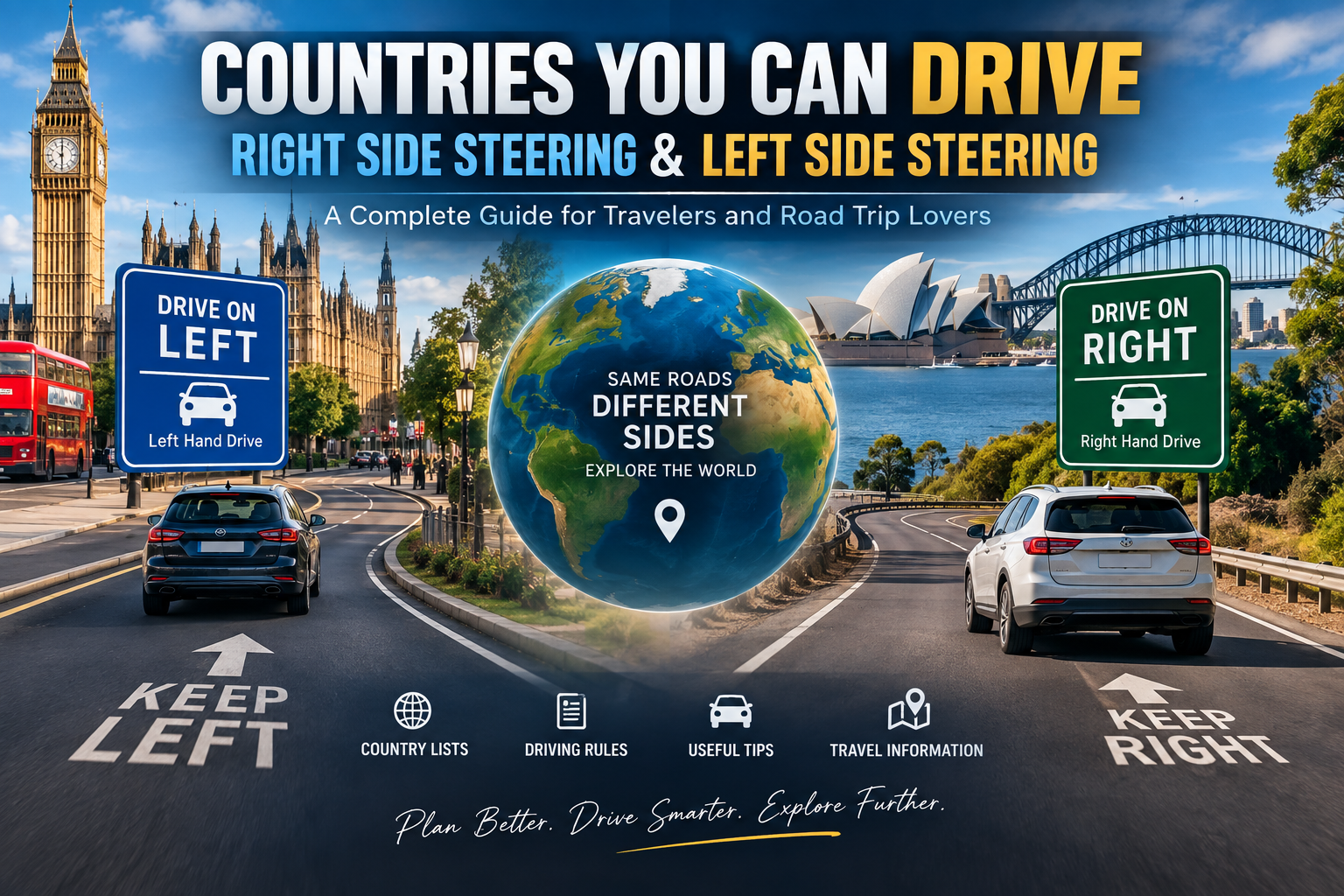
Have you ever noticed that the steering wheel is on the right side of a car in countries such as India, Japan and the United Kingdom, while it is on the left side in countries such as the United States, Germany and France?
The reason is simple: countries follow different sides of the road for driving.
There are two main systems used around the world:
- Left-Hand Traffic (LHT): Vehicles drive on the left side of the road and cars are generally right-hand drive (RHD).
- Right-Hand Traffic (RHT): Vehicles drive on the right side of the road and cars are generally left-hand drive (LHD).
Although the majority of the world’s countries use right-hand traffic, dozens of countries and territories still drive on the left. Together, left-driving countries account for roughly one-third of the world’s population.
What Is the Difference Between RHD and LHD?
The terms RHD and LHD describe the position of the steering wheel, while LHT and RHT describe which side of the road vehicles use.
| System | Road Side | Typical Steering Position | Examples |
|---|---|---|---|
| LHT | Drive on the left | Right-hand drive (RHD) | India, UK, Japan, Australia |
| RHT | Drive on the right | Left-hand drive (LHD) | USA, France, Germany, China |
Important: RHD does not mean that a country drives on the right. It refers only to where the steering wheel is located. Most RHD cars are designed for countries where traffic keeps left, but imported vehicles can create exceptions.
Left-Hand Traffic (LHT)
In a left-hand traffic country, vehicles normally travel on the left side of the road.
- Traffic keeps to the left.
- Cars are generally right-hand drive (RHD).
- Overtaking normally takes place on the right.
- Roundabouts generally circulate clockwise.
Countries such as India, the United Kingdom, Japan, Australia and South Africa use this system.
Right-Hand Traffic (RHT)
In a right-hand traffic country, vehicles normally travel on the right side of the road.
- Traffic keeps to the right.
- Cars are generally left-hand drive (LHD).
- Overtaking normally takes place on the left.
- Roundabouts generally circulate counter-clockwise.
The United States, Canada, France, Germany, China and Brazil are examples of countries using right-hand traffic.
Why Do Some Countries Drive on the Left?
The origins of driving on the left go back centuries. There is no single explanation that applies to every country, but historical travel practices and later British influence played important roles.
Britain eventually established left-side road traffic as its standard. As the British Empire expanded, the practice was adopted in many territories around the world.
This historical connection helps explain why many countries in South Asia, Africa, the Caribbean and the Pacific continue to drive on the left today.
Why Do Most Countries Drive on the Right?
Right-hand traffic became widespread in continental Europe and the Americas through a combination of historical developments, including changes in transportation practices and the influence of major European and American countries.
Once a country establishes a road system, changing it becomes extremely difficult. Roads, intersections, signs, traffic signals, vehicles and driver habits are all designed around the existing system.
Countries That Drive on the Left and Generally Use RHD Cars
Europe
- United Kingdom
- Ireland
- Malta
- Cyprus
Several territories, including the Isle of Man, Jersey and Guernsey, also drive on the left.
Asia
- India
- Pakistan
- Bangladesh
- Nepal
- Bhutan
- Sri Lanka
- Japan
- Thailand
- Malaysia
- Singapore
- Indonesia
- Brunei
- Maldives
- Timor-Leste
Hong Kong and Macau also use left-hand traffic, although they are special administrative regions of China and mainland China uses right-hand traffic.
Africa
- South Africa
- Kenya
- Tanzania
- Uganda
- Botswana
- Namibia
- Zimbabwe
- Zambia
- Malawi
- Mozambique
- Lesotho
- Eswatini
- Mauritius
- Seychelles
Oceania
- Australia
- New Zealand
- Fiji
- Papua New Guinea
- Samoa
- Solomon Islands
- Tonga
- Kiribati
- Nauru
- Tuvalu
Caribbean and Americas
- Guyana
- Jamaica
- Bahamas
- Barbados
- Trinidad and Tobago
- Antigua and Barbuda
- Dominica
- Grenada
- Saint Lucia
- Saint Kitts and Nevis
- Saint Vincent and the Grenadines
Several Caribbean islands and territories also retain left-hand traffic because of historical British influence.
Countries That Drive on the Right and Generally Use LHD Cars
The right-hand traffic system is used by the majority of countries worldwide.
North America
- United States
- Canada
- Mexico
South America
- Brazil
- Argentina
- Chile
- Colombia
- Peru
- Venezuela
- Bolivia
- Ecuador
- Paraguay
- Uruguay
Guyana and Suriname are notable exceptions because they drive on the left.
Europe
- France
- Germany
- Italy
- Spain
- Portugal
- Netherlands
- Belgium
- Switzerland
- Austria
- Poland
- Sweden
- Norway
- Finland
- Denmark
- Greece
- Russia
- Turkey
Most of mainland Europe uses right-hand traffic. The main European countries driving on the left are the United Kingdom, Ireland, Malta and Cyprus.
Asia
- China
- South Korea
- Vietnam
- Philippines
- Laos
- Cambodia
- Myanmar
- Mongolia
- Kazakhstan
- Saudi Arabia
- United Arab Emirates
- Qatar
- Oman
- Jordan
- Israel
Myanmar is an interesting exception: traffic drives on the right, but many vehicles on Myanmar’s roads have right-hand-drive steering because of imported vehicles.
RHD Cars in Countries That Drive on the Right
This is one of the most interesting parts of the subject.
A country can drive on the right while still having many RHD vehicles. Myanmar is a famous example. Imported vehicles from neighboring countries and regional vehicle markets have contributed to this situation.
Similarly, foreign or imported cars can sometimes be found on the “wrong” steering side in almost any country. Whether such a vehicle can legally be registered depends on local regulations.
What Happens When You Drive an RHD Car in an LHD Country?
Driving an RHD vehicle in a country that normally uses LHD cars can be possible, but it can require extra attention.
The biggest challenge is usually visibility while overtaking. When the steering wheel is on the opposite side from what local drivers are accustomed to, it can be harder to see around the vehicle ahead.
Other situations that may feel different include:
- Overtaking on two-lane roads
- Entering and leaving parking areas
- Using toll booths
- Drive-through facilities
- Judging the edge of the road
- Navigating unfamiliar intersections
Can You Import an RHD Car Into an LHD Country?
It depends entirely on the country’s vehicle-registration laws.
Some countries allow imported vehicles with the opposite steering configuration, while others impose restrictions, inspections, age limits, safety requirements or registration conditions.
Therefore, if you are planning to import an RHD or LHD vehicle, always check the current regulations of the destination country before purchasing the car.
Countries That Have Changed Driving Sides
Changing the side of the road is a huge logistical operation, but several countries have done it.
Sweden — 1967
Sweden changed from left-hand traffic to right-hand traffic on 3 September 1967. The event became known as Dagen H.
Road signs, intersections and traffic arrangements had to be changed, and the transition was carefully coordinated across the country.
Samoa — 2009
Samoa changed from right-hand traffic to left-hand traffic in 2009. One major reason given by the Samoan government was to make it easier to use more affordable vehicles imported from Australia and New Zealand.
Hong Kong and Mainland China: A Unique Example
Hong Kong drives on the left, while mainland China drives on the right.
This creates an unusual situation at their boundary, where specially designed road infrastructure is used to transition traffic between the two systems.
It is a fascinating example of how different traffic systems can operate next to each other.
What About Roundabouts?
Roundabouts provide a simple visual way to understand the difference.
- Left-hand traffic: vehicles generally circulate clockwise.
- Right-hand traffic: vehicles generally circulate counter-clockwise.
However, always follow local road signs and markings because individual intersections can have special arrangements.
Tips for Driving in a Different Traffic System
If you normally drive on the left and travel to a right-driving country — or vice versa — the first few hours can require concentration.
- Remember the traffic side before starting the journey.
- Pay extra attention at the first few intersections.
- Be particularly careful at roundabouts.
- Follow road markings rather than relying on habit.
- Take extra care when overtaking.
- Use navigation instructions but continue watching the road signs.
- If renting a car, confirm which side the steering wheel is on before driving.
Why Don’t All Countries Drive on the Same Side?
The simple answer is history and cost.
Once millions of people, vehicles and roads become accustomed to one traffic system, changing it would be enormously expensive.
A nationwide change could involve:
- Changing road signs
- Reconfiguring intersections
- Changing traffic lights
- Modifying road markings
- Changing highway entrances and exits
- Updating public transportation systems
- Retraining drivers
- Adjusting vehicle regulations
Because of these difficulties, countries generally continue using the system they historically adopted.
Quick Reference: LHT vs RHT
| Feature | Left-Hand Traffic | Right-Hand Traffic |
|---|---|---|
| Traffic side | Left | Right |
| Typical steering | Right (RHD) | Left (LHD) |
| Typical overtaking side | Right | Left |
| Roundabout direction | Clockwise | Counter-clockwise |
| Examples | India, UK, Japan, Australia | USA, Germany, France, China |
Final Takeaway
The position of the steering wheel is closely connected to the side of the road a country uses, but the two concepts are not exactly the same.
Drive on the left → vehicles are generally RHD.
Drive on the right → vehicles are generally LHD.
Countries such as India, Japan, the UK and Australia use left-hand traffic, while countries such as the USA, Germany, France and China use right-hand traffic.
There are also fascinating exceptions, such as Myanmar, where traffic drives on the right even though many vehicles are right-hand drive.
So the next time you travel to another country, don’t just check the road signs — check which side of the road you are supposed to drive on!
🚗 Left or right, the rule is simple: follow the local traffic system.